IN-DEPTH / IN-DEPTH
From digital to embodied intelligence: top Chinese AI scientist on China’s contributions and urgent need to bridge global intelligence gaps
Shaping the Future
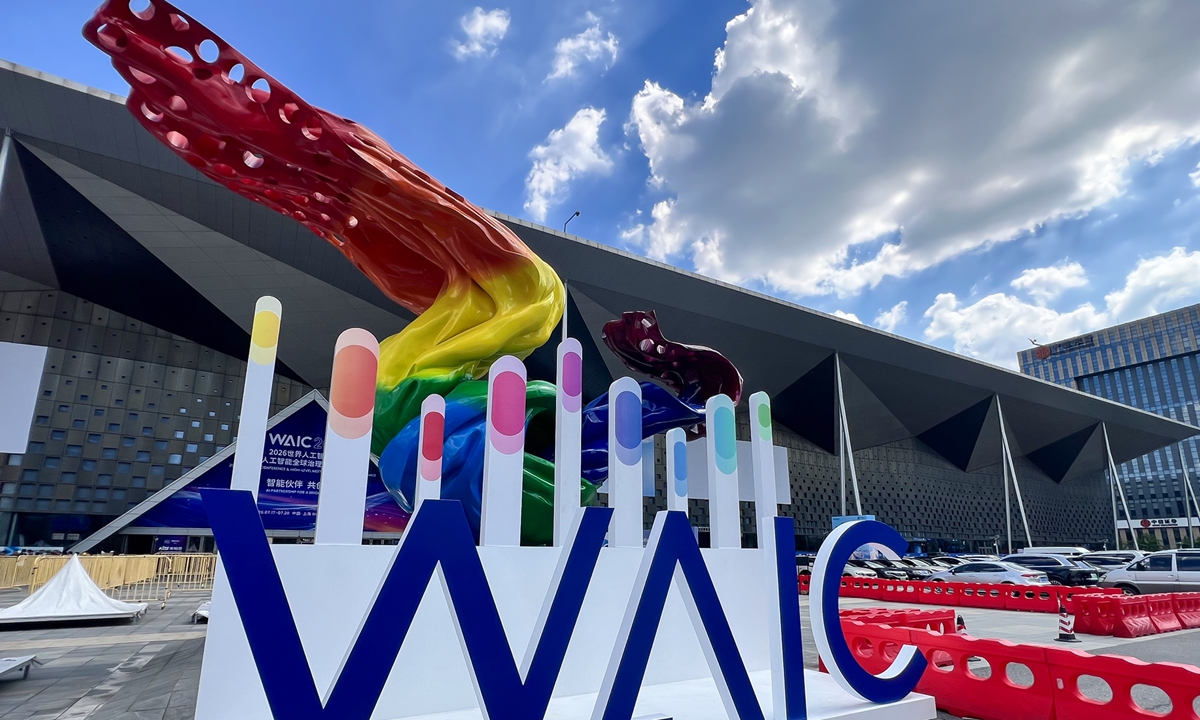
A view of the conference site for the 2026 World AI Conference and High-Level Meeting on Global AI Governance in Shanghai Photo: VCG
Editor's Note:In an era marked by unprecedented global transformations, the world stands at a critical crossroads, grappling with deepening deficits in peace, development, security and governance. As humanity faces unparalleled challenges during this tumultuous period, Xi Jinping, general secretary of the Communist Party of China (CPC) Central Committee and Chinese president, has put forth a solemn call to action through the Global Development Initiative (GDI), the Global Security Initiative (GSI), the Global Civilization Initiative (GCI) and the Global Governance Initiative (GGI). The four pivotal initiatives address the pressing issues of our time, offering viable pathways and robust support for building a community with a shared future for humanity.
Rooted in the rich historical experiences of the CPC's century-long struggle and infused with the wisdom of China's traditional culture, these initiatives are expected to unite the world in the pursuit of common progress and stability. To offer a deeper understanding of the four major global initiatives and elaborate on their global significance, the Global Times is launching a series of articles.
In this installment, Global Times reporters Lin Xiaoyi and Chen Zishuai (GT) spoke with Gong Ke (Gong), executive president of the Chinese Institute of New Generation Artificial Intelligence Development Strategies and former president of the World Federation of Engineering Organizations, who attended the 2026 World AI Conference (WAIC) in Shanghai, to discuss how China's AI governance framework advances fairer global development and bridges the digital divide in the intelligent age.
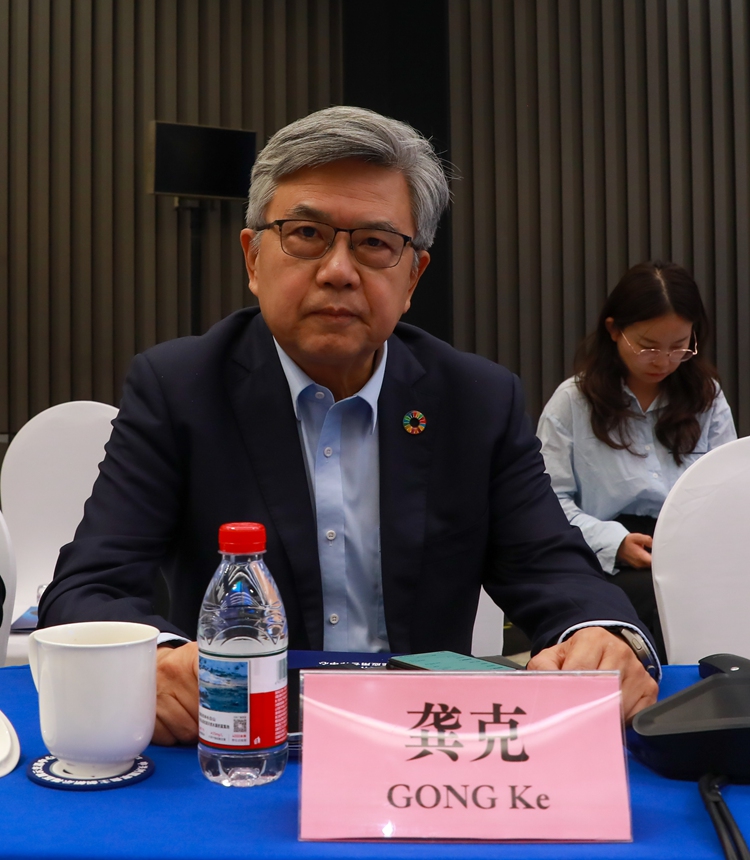
Gong Ke, executive president of the Chinese Institute of New Generation Artificial Intelligence Development Strategies and former president of the World Federation of Engineering Organizations Photo: Lin Xiaoyi/GT
GT: From proposing the Global AI Governance Initiative in 2023 to advancing UN resolutions and advocating the establishment of the World Artificial Intelligence Cooperation Organization (WAICO), China is shaping a clear roadmap aimed at providing AI-related international public goods. What core logic underpins this governance model? And what tangible support can it offer Global South countries to help unlock equal development opportunities?Gong: China's AI strategy is guided by one core principle: AI should benefit all humanity. This reflects the vision of a shared future for humanity, not a mindset of rivalry. At the opening ceremony of the 2026 WAIC and High-Level Meeting on Global AI Governance, Chinese President Xi Jinping put forward "questions posed by our times." Against the backdrop of a new round of technological revolution and industrial transformation gaining momentum, and with the world entering an unprecedented period of hyper-active AI innovation, he asked: "How to get along with thinking machines? How to ensure security when algorithm is part of decision making? How to tackle ethical challenges by technologies through adaptive governance? How to realize AI for all when the divide keeps widening?" These are questions for the entire world.
China isn't seeking competition with any nation. On the contrary, it advocates for AI that is upward, ethical and beneficial to humanity. This philosophy runs through President Xi's four observations: adhere to the principle of openness and win-win and boost innovation-driven development, strengthen risk-awareness and ensure that AI is secure and controllable, encourage inclusiveness and promote mutual learning between civilizations, and advocate solidarity and improve global governance.
Since 2025, the High-Level Meeting on Global AI Governance has become a key part of the WAIC, showing that the WAIC is now both a platform for technology exchange and a venue for global governance dialogue. Against this growing global consensus on standardized and inclusive AI rules, China has actively contributed practical frameworks and multilateral solutions to guide responsible AI development worldwide. In 2023, China proposed the Global AI Governance Initiative - not a solo pitch, but a proposal that distilled input from multiple countries, international organizations, academia, industry and civil society.
The proposed WAICO is also a major step by China to answer calls from the Global South and rally the international community behind coordinated action on AI development and governance. The response from Global South countries has been strong.
GT: The theme of this year's WAIC is "AI Partnership for a Brighter Future." How do you interpret the "partnership" concept, and what new shifts in human-AI relations does it reflect?
Gong: To me, the theme carries a clear meaning: in the intelligent era, countries and people must strengthen partnerships to guide AI toward healthy, beneficial, secure and equitable growth, and jointly build a sustainable global future.
AI capabilities have expanded rapidly and continue to evolve fast, yet one fundamental truth about human-AI relations remains unchanged and unnegotiable: AI must advance humanity's sustainable development. This principle lies at the heart of China's Global AI Governance Initiative - our commitment to putting people first and developing AI for good. It is also a shared position endorsed by all 193 UN member states, as formalized in a March 2024 resolution of the 78th UN General Assembly: seizing the opportunities of safe, secure and trustworthy artificial intelligence systems for sustainable development.
From July 6 to 10 in Geneva, three landmark events ran concurrently: the UN's first Global Dialogue on AI Governance, the AI for Good Global Summit 2026 and the World Summit on the Information Society Forum 2026. Government leaders, ministers, representatives from international organizations, scientists, entrepreneurs, civil society advocates and a broad range of stakeholders gathered to discuss a full spectrum of critical issues. These included designing global AI governance frameworks (covering laws, policies, standards, codes, and guidelines), enabling cross-border interoperability of national AI regulatory systems, fostering effective international cooperation to unlock AI's opportunities while jointly managing security risks, and conducting collective efforts to close digital and intelligence gaps, protect children and vulnerable groups, and preserve linguistic diversity.
This major global gathering marks a key milestone for worldwide AI development. China took on an active, constructive role throughout these events: we laid out our core policy positions, shared domestic experience and technological achievements, and collaborated with global counterparts to design joint action plans. Our participation clearly demonstrated China's firm stance to back the UN's central role in global AI governance, as well as our commitment to cross-border cooperation that ensures AI delivers benefits for all humanity.
After the Geneva talks, WAIC 2026 brought global experts together again in Shanghai. Amid today's volatile global landscape, China has both the will and capacity to drive cross-border AI collaboration and make meaningful contributions to safe, fair, human-centered AI development. We hope WAIC 2026 will serve as a historic milestone following the inaugural Global Dialogue on AI Governance, one that builds broader global consensus, deepens the sharing of national experiences, turns consensus into concrete actions and ensures those actions deliver tangible benefits for the entire world.
GT: In your opinion, which stage of AI development are we in today? What are the biggest opportunities and greatest challenges that lie ahead?
Gong: AI is currently transitioning from information intelligence to embodied physical intelligence. AI is moving beyond digital screens into factory production lines and people's daily lives via physical robotic and embedded systems.
Earlier generations of AI focused solely on knowledge and information retrieval - they could answer questions, look up data, draft text and complete similar informational tasks. Today's embodied AI integrates knowledge with real-world action, a transformative leap that unlocks far greater opportunities for humanity. Examples include safer, more accessible transport, and AI assistants that operate around the clock to support human work and daily life.
At the same time, embodied AI carries far graver risks than the flawed text outputs we saw in earlier models. Powerful physical AI systems can make dangerous real-world mistakes, not just inaccurate statements. The more capable AI grows, the greater the demand for humans to master responsible oversight of these tools — and managing this balance is our single biggest challenge at present.
GT: A small number of countries are seeking to dominate global AI development as the AI divide widens across the world. How can the international community prevent AI from triggering a new round of global fragmentation and widening the development gap between nations?
Gong: Widening digital and intelligence gaps between countries are no longer a theoretical risk; they are now a present reality. These gaps fall into two key categories: hardware gaps, referring to uneven access to digital infrastructure, and software gaps, meaning disparities in national technical capacity and digital skills.
China has taken multiple practical steps focused on capacity building to narrow these divides. In July 2024, the 78th UN General Assembly adopted a China-led resolution on enhancing international AI cooperation, with over 140 countries supporting it. After the resolution's adoption, China co-launched an AI capacity-building working group with Zambia at the UN Headquarters to deliver targeted training programs for developing nations. We also support the World Federation of Engineering Organizations' plan to strengthen African engineering capacity centered on digital and intelligent skills. All these efforts reflect China's consistent focus on bridging the global intelligence gap through targeted capacity support for developing countries.
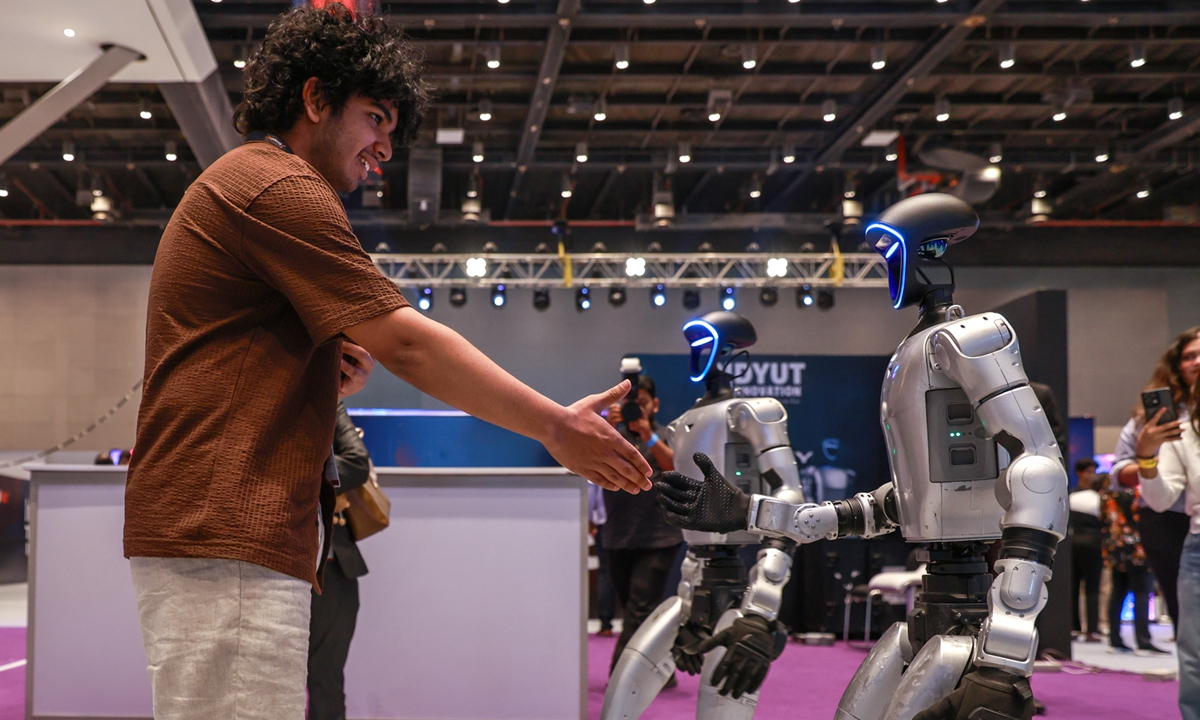
A visitor interacts with a Chinese humanoid robot displayed at a tech exhibition held in Mumbai, India, on May 22, 2026. Photo: VCG
GT: You previously noted that AI technology will push humanity into a fully intelligent age, representing another leap forward in human civilization comparable to farming technology, mechanical power, electrical power, and information technology. What role does China play in this historic shift?Gong: Human society is in the wave of the information revolution. Unlike the industrial revolution, which amplified human physical strength, the information revolution boosts human cognitive capacity and triggers another major shift in productive forces. The development and application of AI is taking the information revolution from the networking phase into an era of full intelligence, forming a new productive force that powers today's technological revolution and global economic and social transformation.
China boasts a 5,000-year continuous civilization. We once missed the Industrial Revolution and suffered backwardness and foreign aggression as a result. Under the leadership of the Communist Party of China, however, we are now achieving national rejuvenation. Reform and opening-up have accelerated China's industrialization and propelled comprehensive modernization at an unprecedented pace.
Today, China stands at the frontier of the intelligent transformation. We have both the duty and capacity to contribute to global shifts toward intelligent, low-carbon development. China will take on three core roles in this global transition: First, as a bold pioneer, sharing innovative technologies with the rest of the world - thereby laying the foundation for all its other global contributions. Second, as a successful practitioner, exporting replicable real-world AI application experience to other nations. Third, as a trustworthy international partner, working with global counterparts to build a shared future of sustainable development.
RELATED ARTICLES