Chinese AI talents choosing homeland instead of US sparks online buzz
Controversy highlights China’s supportive environment for overseas-trained talents, fallout of Washington's restrictions on exchanges: expert
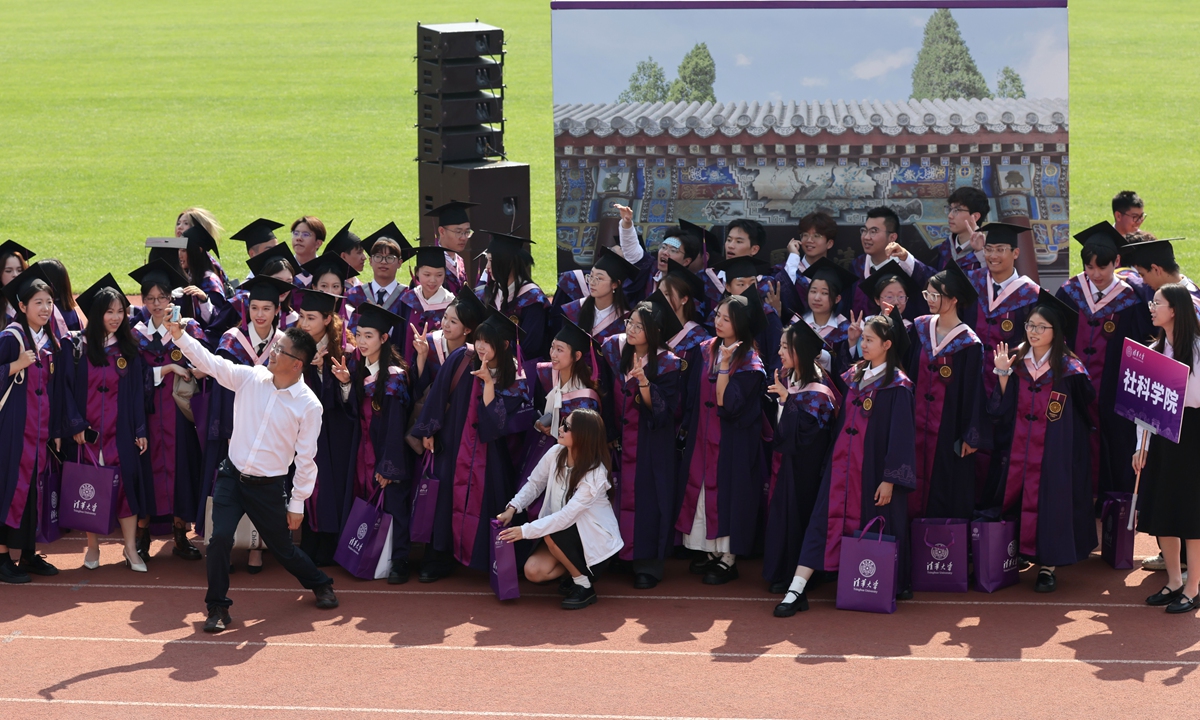
Tsinghua University holds its undergraduate graduation ceremony on June 27, 2026. Photo: VCG
Overseas social media has been abuzz over shifting global talent flows, after the founders of Chinese AI startup Moonshot AI (Kimi) became the center of broad discussion for their decision to return to China despite having studied at top US universities and gaining opportunities to work at the world's top US technology company.
A Chinese expert said that the growing number of Chinese scientific and technological talents opting to return home not only reflects the top-tier supportive environment China has built for cutting-edge industries, but also mirrors the fallout wrought by restrictive policies the US has imposed on talent exchanges.
The launch of Kimi K3, the latest open-weight AI model from Chinese startup Moonshot AI, drew widespread attention in Silicon Valley last week, with Business Insider describing it as a "buzzy new model." The spotlight has also turned to the company's founders, including CEO Yang Zhilin, a 34-year-old researcher and entrepreneur whose educational background and decision to return to China to build his career has become a focus of discussion.
Yang was born in 1992 in Shantou, South China's Guangdong Province. According to US tech and business outlet Business Insider, Yang attended Tsinghua University before earning a PhD at Carnegie Mellon University (CMU) in Pennsylvania, where he studied under prominent AI researchers Ruslan Salakhutdinov and William Cohen.
According to public records, all four core founding members of the Moonshot AI graduated from Tsinghua University, with two of them, including Yang, going on to attend CMU and work at top US AI firms before going back to China.
Before launching Moonshot AI, Yang returned to China and contributed to several major AI projects, Business Insider reported.
According to a post from Salakhutdinov on X, he respected the fact his student Yang was "quite determined to go back" to begin his own startup, while a decision for Yang to join Apple was already being discussed and considered. Salakhutdinov also noted that the US immigration process can be "quite intimidating and uncertain," even for superstar PhD graduates from places like CMU.
After Kimi K3's release this week, some leading tech figures lamented that Yang didn't remain in the US to work at a US AI lab. Investor Vinod Khosla blamed the current US administration's restrictive immigration policies. "Even bigger issue is the brilliant talent we are scaring away from other countries with our immigration policies for great talent," he said in response to the news of Kimi K3's success, Business Insider reported.
The systematic targeting of Chinese and Chinese American researchers in the US has created a strong chilling effect. Combined with rising visa and work permit barriers and narrowing career prospects, it has directly weakened the foundations for overseas talent to remain and develop their careers in the country, Wang Peng, an associate researcher at the Beijing Academy of Social Sciences, told the Global Times on Monday.
According to media reports, citing national security concerns, some House Republicans put forward legislation in mid-March 2025 to prevent Chinese nationals from receiving visas that allow them to study or participate in exchange programs in the US. The chair of a US House committee even asked six American universities to hand over information on their Chinese students.
US's blockades on scientific research cooperation remain unabated. The US National Science Foundation (NSF) recently announced in a notification about its forthcoming policy prohibiting NSF funds from being expended on collaboration with entities on US restricted parties lists, which could effectively bar collaborations between NSF-funded US scientist and nearly all Chinese research institutions and their employees, US media reported.
Additionally, the frustration and shifting choices also come from international students from India. According to Reuters on Monday, citing some students and education consultants, tighter US immigration rules prompt many to rethink the American Dream. For instance, A. Shrinikheathan, a 22-year-old Chennai engineering graduate, is breaking from his family's tradition of studying in the US, opting instead for a master's degree in Germany.
Wang said that this exposes structural flaws in the US system, including immigration policies driven by short-term political goals, work visas excessively tied to employers and increasingly politicized security reviews, which have severely eroded trust within the international research community.
Meanwhile, the policy incentives and relevant facilitation measures rolled out by China for its researchers with overseas academic experience constitute a draw for them to come back to the motherland, the expert added.
China has continued to welcome international students from around the world, viewing overseas talent as an important part of its talent pool and a key driver of high-quality development. China has introduced a slew of policies supporting students to study abroad, encouraging them to return, allowing them to come and go freely, and enabling them to fully utilize their expertise.
Studying in China is also becoming an increasingly attractive option for young people worldwide. According to domestic media outlet Chinatoday.com, 380,000 international students from 191 countries and regions were studying in China in the 2024-25 academic year. Graduate students accounted for 35 percent of the total, with engineering being the most popular field of study.
Wang noted that China has built a world-class research and innovation ecosystem that provides supportive policies and comprehensive services have also made it easier for global talent to study, work and settle in China. As China's international research cooperation continues to expand, talent mobility has become increasingly two-way, with more overseas-trained professionals choosing to return home.
Yang's decision to return to China also sparked broader reflection among some social media users about the US' ability to attract and retain global talent. In a post, X user @WestsideLAGuy, argued that a "lack of respect" and status was a core reason many talented Chinese chose to return home. User @Scobleizer commented that he had been told "it is getting harder to be an immigrant in USA and China is a more interesting place for innovators," while another user, @billtheinvestor, wrote that the Chinese government has done a much better job of retaining talent, whereas the US government is busy fighting ideology.
A Chinese international student surnamed Zhou told the Global Times on Monday that the tightening US immigration policies have made it increasingly difficult to study, work and settle in the country. Finding a job and remaining in the US has also become increasingly challenging, while some employers have become reluctant to sponsor permanent residency applications. He said visa reviews have become more stringent, with some students waiting months for renewals and even avoiding trips home for fear of being unable to return.
Zhou said that China's salaries, research support and strong demand for AI talent are now comparable to, or even better than, those in the US. He said both he and his family feel returning to China is a more promising choice.
RELATED ARTICLES