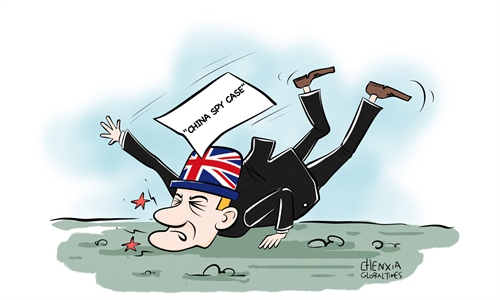
Calculating the costs of Britain’s forced nationalization of British Steel: Global Times editorial
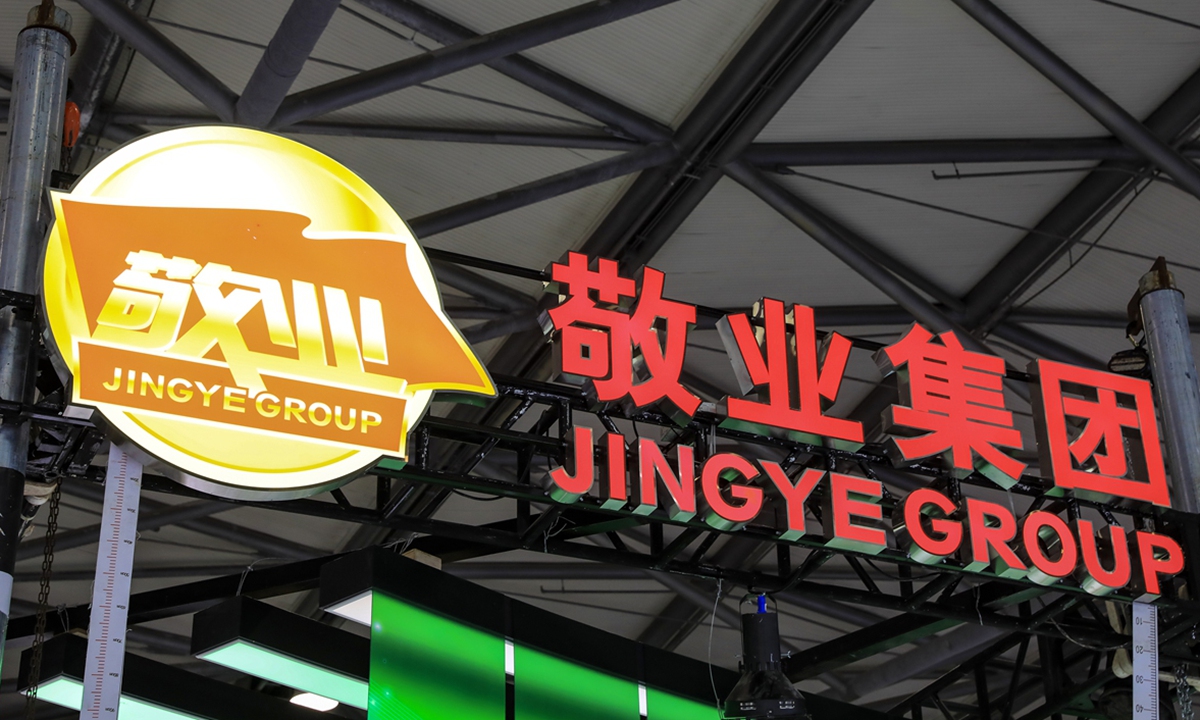
View of a logo of Jingye Group Photo: VCG
Jingye stepped in when British Steel was on the brink of collapse and attracted no other buyers, only to be repaid in what can only be described as a modern-day version of The Farmer and the Snake. If a country cannot honor its contractual commitments or protect the legitimate rights of investors, on what grounds can it claim to champion the rule of law or call itself a civilized nation?
China's Jingye Group on Sunday issued a strongly worded statement, condemning the UK government's forced nationalization of its subsidiary British Steel as "a brazen seizure" and "a flagrant violation of the international rule of law." The statement urged the UK to immediately stop trampling on international investment rules, and promptly, fully and effectively compensate the company for all investment losses, and announced that it had initiated a consultation procedure under the bilateral investment agreement and reserved the right to take legal action, including seeking international arbitration. We support Jingye's determination to seek compensation and defend its lawful rights to the very end without compromise. Meanwhile, it is worth taking a closer look at the costs Britain will have to bear for its actions.
First, the compensation costs. In 2020, when British Steel was on the verge of bankruptcy, Jingye stepped in and lawfully acquired the company. Over the following five years, it invested more than 1.2 billion pounds in equipment upgrades, technological innovation, and green transformation. Jingye made it clear that, if ownership were to be transferred, it would require at least 1 billion pounds in compensation to repay debts and recover its investment. The British government's offer, however, was less than 100 million pounds. After negotiations broke down, London simply chose to legislate the takeover. Even more astonishingly, the UK's Department for Business and Trade stated that an independent evaluation will be carried out to determine if any compensation will be paid. Once expropriation has occurred, providing Jingye with timely, full, and effective compensation is a legal obligation. This is an internationally recognized rule, and where does "if any" come from? Every pound Jingye invested is fully documented. The British side should not imagine it can simply walk away from its obligations.
The British government may believe that bringing British Steel into public ownership is a bargain, but the facts tell a very different story. According to the UK's National Audit Office, the UK government had already spent 377 million pounds to keep British Steel operating. The figure was expected to exceed 600 million pounds by the end of June and could surpass 1.5 billion pounds by 2028. And these are merely operating costs; they do not include the enormous future investments required for equipment modernization and green transition. The UK government has not only forcibly seized assets from Jingye, but also used taxpayers' money to fill a bottomless pit - losing both credibility and money. More importantly, the move has seriously undermined the confidence of multinational companies investing in the UK. Investors make decisions based on the stability and predictability of the business environment. If Britain cannot even uphold the most basic principle of honoring contracts, who will still feel confident investing there?
Now let's turn to the political credibility cost. Britain was once a nation that prided itself on the sanctity of contract. British thinkers such as Thomas Hobbes and John Locke all grounded their philosophies on the foundation of contract. When China's Jingye Group acquired British Steel in 2020, then UK Secretary of State for Business, Energy and Industrial Strategy Alok Sharma visited British Steel's Scunthorpe site and said, "the sale of British Steel represents an important vote of confidence in the UK's steel industry."
Yet just over five years later, the UK's attitude has shifted with remarkable speed. Through the pandemic, Brexit, the Russia-Ukraine conflict, soaring inflation, and other challenges, Jingye honored its commitments by keeping every employee on the payroll and ensuring wages were paid in full and on time. In return, the UK has used "national security" as a pretext for what amounts to asset seizure. What the British government is undermining is not merely a Chinese company's interests, but its own credibility, global investor confidence, and the very foundations of its reputation as a country governed by the rule of law.
There is also a moral ledger that cannot be ignored. Jingye stepped in when British Steel was on the brink of collapse and attracted no other buyers, only to be repaid in what can only be described as a modern-day version of The Farmer and the Snake. Within just one year of the acquisition, Jingye had turned the company profitable again and helped sustain tens of thousands of local jobs. Instead of recognizing these contributions, the British government has chosen to wield state power and administrative measures to seize the company's assets. Such conduct is not only an injustice to Jingye but also a violation of the most basic principles of international business ethics. If a country cannot honor its contractual commitments or protect the legitimate rights of investors, on what grounds can it claim to champion the rule of law or call itself a civilized nation?
In addition, the Australian government has recently moved to block the voting and other shareholder rights of three China-linked investors in rare-earth miner Northern Minerals. Earlier, the Dutch government invoked a Cold War-era law to forcibly take control of Chinese-owned Nexperia. These cases suggest that some Western countries are increasingly casting aside the banner of the free market and using "national security" to justify protectionism. We urge these countries to recognize that respect for contracts is the cornerstone of a market economy and the rule of law is the bottom line of international relations. Only by upholding these fundamental principles can they credibly speak about development and the future.
China's position is clear and firm: It supports Chinese companies in defending their legitimate rights through legal means. China and the UK are parties to a bilateral investment protection agreement, and the British side must stop using domestic legislation to override international investment rules. It should provide Jingye with timely, adequate, and effective compensation for all investment losses.
This case has attracted widespread attention among the Chinese public. The international community is also watching closely to see whether the British government can offer a convincing explanation for this series of misguided actions.
RELATED ARTICLES