China’s flagship heavy-ion accelerator begins trial runs to unlock atomic nuclei secretes
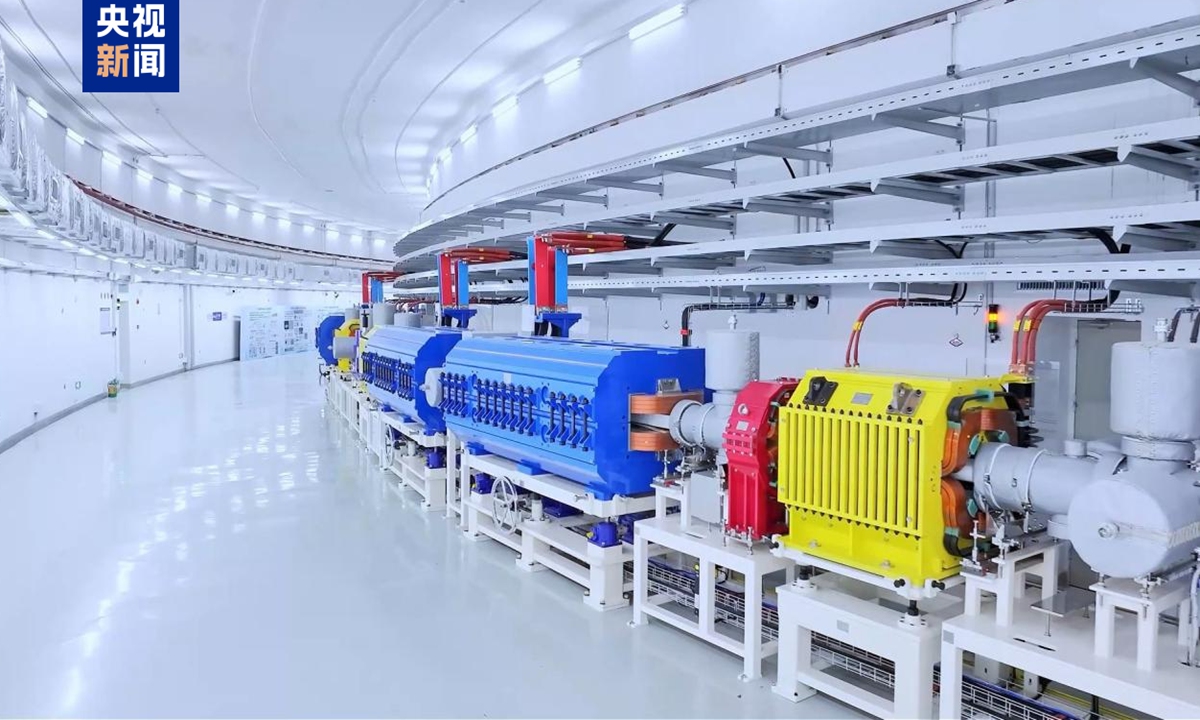
A view of the High Intensity Heavy-ion Accelerator Facility Photo: Screenshot from China Media Group
The High Intensity Heavy-ion Accelerator Facility (HIAF), a major national science and technology infrastructure located in Huizhou, South China's Guangdong Province, began trial operations on Tuesday. It will support the development of heavy-ion cancer therapy equipment, special new materials, and advanced nuclear energy technologies, while providing critical experimental platforms for aerospace, biomedicine, and other fields, China Media Group (CMG) reported on Tuesday.
The HIAF has three major objectives: exploring the limits of atomic nuclei existence, revealing nuclear astrophysical processes, and advancing nuclear energy development along with multidisciplinary applications, according to the report. It is a national key instrument for studying the microscopic world of atomic nuclei.
The instrument accelerates ions to extremely high speeds to bombard atomic nuclei. In addition to simulating space radiation and extreme fusion environments, it explores the internal laws governing atomic nuclei, attempts to synthesize entirely new superheavy elements, and helps solve the mystery of the origin of heavy elements such as uranium.
The HIAF is the world's first advanced heavy-ion research facility that combines a superconducting linear accelerator, a synchrotron, and a storage ring. It integrates the advantages of high continuous beam intensity from the superconducting linear accelerator and high pulsed beam intensity from the ring-shaped synchrotron.
The project team has achieved full domestic production and independent control of key equipment and core software. It successfully realized the full 2-kilometer beamline transmission in 16 hours, setting a new world record for beam commissioning speed in similar facilities.
During the process testing phase, both oxygen ion and bismuth ion beam intensities broke international records, representing increases of three times and 7.5 times respectively, compared with the previous global highest levels. The experimental team has achieved important results in areas such as nuclear mass measurement, radioactive beam production, nuclear structure research, and nuclear material irradiation.
Construction of the HIAF began in December 2018, with the first beam successfully extracted in October 2025. The completion of this facility will provide an internationally leading research platform for cutting-edge nuclear science and major heavy-ion applications. It will also significantly enhance China's innovation capabilities in heavy-ion science and technology and establish a world-class heavy-ion science research center with international influence, according to the report.
Global Times
RELATED ARTICLES