China’s first subdural flexible implantable BCI gains fast-track approval pathway
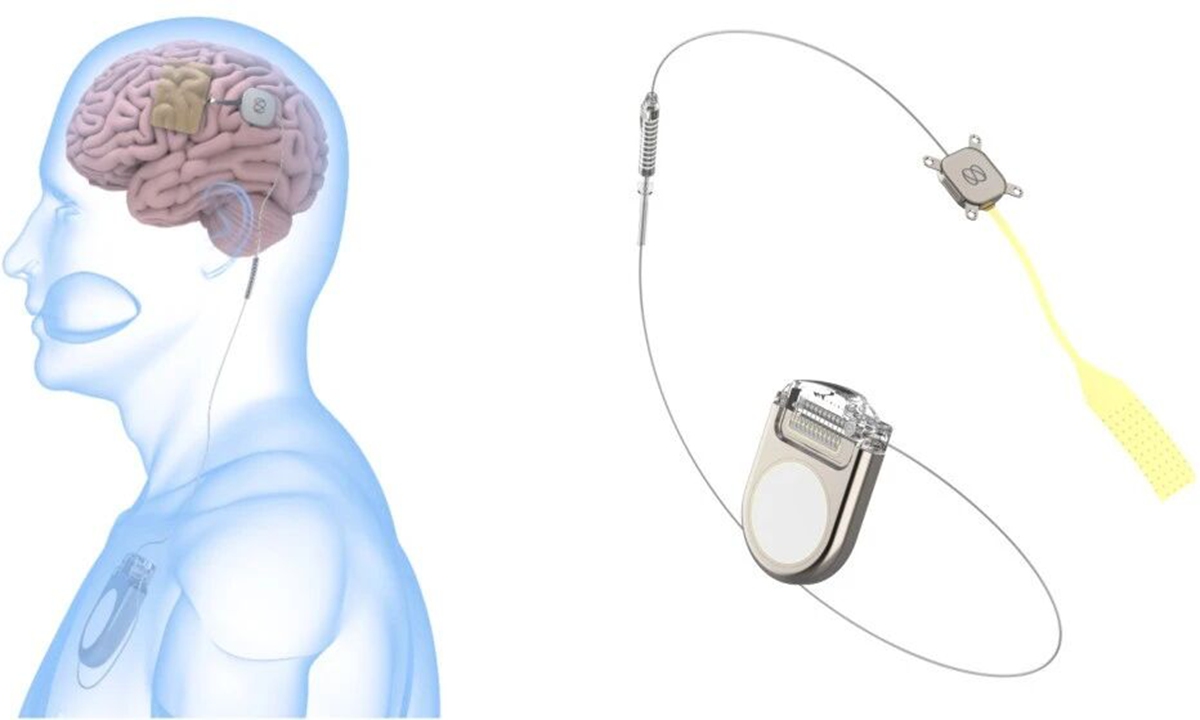
NeuroXess' fully implantable brain-computer interface (BCI) system Photo: Screenshot of NeuroXess' WeChat post
Shanghai tech firm NeuroXess said on Tuesday that its fully implantable brain-computer interface (BCI) system designed to restore hand movement has been selected for a fast-track review by China's medical device evaluation center. The development comes as domestic BCI technology quickly moves out of labs and into real medical use.
It is the first flexible subdural implantable BCI in China to enter this special innovative medical device review program run by the Center for Medical Device Evaluation (CMDE), a notable breakthrough for the country's high-end implant medical device industry, the company said in a statement on its official WeChat account.
Chinese regulators rolled out the official special review program for innovative medical devices in December 2018. The revised rules refine application procedures to boost review efficiency, and are designed to facilitate medical device innovation, according to the National Medical Products Administration (NMPA).
In June, the NMPA announced the guiding principles for classification of BCI medical devices and the guiding principles for generic naming of BCI medical devices, explicitly classifying the management of invasive and implantable BCI products.
"We will take this opportunity to accelerate multi-center clinical trials and regulatory registration reviews, so that this safer, more precise and user-friendly brain-computer interface product can benefit more patients at an earlier date," said Tao Hu, founder, CEO and chief scientist of NeuroXess.
NeuroXess is developing a fully implanted, fully wireless and fully functional BCI system. It adopts a subdural implantation design that uses flexible electrodes placed on the surface of the cerebral cortex without invading brain tissue, which can precisely collect neural signals and protect brain tissue, the company said.
The device has undergone multiple human implantation trials. Clinical results indicate the system enabled a 28-year-old patient with high paraplegia caused by spinal cord injury to surf the internet, control a wheelchair and perform precise, fine finger movements via exoskeleton gloves, while a 26-year-old patient gained the ability to eat unassisted and draw birthday cards, the company said.
NeuroXess said that it has completed 60 clinical trials and formed partnerships with more than 70 top research and medical institutions nationwide. Its factory in East China's Jiangxi Province is scheduled to start operation in the second half of 2026, enabling stable annual delivery of tens of thousands of sets of products.
The green‑channel review bypasses routine evaluation procedures for Class‑III active medical devices, speeding up overall approval timelines, Li Xiaojian, professor at the Greater Bay Area Center for Brain Research and ZhuJiang Hospital of Southern Medical University and founder of BCI firm We‑Linking, told the Global Times on Tuesday.
Chinese‑developed BCI products are frequently compared against Musk‑founded Neuralink.
When commenting on the China‑US industry landscape, Li stated that segmented‑market participants face little cut‑throat competition, as all players remain in exploratory phases with no single mainstream leader.
"US‑based projects advance at a slower pace yet prioritize verified clinical outcomes backed by robust clinical data. By contrast, China benefits from abundant clinical resources and a large patient pool that support industry development," Li added.
BCI is not a single technological breakthrough. It requires coordinated support from multiple fields including precision manufacturing, algorithms and medical materials. China boasts the world's most complete industrial chain with abundant upstream and downstream supporting enterprises and coordinated development across multiple industries, giving it an inherent competitive edge in industrial supporting capacity over overseas counterparts, Liu Dingding, a tech analyst, told the Global Times on Tuesday.
There is huge market demand for medical applications, and the BCI industry has tremendous long-term growth potential, Liu noted.
China's BCI industry is accelerating its transition from the laboratory to industrialization.
On July 13, Huashan Hospital Affiliated to Fudan University in Shanghai completed the world's first commercial implantation surgery for Neuracle Technology's domestically developed implantable BCI system, just four months after the device obtained official marketing approval, according to the official WeChat account of the Shanghai Science and Technology Commission.
In March, the NMPA approved the innovative product registration application for an implantable BCI hand motor function compensation system developed by Neuracle Technology, marking the market launch of this BCI medical device. It is also the world's first invasive BCI medical device to enter the clinical application stage, according to the Xinhua News Agency.
The BCI sector was designated a future industry in this year's government work report. It was also included in the outline of the 15th Five-Year Plan (2026-30) period as the country aims to cultivate it into a new engine of growth.
China's BCI market is projected to reach 6.14 billion yuan ($904.3 million) by 2028, with a compound annual growth rate of 17.7 percent from 2024 to 2028, according to CCID consulting under China's Ministry of Industry and Information Technology.
RELATED ARTICLES