Illustration: Liu Rui/GT
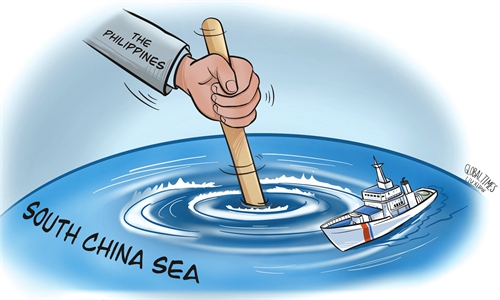
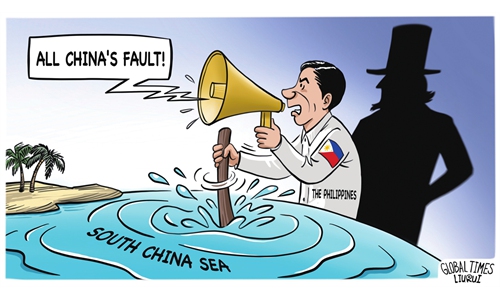
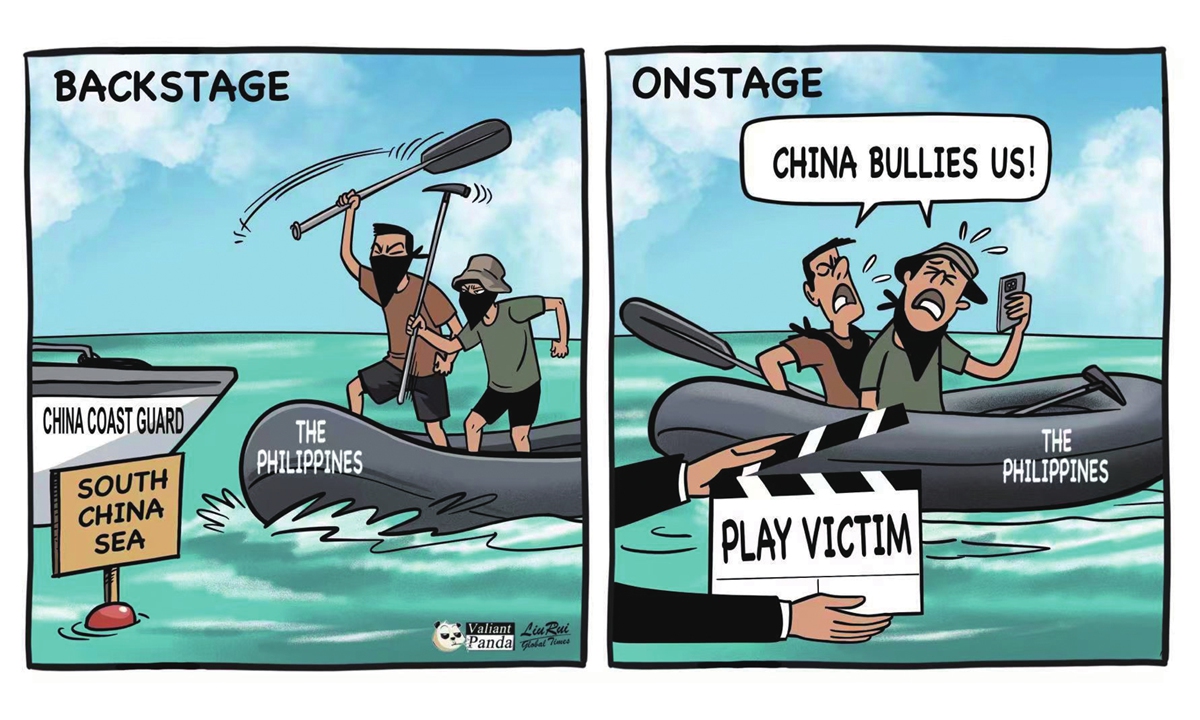
A farcical "hit first, cry victim later" drama unfolded in the waters near Ren'ai Jiao on Monday morning. Two rubber boats launched from the Philippines' illegally grounded warship ignored repeated Chinese warnings and dangerously rammed a Chinese patrol vessel. Filipino personnel even attacked Chinese law enforcement officers with paddles and long sticks. After being lawfully repelled, they fled in a hurry. What's even more ridiculous is that after every provocation, the Philippine side edits videos selectively, distorts facts and quickly paints itself as the "victim."The Philippines has pulled this "hit first, cry victim later" stunt many times in recent years. It makes one wonder: Is the Philippines conducting serious maritime law enforcement, or just shooting a soap opera with a maritime crew?
This January, the Chinese military expelled Philippine aircraft intruding into China's territorial airspace around Huangyan Dao. In May, five Philippine crew members illegally landed on Tiexian Jiao of China's Nansha Qundao, in disregard of the Chinese side's repeated dissuasion and warnings. In June, China and the Philippines had a naval stand-off near Huangyan Dao after a Philippine vessel intruded into the island's territorial waters. Add to the rickety warship that has been illegally grounded at Ren'ai Jiao for 27 years, along with repeated incursions by Philippine government vessels and aircraft into waters near Chinese reefs - from the sky to the sea, the Philippines has provoked China at every possible flashpoint.
As this year's rotating chair of ASEAN, the Philippines is supposed to build consensus and promote cooperation. That's exactly what it claims to be doing. The administration of Philippine President Ferdinand Romualdez Marcos Jr. is reportedly actively pursuing the finalization of a legally binding South China Sea Code of Conduct (COC) during the country's ASEAN chairmanship in 2026.
Yet, in reality, while pushing the South China Sea issue into the ASEAN agenda and trying to insert its own illegal claims into the COC negotiations, Philippine Defense Secretary Gilberto Teodoro Jr. openly declared at this year's Shangri-La Dialogue that "Why is there a need for a code of conduct when we have peremptory norms such as UNCLOS, such as UN Charter…" One moment shouting that the Philippines wants to promote the COC, the next saying it is not needed - this schizophrenic performance makes it hard for anyone to trust Manila's sincerity.
Take a broader view. The year 2026 marks the 10th year of the so-called "South China Sea Arbitration Award." This illegal and invalid "ruling" has not solved anything over the past decade. Instead, it has become a tool for the Philippines to expand its maritime claims and a pretext for external forces to meddle in the South China Sea. For 10 years, Manila has repeatedly stirred up trouble around Huangyan Dao, Ren'ai Jiao, Xianbin Jiao and Tiexian Jiao. This year, it has gone even further - holding a flag raising ceremony on July 6 in commemoration of the 10th anniversary of the "award" and launching a "National Peace Walk 2026 for the West Philippine Sea" on July 12.
The latest joint statement on the "award" issued by the Philippines and a group of other countries, many of which don't have a single inch of coastline in the South China Sea, once again reveals their malicious intention as they seek to recycle an illegal and invalid award that has long served as a pretext for geopolitical maneuvering in the South China Sea.
In order to smear China, the Philippines' actions are aimed at creating the false narrative of "China bullying the small," while currying favor with the US and its allies. Meanwhile, however, other ASEAN countries choose to prioritize regional stability and development - especially since the China-ASEAN Free Trade Area has been upgraded to version 3.0, and everyone is busy doing business and pursuing growth. By stubbornly relying on outsiders to stir up trouble at sea, the Philippines will only end up increasingly isolated within ASEAN. This kind of rotating chair is simply unworthy of the title.
Peace in the South China Sea does not need "performance art" or "short-video screenwriters." The Declaration on the Conduct of Parties in the South China Sea, jointly promoted by China and ASEAN countries, has been in place for over two decades, and negotiations on the COC are accelerating. These are the right paths to maintaining regional peace and stability. It is time for the Philippines to end its two-faced act.
The author is director of the Center of Philippines Studies, Jinan University. opinion@globaltimes.com.cn
RELATED ARTICLES