The World Cup party is over, but the war is not
By Published: Jul 22, 2026 07:27 PM

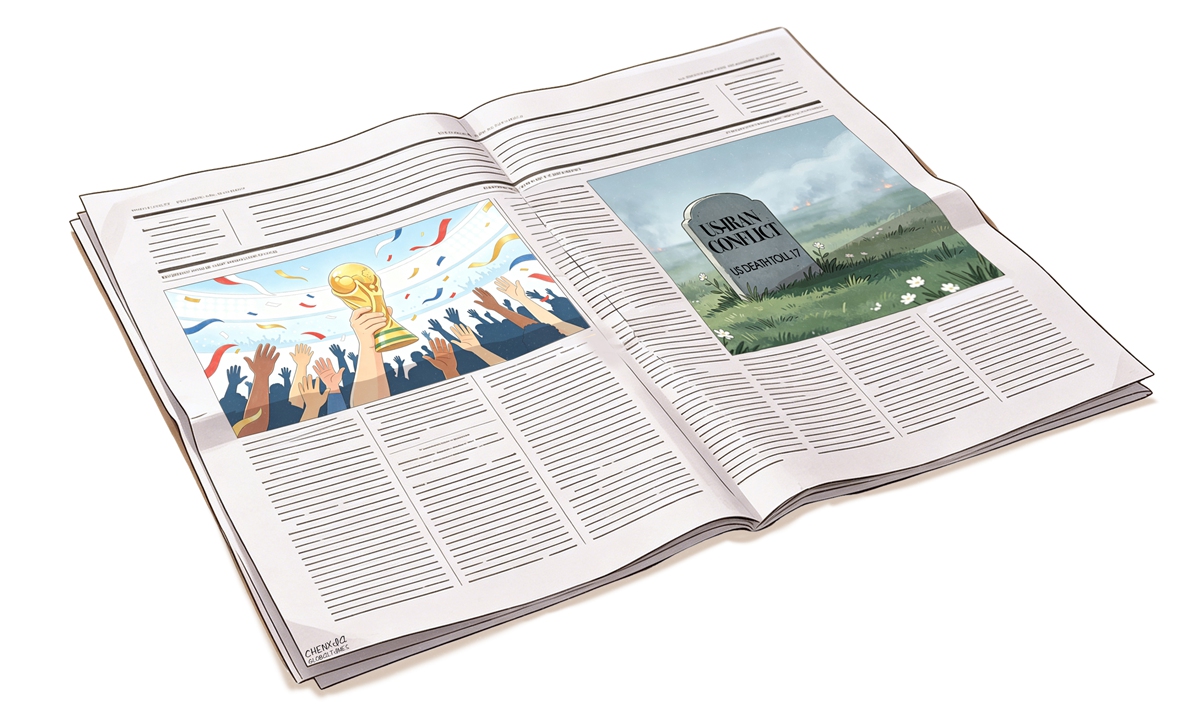
Illustration: Chen Xia/GT
The confetti from Sunday's World Cup final hadn't even been swept up before American newsrooms turned the page.By Monday evening, the lead story on CNN and NPR was no longer Spain's extra-time win over Argentina; it was a grim bulletin from northern Iraq: Another US service member killed while disposing of a downed Iranian drone.
He was the third American to die in recent days, bringing the US death toll to 17, with more than 420 wounded since the conflict began. On Monday night, both sides resumed their exchange of fire.
The handoff was seamless: The sports pages celebrated while the front pages mourned.
None of this should shock anyone who's spent time in a newsroom. A World Cup final, however thrilling, is a finished product. The trophy is lifted, the confetti has fallen, and all that's left is the highlight reel and the hangover.
A war is the opposite - an open-ended story with no final whistle. A soldier's death isn't the end of a news cycle; it's the latest tick mark on a casualty curve that hasn't peaked. Editors will pick the story still unfolding over the one already wrapped every single time. It's not cynicism. It's physics.
And let's be fair: Americans actually watched this World Cup. The final drew record US audiences, with viewership up more than 150 percent over the last tournament's quarterfinals. That's exactly what makes the sudden shift so jarring - millions of people were still excited about the match while the Pentagon was already notifying families of fallen soldiers, and Capitol Hill was limbering up for the next round of partisan cage-fighting.
Democrats have seized on the mounting toll to argue that Congress must reclaim its constitutional authority over war - that quaint little clause in Article I that's been gathering dust.
In June, the House passed a war powers resolution, with four Republicans crossing the aisle to demand that the president obtain authorization before further military action. The Senate followed suit. It was a rare bipartisan rebuke, roughly as common in Washington these days as a humble press conference. However, the resolution is nonbinding, and the White House has treated it with the respect usually reserved for expired parking tickets.
Each new death is now fresh ammunition for those arguing that the executive branch is waging a war nobody voted on.
President Donald Trump responded to the defectors by calling them "unpatriotic," which in his vocabulary ranks somewhere between a misdemeanor and a personality disorder. More revealing was what came next: He framed the latest strikes on Iran as retribution "in honor" of the fallen. That's a telling choice of words.
Wars fought in the name of honor have a way of generating more honor to defend - and more casualties to avenge. It's the geopolitical version of a bar tab that never closes.
The boos that greeted the president at the medal ceremony made for a great clip and a viral meme, but they'll be forgotten by the weekend.
However, a growing stack of folded flags is the kind of news that moves legislation, tests executive power and - not coincidentally - shapes midterm elections. Stadium cheers don't echo in congressional hearing rooms. Casualty reports do.
This isn't a story about the media ignoring sports for politics. It's about a country running two parallel narratives: the entertainment economy that unites the people for ninety minutes, and the war machine that quietly pulls them apart. Both are loud. Only one is still writing new chapters.
When the World Cup tide recedes, people remember the champion. When a war recedes, it leaves behind things the country has to carry: the costs, the explanations, the accountability.
A victory can make a divided nation forget its divisions for a while. A lengthening list of the dead makes forgetting impossible. America has always been world-class at moving on, but the scoreboard and the casualty report are not the same thing. Only one of them still matters after the final whistle.
The party is over. The war is not.
The author is a senior editor with the People's Daily and currently a senior fellow with the Chongyang Institute for Financial Studies at Renmin University of China. dinggang@globaltimes.com.cn. Follow him on X @dinggangchina
RELATED ARTICLES