ARTS / CULTURE & LEISURE
State troupes take to livestreams to bring traditional arts to wider audiences

Illustration: Liu Xiangya/GT
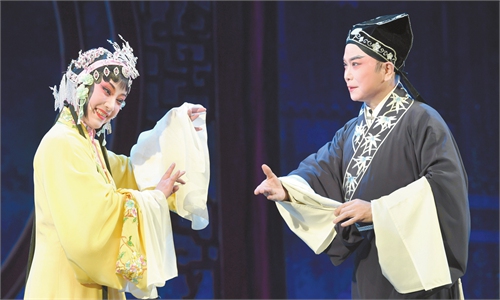
Open Douyin, China's version of TikTok, and you may find yourself watching scenes once reserved for theater halls unfold on your smartphone screen. Dancers from the acclaimed Chinese dance drama The Journey of a Legendary Landscape Painting strike elegant poses, musicians from the China National Traditional Orchestra breathe new life into classical melodies, and thousands of viewers respond in real time through comments and virtual applause.Group livestreaming refers to a multi-person livestream format operated by a team. For professional performing arts troupes, it can be seen as bringing a reimagined, "miniature" stage production onto mobile screens, allowing audiences to enjoy an experience close to a theater performance without leaving home.
For generations, experiencing many of China's premier performing arts required a ticket, a trip to a major city and the time to attend a theater performance. Today, a smartphone is increasingly all that is needed.
This shift is not merely about convenience. It reflects a broader transformation in how Chinese traditional culture can survive and thrive in the digital age.
At a time when many countries are grappling with how to preserve traditional culture and attract younger audiences, China's performing arts sector is experimenting with a simple but powerful approach: meeting audiences where they already are.
China's state-owned performing arts troupes have embraced livestreaming at a remarkable pace. As of May 2026, 576 state-owned arts organizations and more than 8,100 professional performers had joined Douyin, hosting more than 1.06 million livestreams and attracting more than 6.14 billion views. Among them, 57 performing arts troupes have launched regular livestreaming programs, staging more than 16,000 sessions and reaching 320 million viewers.
China Oriental Performing Arts Group launched regular troupe livestreaming in April, featuring performances from several of its signature productions, including The Journey of a Legendary Landscape Painting. Jing Xiaoyong, the group's chairman, described troupe livestreaming as "an important experiment in revitalizing traditional performing arts."
"The vitality of classics lies in their ability to evolve with the times," he told the Global Times. "Offline performances preserve the artistic essence, while online platforms expand their reach."
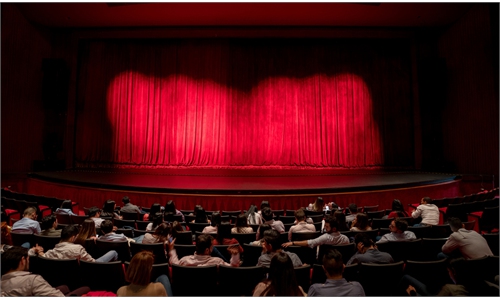
Historically, traditional performing arts have faced an inherent limitation: A theater has only so many seats, and audiences are constrained by geography, time and cost. Livestreaming changes that equation.
Digital platforms are, in effect, expanding the walls of the theater.
This matters not only for audience development but also for cultural exchange. Bu Xiting, an associate researcher at the School of Cultural Industries Management at the Communication University of China, told the Global Times that livestreaming has become a new window through which international audiences can encounter Chinese culture in a more immediate and accessible way.
Unlike museum exhibitions or carefully curated cultural showcases abroad, livestreams are spontaneous and interactive. Viewers can ask questions, leave comments and engage directly with performers in real time.
In this sense, China's performing arts troupes are not simply moving online; they are participating in a global conversation about how culture is transmitted in the digital age, he added.
Professional troupe livestreams involve choreographers, lighting designers, camera operators and directors. Productions are frequently reimagined for vertical screens, with close-up shots highlighting facial expressions and movements that might be difficult to appreciate from the back row of a theater. State-owned arts organizations are learning to speak a new visual language without abandoning their artistic identity.
But the results are already visible. The Shaanxi Song and Dance Theater has reported stronger-than-expected viewer support and an influx of new audiences through its livestreams. The Guangzhou Song and Dance Theater found that its online performances helped boost ticket sales for offline productions. The Jiangsu Performing Arts Group also saw its original dance production gain significant online exposure, while holiday performances quickly sold out, according to the Xinhua News Agency.
This points to another important development: Livestreaming is creating new possibilities for the sustainability of the traditional arts.
For decades, performing arts institutions around the world have wrestled with familiar challenges - aging audiences, rising production costs and financial pressures. Digital platforms are unlikely to solve all of these problems, but they can become part of the solution, according to Bu.
Features such as livestream interaction, online performances, virtual gifts and viewer support mechanisms offer arts organizations new ways to engage audiences and explore more sustainable operating models. For performers and troupes, these features provide not only financial support but also direct feedback from audiences, helping them better understand what resonates with viewers in the digital age. More importantly, they encourage institutions to think differently about audience engagement.
A smartphone screen will never fully replicate the atmosphere of a theater hall. But if it inspires someone to buy a ticket, learn about an art form or simply spend a few minutes appreciating a performance they might never have encountered otherwise, then it has already accomplished something meaningful.
The author is a reporter with the Global Times. life@globaltimes.com.cn
RELATED ARTICLES