China, US seek input on $30b reciprocal tariff reductions, push implementation: MOFCOM
Lower tariffs would help businesses, consumers lower costs, support global supply chain stability: expert
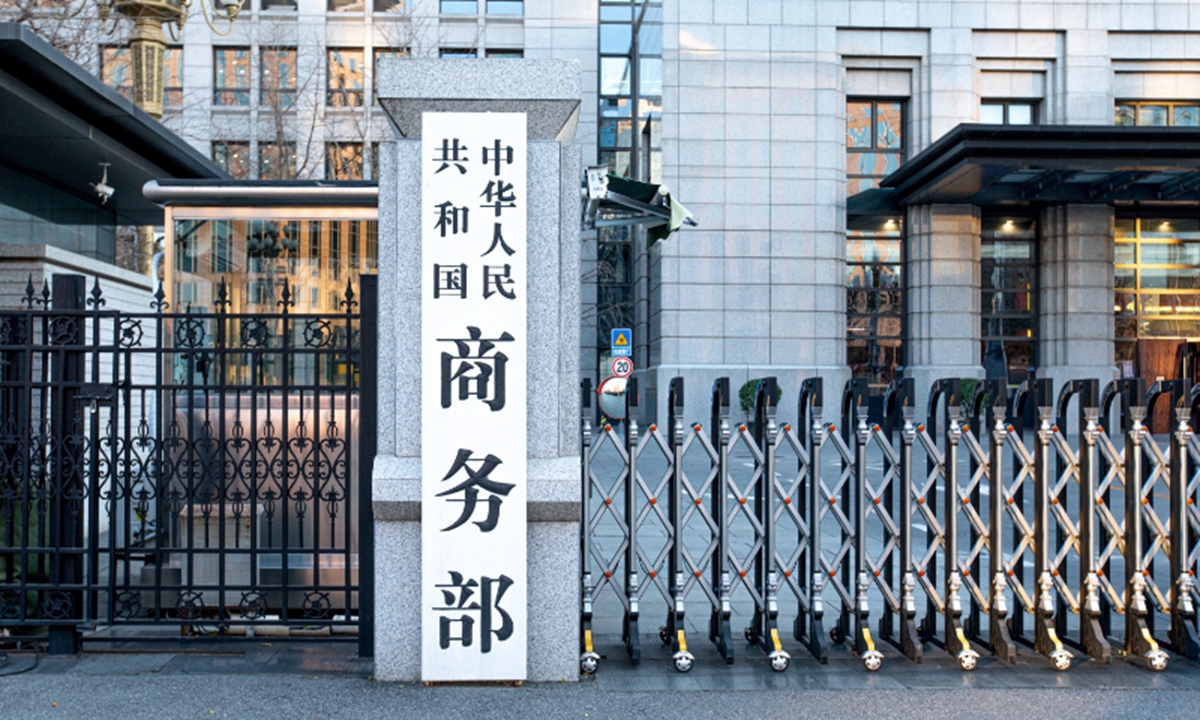
The Ministry of Commerce of China File photo: VCG
China and the US are discussing a framework for reciprocal tariff reductions worth $30 billion on each side, while seeking input on related plans and working to finalize specific product-level tariff reduction measures for implementation as soon as possible, an official of the Ministry of Commerce (MOFCOM) said on Thursday.The latest progress shows that China and the US are moving from high-level consensus toward concrete arrangements, marking further efforts to implement the outcomes of previous economic and trade consultations, a Chinese expert said.
Meng Huating, director-general of the Department of Foreign Investment Administration at the MOFCOM, said at a press conference that the two countries' economic and trade teams are maintaining close communication on specific arrangements for the structure, functions and operating mode of a trade council.
The two sides are also discussing advancing a framework arrangement for reciprocal tariff reductions worth $30 billion on each side, Meng said.
China is extensively soliciting opinions from relevant stakeholders, including domestic enterprises, industry associations, local governments, as well as chambers of commerce and business associations of US companies in China, on the proposed tariff reduction arrangements, Meng said at Thursday's briefing.
The US side is also soliciting public comments on the trade council and reciprocal tariff reduction arrangements, she noted.
USTR in June formally opened a public-comment process on the scope and operation of the proposed bilateral trade mechanism, including which Chinese products could be considered for lower tariffs. US Trade Representative Jamieson Greer had earlier said the two sides would initially identify around $30 billion worth of non-sensitive goods on each side for possible tariff reductions or elimination.
The two sides will continue close consultations, work to finalize specific product-level tariff reduction arrangements as soon as possible, and push for their implementation, with the aim of further expanding bilateral trade, according to the official.
"The latest developments signal that China and the US are advancing follow-up economic and trade work in line with the consensus reached by the two heads of state," Gao Lingyun, a research fellow at the Chinese Academy of Social Sciences, told the Global Times on Thursday.
Based on the information from the MOFCOM, preparations for the trade council appear to be moving toward a more concrete stage, while the new communication on tariff reductions could be seen as a positive step in translating consultation outcomes into practical arrangements, Gao added.
The latest progress builds on the outcomes of China-US economic and trade consultations held in South Korea in May.
During the talks, the two sides agreed to establish trade and investment councils to discuss their respective concerns in the trade and investment areas. They also agreed in principle to discuss a framework for reciprocal tariff reductions on products of the same scale under the trade council, according to the MOFCOM.
The two sides continued communication on follow-up arrangements following the consultations. In June, MOFCOM spokesperson He Yadong said that the two countries' economic and trade teams would discuss cooperation under the trade council, including reciprocal tariff reductions.
"Such a trade council mechanism requires both sides to determine details such as the level of participation, membership structure, discussion agenda and communication frequency. Once these arrangements are in place, it will provide clearer channels for addressing specific issues," Gao said.
Over the longer term, the mechanism could help make China-US economic and trade communication more regular and stable, ensuring that agreed outcomes can be further implemented, Gao added.
In 2025, the US administration announced additional tariffs against Chinese goods, triggering renewed tariff tensions. China responded with corresponding countermeasures and has consistently said that "trade wars have no winners and protectionism has no way out," and it urged the US to resolve differences with trade partners through equal dialogue.
Gao said that China has consistently demonstrated its commitment to advancing the process. "The next step will depend on whether the US responds positively and responsibly, and whether the two sides can maintain pragmatic coordination at the working level, as meaningful progress requires efforts from both sides," he said.
Amid signs of easing trade tensions, China-US trade showed signs of recovery in the second quarter, with bilateral goods trade rebounding 13.7 percent year-on-year after an 18.7 percent decline in the first quarter, a customs official said at a press conference on Tuesday.
As the world's two largest economies, any progress in China-US tariff reductions would have effects beyond bilateral trade, Gao noted. "Lower tariffs would not only help businesses and consumers in both countries lower costs, but also improve market expectations and support global supply chain stability," he said.
RELATED ARTICLES