EP delegation wraps up China visit with Shanghai leg; engagement sends pragmatic signal amid trade strains: expert
By Published: Jul 23, 2026 06:08 PM

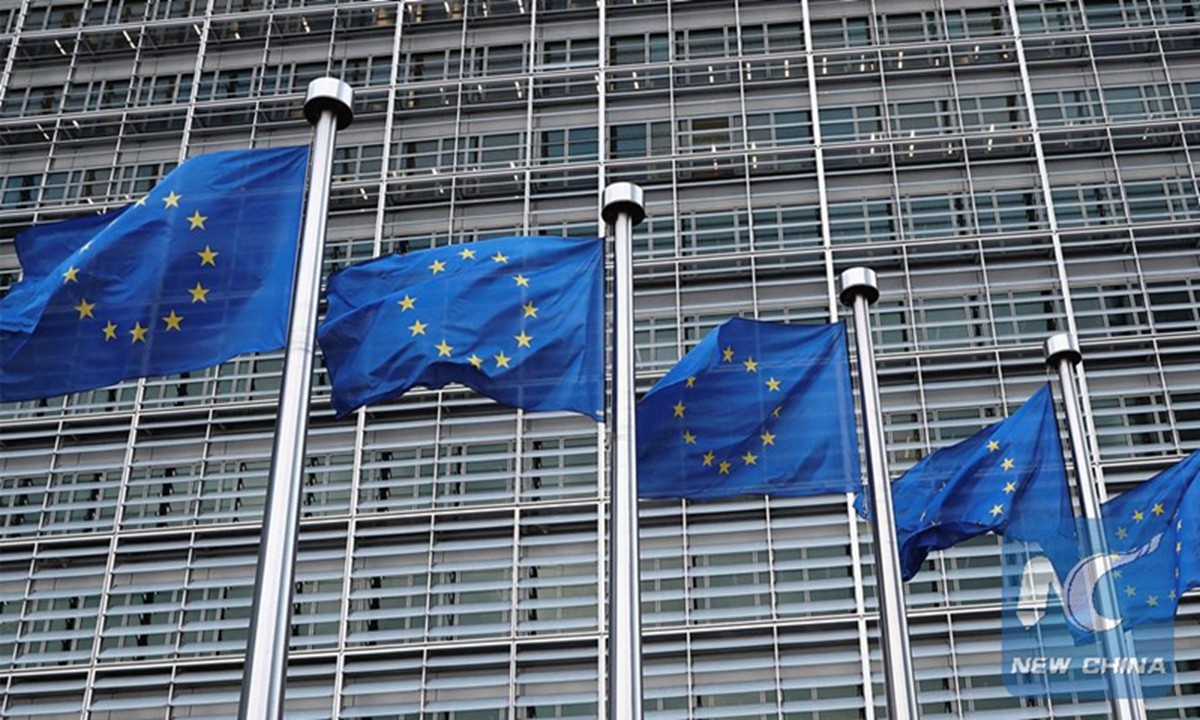
The European Union flags in front of EU headquarters in Brussels, Belgium. Photo: Xinhua
Having concluded its itinerary in Beijing, the eight-member delegation of the European Parliament (EP) Committee on Foreign Affairs (AFET), headed by Chair David McAllister, embarked on Shanghai leg of its visit on Thursday. Amid growing geopolitical volatility and intensifying economic and trade tensions, the delegation is expected to further engage in in-depth exchanges with Chinese sides on issues of shared interest, with a view to boosting mutual understanding and stabilizing EU-China relations.Shanghai serves as the second and final stop of the delegation's three-day China visit from July 21 to 23. As outlined on the official website of the EU, members of the European Parliament (MEPs) will hold a series of meetings with representatives of the municipal authorities and local tech companies. They will focus on the technological dimension of EU-China relations including tech sovereignty and competition, as well as the global governance of artificial intelligence.
In Beijing, the EU delegation met with Chinese Foreign Minister Wang Yi and Li Hongzhong, vice chairman of the National People's Congress (NPC) Standing Committee on Tuesday.
As official releases issued by both sides note, Liu Haixing, head of the International Department of the Communist Party of China Central Committee, held discussions on Wednesday with the delegation. The group additionally held exchanges with researchers at the Chinese Academy of Social Sciences over the evolving EU-China relationship and areas of cooperation.
During the meeting with the cross-party EP delegation on Tuesday Chinese foreign minister Wang Yi said that China and Europe should stick to the overarching positioning of ties as a partnership, refrain from politicizing economic and trade issues and overstretching the concept of security in exchanges, and work for an upward and dynamic balance of trade from a long-term perspective.
According to Xinhua, McAllister said the EU attaches great importance to its relations with China, welcomes the resumption of exchanges between the legislative bodies of the two sides, and stands ready to boost dialogue with China, deepen mutual understanding, and advance cooperation, to promote the sound and steady development of EU-China relations.
The delegation marks the first of its kind sent by the Committee on Foreign Affairs to China, as well as another delegation to China this year sent by the EP following a previous nine-member delegation, led by the chair of the Internal Market and Consumer Protection Committee Anna Cavazzini from March 31 to April 2, marking the first parliamentary delegation to China in eight years.
Zhao Junjie, senior fellow at CASS Institute of European Studies, called the trip a positive signal for EU-China relations. He noted a pragmatic shift in the EP over the past six months: more lawmakers now recognize blanket criticism of China cannot solve Europe's own woes. Amid Europe's tough economic outlook, China's strategic and economic significance keeps growing, as proven by successive visits by European leaders.
This visit and exchanges by the AFET delegation demonstrate the EU side's willingness to engage China more openly and step up more dialogue. It will help normalize exchanges between the EP and China, enable European lawmakers to build a fuller picture of China, allow them to play a constructive role after returning home, and steer the EU's China policy toward greater rationality and pragmatism, Zhao said.
China-EU trade and economic relations have encountered headwinds recently. Amid the EP delegation's China visit, a spokesperson of China's Ministry of Commerce (MOFCOM) on Wednesday expressed strong dissatisfaction and serious concern over the EU's "discriminatory measures to restrict and suppress the normal operations of Chinese e-commerce enterprises," after the European Commission (EC) announced a fine of 550 million euros ($627 million) on AliExpress on Monday.
Also in this week, addressing recent trade-related "concerns" raised by French President Emmanuel Macron and German Chancellor Friedrich Merz, Chinese foreign ministry spokesperson Lin Jian said on Tuesday, that the root cause of the EU's problems on trade and economy does not lie with China, and instead, China can be a partner for the EU in addressing the problems.
Zhao further stated that the EP, a key variable in bilateral ties, has displayed a willingness to improve exchanges and boost political trust, yet China-EU relations will inevitably navigate constant ups and downs going forward. "While competition and tensions persist, both sides strive to manage disagreements and foster mutual trust, with pragmatic cooperation still taking precedence."
Agencia EFE reported on Wednesday that Nicolás Pascual de la Parte, a member of the EP within the visiting delegation, told reporters in Shanghai the EU had no intention of waging a trade war against China and sought to resolve bilateral economic and trade frictions through negotiations.
"Three days of intensive discussions have shown that Europe and China will not see eye to eye on every issue. But anyone who wants to shape the future must be prepared to listen, speak plainly and, at the same time, build bridges. That is precisely what diplomacy is all about," Engin Eroglu, the Chair of the EP's China Delegation who is on the visit to China, said in an X post on Wednesday.
RELATED ARTICLES