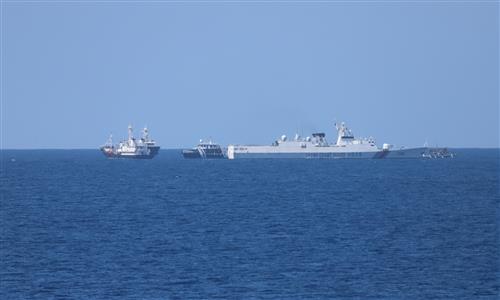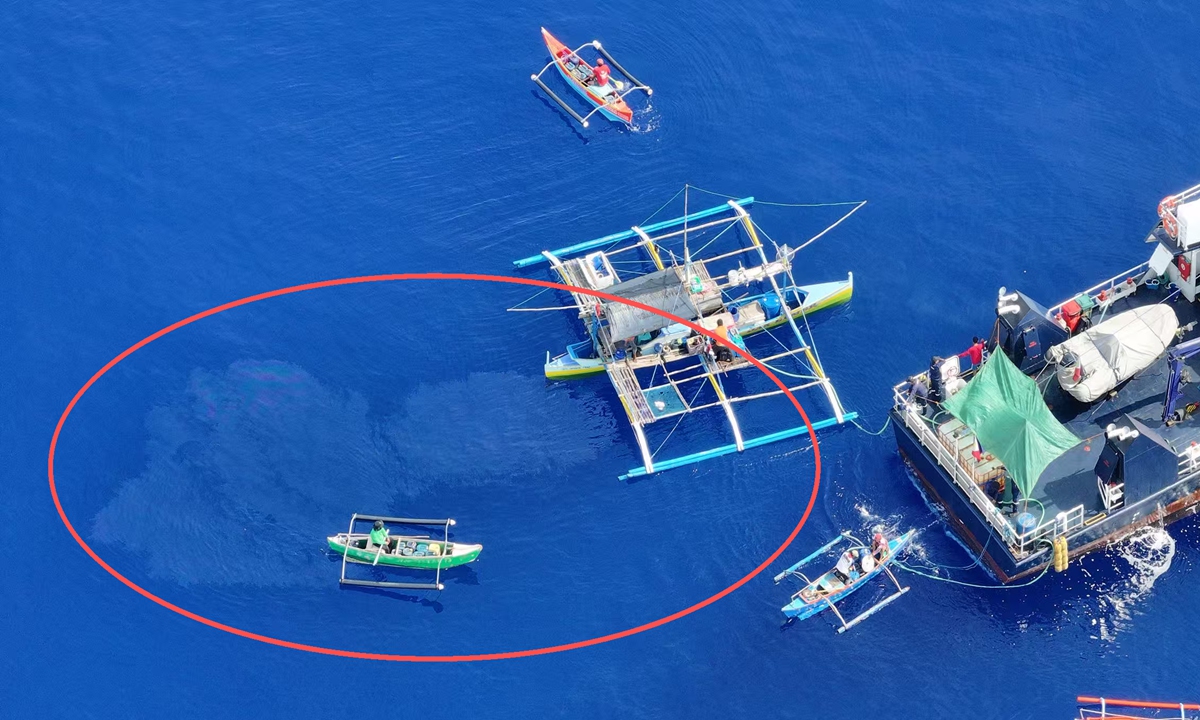
Screenshot from a video obtained by the Global Times on July 23, 2026 shows Philippine government vessels attempting to deliver supplies to Philippine "armed fishermen" boats. After being expelled by the China Coast Guard, the transfer operation failed, and improper handling during the attempted transfer caused a massive fuel leak. Photo: Courtesy of the China Coast Guard
Two Philippine public vessels (MMOV 3012 and MMOV 3018) ignored repeated dissuasion and warnings from the Chinese side and obstinately intruded into the waters under China's jurisdiction at Huangyan Dao on Thursday. The China Coast Guard (CCG) took necessary countermeasures in accordance with the law to track, monitor and block the Philippine vessels, compelling them to leave the area. The on-site operations by the Chinese side were professional, standardized, legitimate and lawful, the CCG announced in a statement on Thursday.
Video footage obtained by the Global Times shows that during this operation, the Philippine official vessels were tasked with two objectives. They not only attempted to forcibly break into waters off China's Huangyan Dao, but also acted as "supply vessels," seeking to transfer materials to Philippine outrigger fishing boat. Adopting an "ant relocation" tactic, they aimed to deliver supplies to Philippine "armed fishermen" conducting harassment and infringement operations around Huangyan Dao.
However, both tasks ended in failure. Subjected to water cannon dispersal, the vessels were effectively kept outside the territorial waters of China's Huangyan Dao by CCG ships. Furthermore, during the attempted ship-to-ship transfer of materials, improper operations caused massive leakage of fuel supplies, creating ecological hazards in the sea areas surrounding Huangyan Dao.
Shortly after major diplomatic events, the Philippines has hastily staged another farce of intruding into the adjacent waters of China's Huangyan Dao. Such acts seriously violate China's territorial sovereignty and maritime rights and interests, laying bare its ugly attempt to take the initiative to stir up South China Sea issue. Moreover, the fuel leakage caused by its clumsy operations further exposes the country as a genuine saboteur of marine ecology in the South China Sea, Chen Xidi, an expert from the China Institute for Marine Affairs under the Ministry of Natural Resources, told the Global Times on Thursday.
The fuel leakage has directly threatened the marine ecological environment around Huangyan Dao. The oil film formed after fuel enters seawater will trigger a sharp drop in dissolved oxygen in the water, while various toxic compounds contained in the fuel will directly poison fish, plankton and other marine organisms. Adhered oil stains may lead to coral bleaching and death. The resulting damages can also spread through the food chain, posing severe ecological risks to the marine environment across a large surrounding area, Chen said.
The Global Times also learned from a source close to the matter that under the pretext of the so-called "New Hero-Fisherfolk" program, the Philippines has mobilized more than 30 outrigger fishing boats to conduct harassment operations against China in waters of Huangyan Dao. These small fishing boats, which are only capable of operating in the offshore waters of the Philippines, lack adequate living support facilities and necessary waste disposal equipment. Their large-scale long-distance operations in open waters will inevitably trigger local marine pollution incidents.
Chen further explained that some Philippine fishermen, under government instructions, have long conducted invasive activities in the waters of Huangyan Dao. Domestic sewage and production waste discharged by their vessels have caused continuous and chronic damage to the local marine ecology.
The massive illegal gathering and lingering of Philippine fishing boats — which lack basic waste disposal conditions and effective management — has resulted in arbitrary discharge of pollutants into the sea. These vessels are also suspected of adopting destructive fishing methods to catch endangered aquatic wildlife. The cumulative impact of such behaviors continuously undermines the health of the coral reef ecosystem at Huangyan Dao, according to the expert.
"More worryingly, Philippine vessels have frequently carried out illegal activities and provocative traversals in relevant South China Sea waters in recent years, greatly increasing the risks of vessel collisions, oil spills and other maritime accidents. Facts have proven that the Philippines is the real destroyer and major risk source of the marine ecological environment in the South China Sea," Chen added.