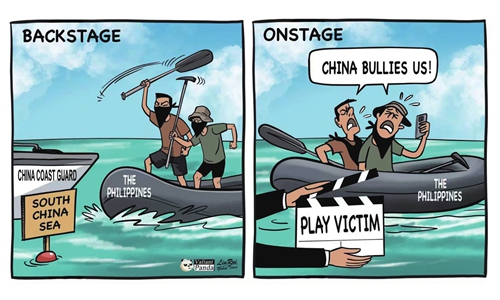
As China and US step up high-level engagement, the Philippines would do better to restrain itself
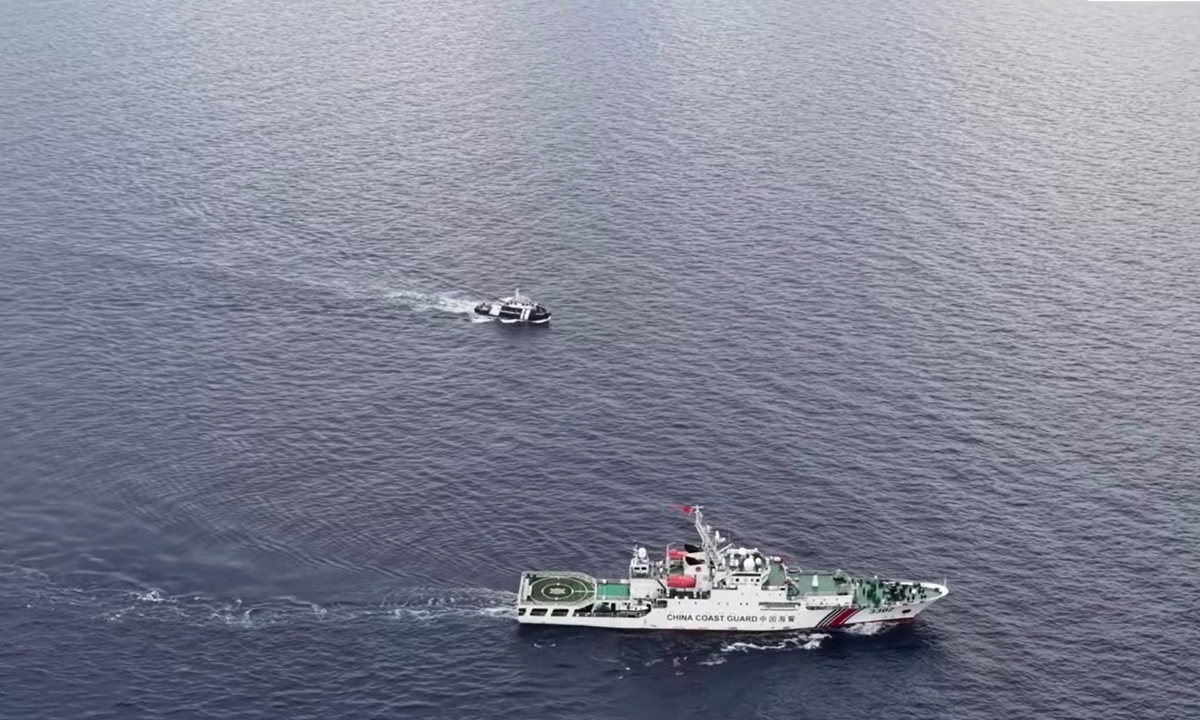
The China Coast Guard (CCG) on Friday took control measures in accordance with the law against multiple Philippine vessels engaged in illegal activities within the territorial waters of China's Huangyan Dao, according to a CCG statement. Photo: screenshot of XinhuaVideo
On Friday, the Philippine side organized seven government vessels, three coast guard ships and one fish carrier and instigated a large number of fishing boats to illegally congregate in waters under the jurisdiction of China's Huangyan Dao. During the process, three Philippine government vessels ignored repeated warnings and dissuasion from the CCG and insistently intruded into China's territorial waters of Huangyan Dao. The Chinese side ultimately took resolute action by using water cannons to drive them away. This marks the second consecutive day of deliberate provocation by the Philippine side following its violent assault on Chinese personnel at Ren'ai Jiao on Monday.
Its sole purpose is to create trouble on the occasion of the ASEAN Foreign Ministers' Meetings and continue serving as a pawn for external forces in the South China Sea.
While the Philippines has been busily stirring up trouble, a series of constructive interactions between China and the US have been noteworthy. On July 22, Chinese Foreign Minister Wang Yi and US Secretary of State Marco Rubio met in the Philippine capital Manila for 90 minutes of talks. After the talks, Rubio stressed the need to "maintain relations with China." On the same day, Chinese Vice Foreign Minister Ma Zhaoxu visited the US at invitation, held consultations with US Deputy Secretary of State Christopher Landau, met with Ivan Kanapathy, senior director for Asia at the White House's National Security Council, and US Under Secretary of War for Policy Elbridge Colby. After meeting the Chinese side, Colby posted on Friday that it was "an honor" to host the Chinese delegation, stating that "we deal with our Chinese counterparts in a spirit of respect, candor, and realism. In that vein, I had a direct discussion with Minister Ma, and we look forward to further exchanges with our Chinese counterparts in the coming months."
The Philippines must clearly recognize a basic fact: After the Chinese and US presidents agreed to "build a constructive relationship of strategic stability" as the new positioning for bilateral ties, interactions at various levels between the two countries have continued, overall sending positive signals. This shows that both sides recognize the importance of avoiding confrontation and loss of control. It also means that those opportunistic players who fancy they can profit by exploiting the situation often end up being pushed to the front line to collide head-on and ultimately pay the price. Certain people in the US use "alliance obligations" to mislead Manila precisely to encourage it to take strategic risks, while Washington will never foot the bill for the Philippines' losses. China and the US can sit down to discuss strategic stability; Philippine government vessels, however, can only be driven away in disgrace after repeated illegal intrusions. This is the difference between a chess player and a chess piece.
The continuous advancement of a constructive China-US relationship of strategic stability means that the space for the Philippines to fish in troubled waters is shrinking overall. The Marcos administration is advised not to mistake the encouragement of certain forces in the US for a "life-saving talisman." Those fantasies of stirring up the South China Sea with a few rubber boats and presenting "pledges of allegiance" to external forces had better be thrown into the Pacific as soon as possible. Otherwise, what Manila faces may well be more than just the resolute countermeasures of the China Coast Guard.
RELATED ARTICLES