45 rescued by Chinese side after Vietnamese ship sinks in South China Sea; joint rescue efforts highlight China's role in providing regional maritime public goods: expert
By , Fan Wei and Shen Sheng Published: Jul 26, 2026 11:42 AM Updated: Jul 26, 2026 03:02 PM

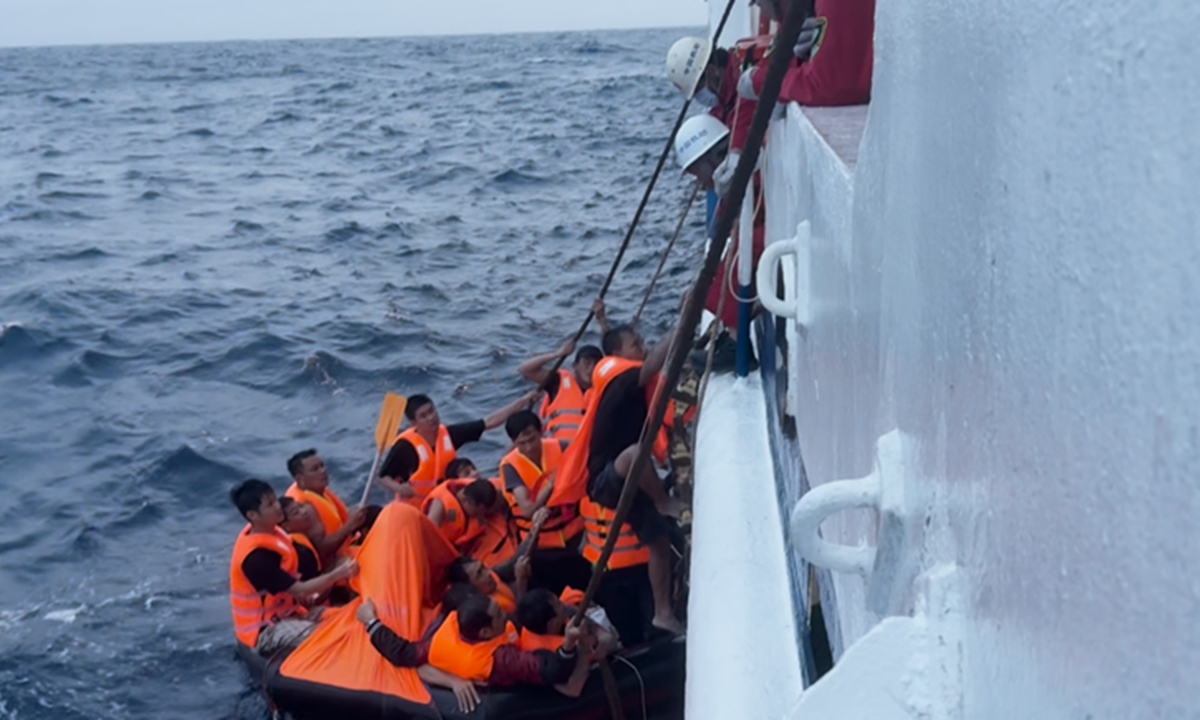
Photo: a screenshot of a footage of the rescue operation
According to the Sansha authorities in South China's Hainan Province, a Vietnamese vessel, the KHOI NGUYEN 18, sank after encountering distress in waters near Yongshu Reef in the Nansha Islands on July 25. As of now, 45 people have been rescued, with the latest rescued by the Chinese side at 1:42 pm on Sunday, Sansha authorities told the Global Times.China has dispatched six vessels and one rescue helicopter to assist in the operation, and seven Vietnamese ships are now also participating in the on-site search and rescue effort.
According to the Sansha maritime search and rescue authorities, the distressed vessel was the Vietnamese-flagged KHOI NGUYEN 18, measuring 69.9 meters in length and 10.8 meters in width, with 62 people on board.
As of 8:05 pm on Sunday, 41 of the rescued Vietnamese individuals onboard the distressed KHOI NGUYEN 18 have been safely transferred to Vietnamese ships, and the remaining four will be transferred tomorrow, Sansha maritime search and rescue authorities told the Global Times.
Leading the efforts
China and Vietnam have set up a joint, unified search and rescue command system. The Chinese rescue vessel Nanhai Jiu 115 is serving as the on-site commander. Rescue forces from both countries have demonstrated strong overall coordination, regional synergy, and efficient collaboration, according to Sansha authorities.
Global Times learned more details of the rescue from Sansha maritime search and rescue authorities on Sunday at noon.
On Saturday, at 6:53 pm, the research and rescue authorities received an alert from the Hainan Provincial Maritime Search and Rescue Center, which stated that at 6:23 pm the same day, the Chinese rescue vessel Nanhai Jiu 115, while sailing back to Sanya, spotted a life raft and rescued 29 Vietnamese nationals on board.
According to the rescued individuals, the distressed vessel was the Vietnamese-flagged ship KHOI NGUYEN 18. The vessel sank after encountering distress on Friday night in waters approximately 220 nautical miles east of Khanh Hoa Province, Vietnam.
There were 62 Vietnamese nationals on board who urgently required assistance.
Upon receiving the alert, the Sansha maritime search and rescue authorities immediately activated their emergency plan. A unified search and rescue command system was quickly established with Vietnamese vessels on site, enabling coordinated deployment of forces, regional collaboration, and highly efficient cooperation.
The center also notified relevant military, police, and civilian units and set up a three-level command linkage mechanism involving provincial, city, and district levels.
The Nanhai Jiu 115 was designated as the on-scene command vessel, coordinating with the Nanhai Jiu 113, rescue helicopters, coast guard vessels, and other forces to conduct search-and-rescue operations.
Navigational alerts were issued to alert nearby vessels, coordinating their participation in the rescue efforts. Additionally, the South China Sea Forecasting Center under the Ministry of Natural Resources was asked to produce drift prediction models for personnel in the water to guide the search plan.
Satellite imagery was also used to help locate survivors, while passing ships were reminded to maintain a sharp lookout and report any sightings immediately.
Search-and rescue-operations are still underway.
In response to a question from Global Times reporters, a staff member from the Sansha maritime search and rescue authorities revealed that six more Vietnamese vessels had joined the rescue efforts as of Sunday noon, and fortunately, the typhoon Noul has not impacted the rescue operation.
Yang Linxiang, an official responsible for coordination, information transmission, and the formulation of rescue plans with the Sansha maritime search and rescue authorities, told the Global Times that he had been working round the clock since after 7 pm on Saturday until past 11 am on Sunday.
As of Sunday noon time, China and Vietnam had together located 46 Vietnamese nationals from the distressed vessel. Chinese rescue forces had saved 45 people, while Vietnamese forces rescued two - one survivor and one fatality, Yang told the Global Times.
In a thank-you note written by Nguyễn Văn Toàn, a rescued Vietnamese mechanician, he said "You did everything you could to rescue me, which allowed my two friends and me to survive. For this, I sincerely thank you. From the bottom of my heart, I am deeply grateful to the ship owner and all the brothers and sisters on board. It was you who gave me a second chance at life. My friends and I would like to express our heartfelt gratitude to you."
Later on Sunday afternoon, the rescued Vietnamese crewmembers gathered together and expressed their gratitude by saying "Xie xie Zhong guo"("Thank you, China") in Chinese.
Global Times also learned that the survivors had been provided with meals aboard the Chinese rescue vessels and were recovering well.
Search and rescue operations would continue in the afternoon, with rescue efforts and the handover of survivors proceeding simultaneously.
Much-needed public products
Ding Duo, director of the Center for International and Regional Studies at the National Institute for South China Sea Studies, told the Global Times on Sunday this joint rescue effort is the latest example among countless emergency search and rescue operations in the vast waters of the South China Sea. It clearly demonstrates the core elements required for effective maritime search and rescue under complex sea conditions and sudden emergencies: rapid response capabilities based on a clear legal framework and emergency mechanisms, the humanitarian and public welfare nature that transcends maritime disputes, and efficient multi-party, multi-level coordination, he noted.
More importantly, it once again confirms China's irreplaceable role and undeniable efforts as a responsible major country and major coastal state in fulfilling its international obligations in the South China Sea, providing international public goods, and promoting functional maritime cooperation, Ding said.
According to the expert, China has long regarded safeguarding navigation safety in the South China Sea as an important responsibility. Through the establishment of search and rescue coordination institutions such as the Sansha and Nansha maritime search and rescue centers, the optimization of rescue force deployment, and the gradual building of a three-dimensional air-sea emergency rescue system, China is committed to providing maritime public services and navigation safety guarantees for ships from neighboring countries, regional waters, and international shipping lanes.
This precisely shows that any discourse that ignores concrete practice, disregards the actual contributions of major providers of public goods, and attempts to obscure the common need for non-traditional security cooperation through one-sided narratives runs counter to the fundamental goal of safeguarding navigation safety and humanitarian values in the South China Sea, he noted.
RELATED ARTICLES