Building tomorrow’s cities from blank ground: urban‑development experiments in Xiong’an and Egypt’s New Capital
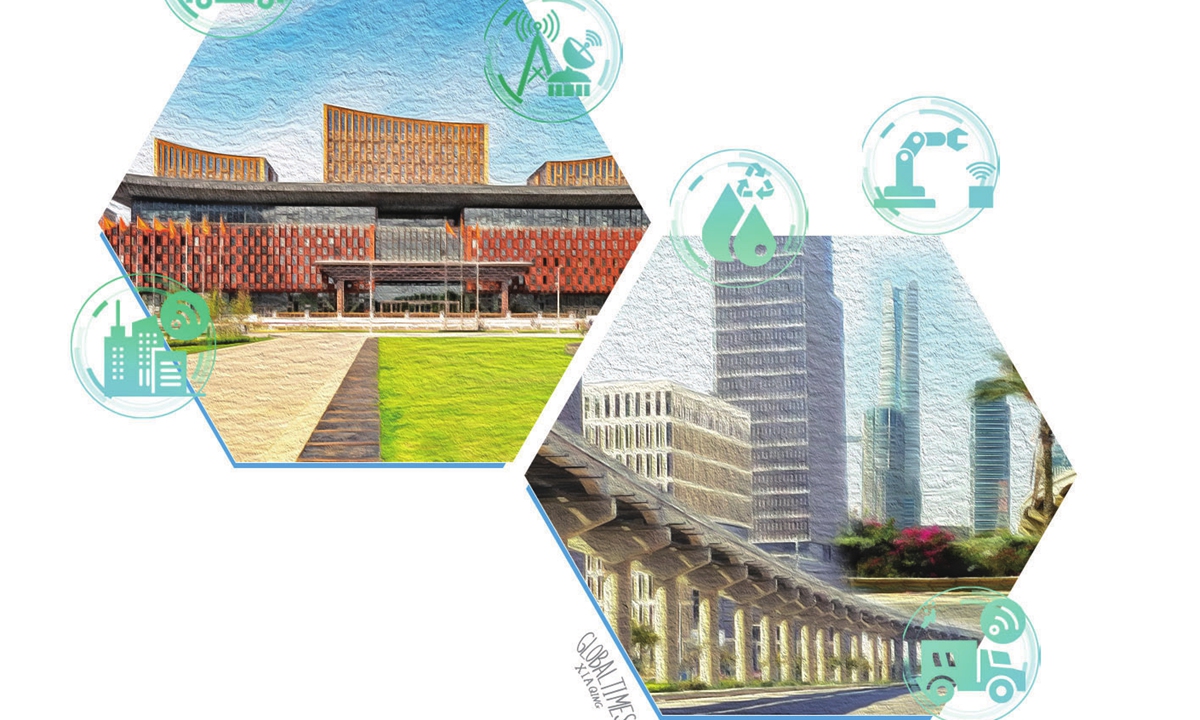
Illustration: Xia Qing/GT
Scrolling through social‑media travel content this summer, I recently stumbled upon a "futuristic city" video. The second I clicked on it, two brand-new cities popped up side by side.One is Xiong'an New Area in North China, where self-driving cars glide through neighborhoods on the North China Plain, with smart traffic lights that seem to think for themselves. The other is Egypt's New Capital - a dazzling skyline of glass towers rising from the endless desert sands, resembling a sci‑fi vision brought to real‑life reality.
Neither location held inherent natural‑resource advantages. Xiong'an emerged from quiet, unremarkable farmland with no major rivers or coastline. Egypt's New Capital rose from windswept sands of the North African desert. Over seven thousand kilometers apart, these two radically different places are proving the same powerful point: The urban blueprints for future‑oriented cities are increasingly being written from entirely blank land, rather than upgrading over‑burdened historic metropolitan centers.
The driving pressures behind both projects stem from identical long‑standing urban‑dilemmas troubling their respective capital hubs. Xiong'an New Area is designed to relieve functions that are non-essential to Beijing's role as the national capital and advance the coordinated development of the Beijing-Tianjin-Hebei region. Egypt's New Capital is created specifically to relieve Cairo's crippling congestion and overcrowding and boost economic development.
To break age‑old urban pitfalls, China started from scratch to build a city on the vast, empty North China Plain, while Egypt began rising one from the dunes of the Sahara, as a core pillar of Egypt Vision 2030. Almost in perfect sync, the two countries launched parallel experiments in building the cities of tomorrow.
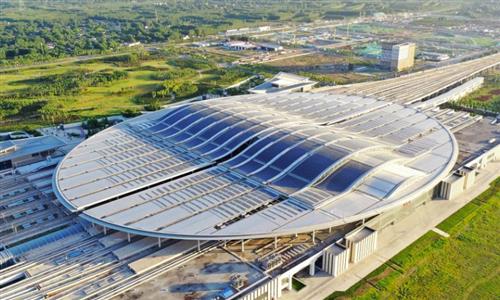
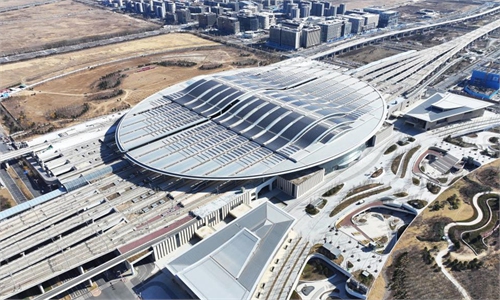
Just nine years ago, Xiong'an was nothing but endless farmland. Today, it has rapidly matured into a three‑tiered city framework comprising above‑ground living spaces, underground utility tunnels, and a cloud‑based digital smart‑brain system.
Above ground, livability is taken to the extreme. You're never more than 300 meters from green space, and parks are often just a five-minute walk away. Low-rise buildings blend into lush woods and flowerbeds. More importantly, the city offers a comprehensive support system - affordable and stable housing, diverse jobs, branch campuses of top schools, and quality healthcare. Cozy cafes, restaurants, and shops are already bustling with students, workers, and residents. The city planners also built high-tech zones to nurture innovative companies that will grow alongside the city.
Have you ever seen a city with no manhole covers? Xiongan has made it happen. All municipal utility lines - water, electricity, gas, heating, and internet - are neatly housed together in underground utility tunnels, along with over 20 million square meters of parking and world-leading autonomous logistics tunnels. Goods move below, while the surface belongs to people, bikes, and buses - a true "people above, things below" approach.
At the digital level, the city's powerful AI "brain" keeps a constant watch over traffic, utilities, and the environment. It spots trouble early, prevents issues before they arise, clears the way for ambulances, and acts like a tireless doctor performing round-the-clock check-ups on the entire city.
It's like planting a thriving oasis in the desert, getting everything ready for comfortable living, then warmly welcoming people with dreams to come and make it truly alive.
This isn't just Xiong'an's story - Egypt's New Capital tells a similar one. Lacking rivers, seaports, or mineral wealth, both cities used visionary planning, green design, and smart technology to show that even empty land can grow into a thriving modern city.
The videos on social media are breathtaking: buildings and Africa's tallest skyscraper rising from the desert sands, glass towers dramatically clashing with golden dunes - a striking reminder that desert countries can fight the sand and build the future at the same time.
Like Xiong'an, Egypt's New Capital is also embracing AI. A smart central system links power, water, and transport via IoT, while real-time AI manages traffic and energy. To tackle the desert's extreme dryness, the city aggressively recycles water and uses smart irrigation to maximize every drop.
This common focus on intelligent, sustainable designs creates a strong resonance between the Xiong'an New Area and Egypt's New Capital.
Egypt's new governmental CBD is already taking shape, though residential areas and everyday amenities are still catching up - something that has raised concerns. But the cranes keep turning in the desert, and construction continues. Chinese vloggers have even made the trip to see it for themselves. This desert city's story is only just beginning.
Xiong'an and Egypt's New Capital both have broken free from centuries of traditional urban evolution. They prove that a country can start with ecology, infrastructure, and public services first - then attract people and industries. Bold vision and strong execution are all it takes to build a truly sustainable city.
Two small but touching moments from the videos stay with me: In Xiong'an, the city brain alerts staff when an elderly person's water meter stops moving for a period of time, prompting a caring check-in. In the Egyptian desert, people stand at the foot of Africa's tallest tower, gazing hopefully at unfinished neighborhoods and dreaming of the life yet to come. Two tiny scenes, bound by one universal aspiration: better cities for everyone.
Rising from blank land these two cities are writing their own unique stories. They offer no single perfect model, but together they're opening an exciting new path for the future of human living.
The author is a chief reporter with the Global Times. The article was originally published in Egyptian media Sout Al Omam. liaixin@globaltimes.com.cn
RELATED ARTICLES