ARTS / CULTURE & LEISURE
Court dismisses viral claim linking Louis Vuitton lawsuit to housing project decorations

A Louis Vuitton store in Xiamen, East China's Fujian Province Photo: VCG
A viral claim that Louis Vuitton sued a Xiamen residential project over decorative floral patterns has been dismissed by a local court, which said that the lawsuit actually concerns the alleged sale of counterfeit Louis Vuitton products.The Huli District People's Court in Xiamen released a statement on its WeChat account on Sunday, clarifying that online claims describing the case as Louis Vuitton suing a property developer over four-petal floral decorations on a residential building's facade were "not true."
"The case was filed by Louis Vuitton against the operator of a street-facing clothing store in a residential community for selling apparel that infringed its registered trademarks," the court said in a statement.
The court added that the other defendants were sued because they were allegedly "negligent in fulfilling their management responsibilities" and were required to bear corresponding legal responsibilities.
"The case has no connection with the decorative floral patterns on the exterior of the residential buildings," the court statement reads, adding that the case "has not yet been heard."
The court urged the public to rely on official information, stating that "case-related information should be based on official releases from the court" and called on internet users to "rationally distinguish true and false online information, and avoid believing or spreading false rumors."
The clarification came after a court announcement published in June resurfaced on social media recently and was widely misinterpreted as evidence that Louis Vuitton had expanded its trademark enforcement from commercial products to architectural decoration.
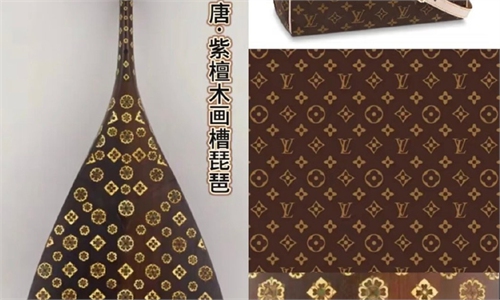
The online reaction echoed public debate surrounding Louis Vuitton's recent trademark dispute with Chinese tea chain Molly Tea, in which a court in Suzhou, East China's Jiangsu Province, ruled that the company's four-petal flower logo infringed several of Louis Vuitton's registered trademarks.
This ruling prompted many Chinese internet users to question whether the luxury brand was seeking exclusive rights over a design they regarded as part of Chinese cultural heritage inspired by baoxianghua, or treasured floral.
The viral narrative quickly triggered criticism online, with many Chinese internet users criticizing the luxury brand for taking trademark protection too far. Some argued that four-petal floral motifs are common elements in traditional Chinese decorative art and should not be monopolized by a commercial brand.
According to a report by China Newsweek on Sunday, Louis Vuitton has filed more than 1,600 trademark-related lawsuits in China over the past five years, including dozens in the first half of 2026.
The company has also recently been involved in a trademark administrative dispute before the Beijing Intellectual Property Court.
RELATED ARTICLES