IN-DEPTH / IN-DEPTH
GT exclusive: Ryukyu visitors honor ancestors at a Beijing cemetery site, thank China for restoration and call for lasting East Asian peace
A shared remembrance
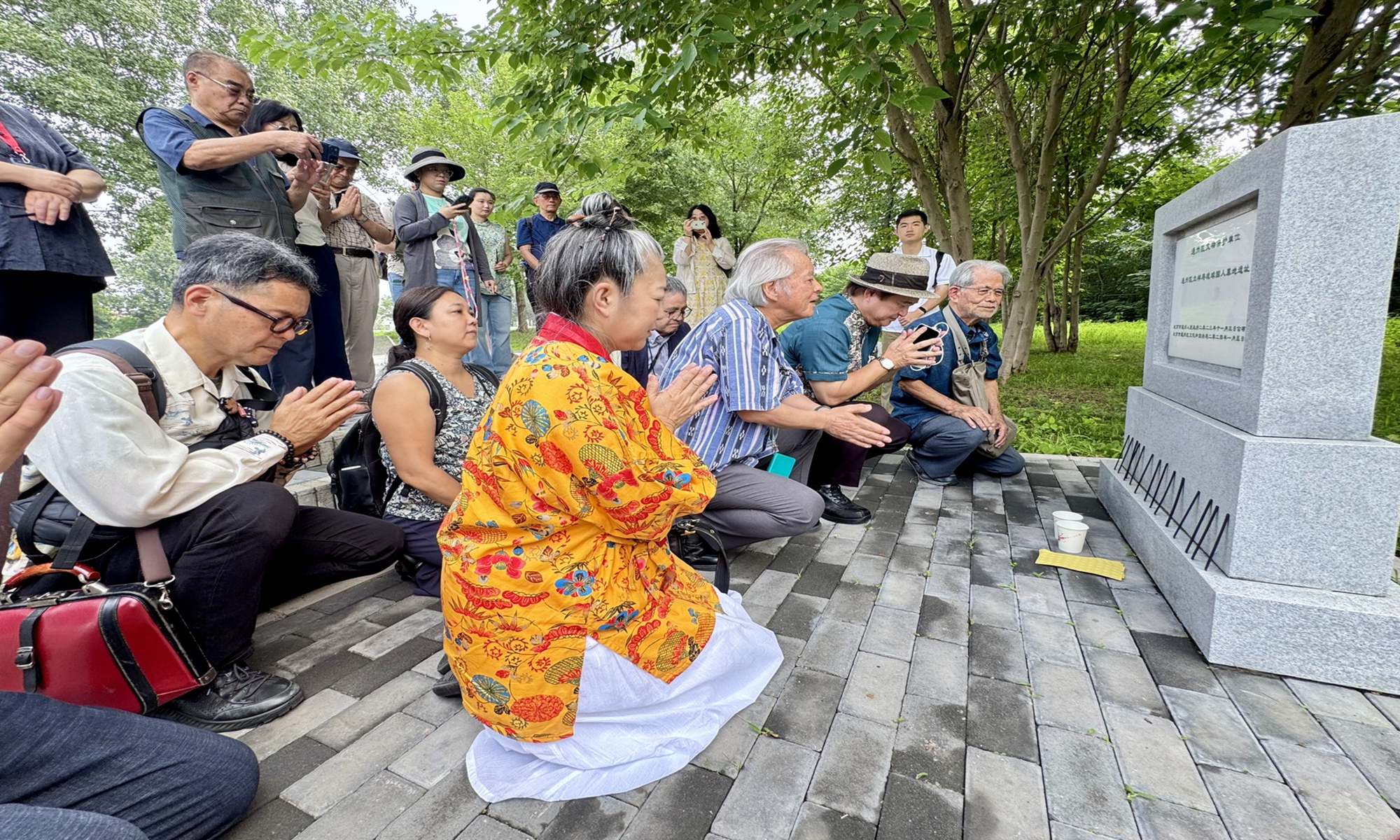
The Ryukyu Kingdom Cemetery Site, which is under restoration, welcomes a Ryukyuan group for the first time in Tongzhou, Beijing, on June 29, 2026. Photo: Xing Xiaojing/GT
On a summer's day in late June, sunlight streamed through the clouds onto a vibrant green space on the outskirts of Beijing. The Ryukyu Kingdom Cemetery Site under restoration welcomed a group of visitors from Ryukyu, which Japan calls "Okinawa."
Dressed in traditional Ryukyuan attire, they neatly arranged Ryukyu's distinctive Awamori liquor and traditional incense sticks before the altar. With their palms pressed together and solemn expressions on their faces, they paid tribute to their ancestors in accordance with Ryukyuan customs.
Having traveled from afar, these descendants of Ryukyu finally completed a dialogue across the centuries with their ancestors, who have rested at the site for hundreds of years.
China and Ryukyu share a history of friendly exchanges spanning more than 600 years. Once an independent kingdom, Ryukyu maintained close official and people-to-people exchanges with China for centuries. Large numbers of Ryukyuan tribute envoys and students traveled to China for exchanges, leaving their footprints in many parts of the country.
Located on the outskirts of Beijing, the site is important historical evidence of the activities of Ryukyuan people in China during the Ming Dynasty (1368-1644) and Qing Dynasty (1644-1911), as well as the longstanding friendship between China and Ryukyu.
The Global Times reporter recently joined scholars and members of civil society from various sectors of Ryukyu on an exclusive visit to the historical site. It was the first time that a Ryukyuan group had visited the site during its restoration, and the visitors paid tribute to their ancestors there. Amid a turbulent and unpredictable regional situation, they recalled the profound friendship forged between Ryukyu and China over hundreds of years.
First Ryukyuan ancestral tribute group welcomed during heritage restoration
At noon on a summer day, Beijing unexpectedly cleared up despite forecasts of rain. A coach slowly entered Lichan'an village in Zhangjiawan township, Tongzhou district.
Before the coach had even come to a complete stop, Ryukyuan writer and part-time lecturer at Okinawa International University Ushi Chinen excitedly grasped the reporter's hand and said, "I am overwhelmed with emotion! Here, I feel as though I can hear the breathing and heartbeats of my ancestors and have formed a connection with them. This extraordinary feeling is like discovering the missing half of myself."
The Global Times reporter had visited the site before. At that time, visitors first had to navigate to a mutton soup restaurant in the village, get out of the vehicle and follow a dirt path through fields and a small grove before finding a blue sign bearing the white characters "Ryukyu Kingdom Cemetery Site."
In just three years, the historical site hidden in the countryside has undergone major changes. The former dirt road has been paved with gray-blue bricks to form an orderly walkway. Weeds have been cleared away and replaced by level lawns and flower beds. Navigation apps now also clearly mark the precise location of the Ryukyu Kingdom Cemetery Site.
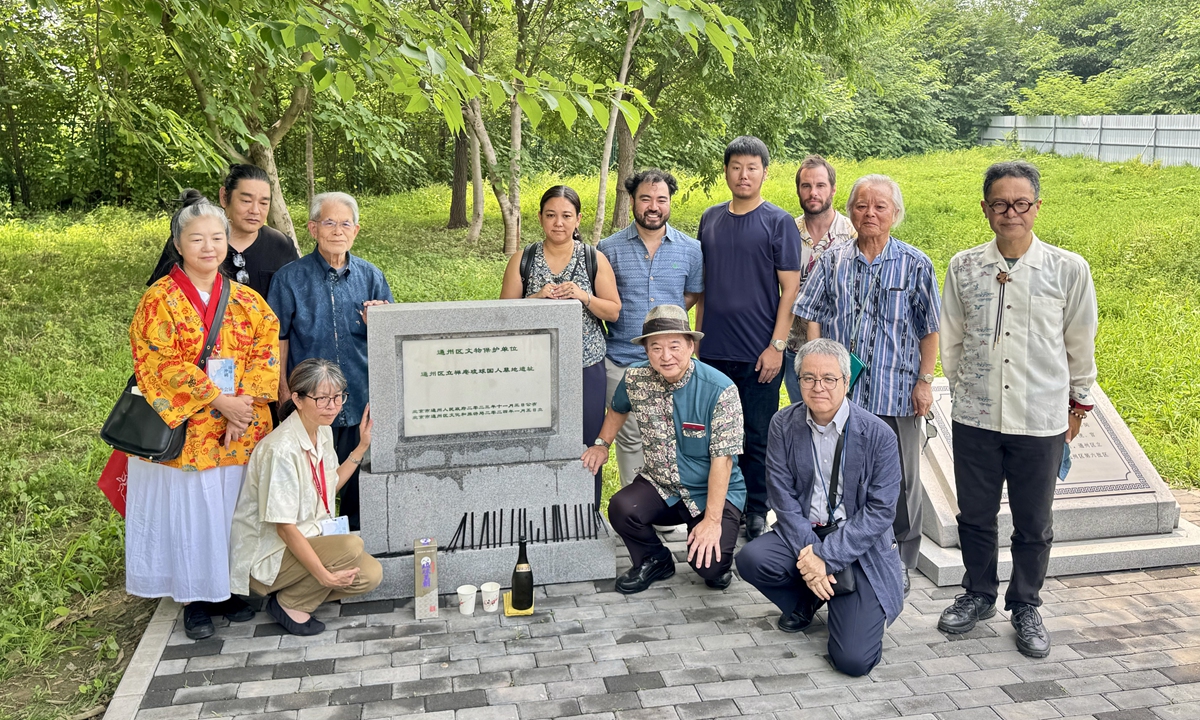
New features conveying a sense of solemnity continually came into view. A platform paved with permeable bricks has been built inside the cemetery grounds, with two stone steles erected directly to its south. The eastern stele marks the site's protected status, while the western one provides information about the protected cultural relic.
The marker reads, "Lichan'an Ryukyu Kingdom Cemetery Site, Tongzhou district" and "Cultural relic protection unit of Tongzhou district." The site was designated a district-level cultural relic protection unit by the Tongzhou District People's Government on November 3, 2023, and the stele was erected by the Tongzhou District Bureau of Culture and Tourism on January 5, 2024.
Ryukyuan visitors pay tribute to their ancestors at the Ryukyu Kingdom Cemetery Site under restoration in Tongzhou district, Beijing, on June 29, 2026. Photo: Xing Xiaojing/GT
The explanatory stele provides a detailed account of the site's background: Located southeast of Lichan'an village, the cemetery contains the remains of more than 10 Ryukyuan tribute envoys, official students, petition envoys and chief interpreters.Ren Deyong, an associate research fellow at the Tongzhou District Bureau of Culture and Tourism, told the Global Times that the cemetery site is located southeast of Lichan'an village. Its core area covers approximately 0.3 to 0.4 hectares. The cemetery faces south, with a stream flowing past its front.
The stream, known as Tianshi Ditch, was once a branch of the old Liangshui River. Zhangjiawan, where the site is located, lies in southern Tongzhou. During the Ming and Qing dynasties, it was an important wharf on the Beijing-Hangzhou Grand Canal and served as a gateway for travelers entering Beijing from other parts of China. Ren said that envoys and official students from the Ryukyu Kingdom generally landed in East China's Fujian Province before traveling north along the Grand Canal. They disembarked at Zhangjiawan and transferred to horse-drawn carriages for the final leg of their journey to Beijing.
Consequently, Zhangjiawan became an important center of Ryukyuan activity. Ryukyuan visitors to
Beijing stayed for several months, or even several years. Those who died from illness or lost their lives during their stay were buried in the cemetery.
'We have not forgotten them'
The Ryukyuan visitors' respect for tradition was also reflected in the memorial ceremony. They brought offerings characteristic of Ryukyu, including Awamori liquor and Ryukyuan incense. With solemn expressions, they knelt before the altar, pressed their palms together and paid tribute in accordance with traditional Ryukyuan rituals.
For the special occasion, Chinen deliberately wore traditional Ryukyuan clothing. Her bright yellow top was covered with traditional Ryukyuan patterns and paired with a plain white, lightweight cotton-linen skirt - a style entirely different from that of a Japanese kimono.
"Coming to China in Ryukyuan dress to pay tribute to my ancestors is profoundly meaningful to me," Chinen told the Global Times. "Modern Ryukyuan people have long been subjected to the powerful influence of Japanese and US cultures, while our own culture, which has roots in China, is gradually being forgotten. Tracing our origins and searching for our ancestral roots seems to have become taboo. In the past, it was difficult to truly relate to this history even when reading books about it."
"Setting foot on Chinese soil and coming to this cemetery where Ryukyuan ancestors are buried has helped me rediscover important cultural roots," she said. "I am tremendously moved. Standing before the graves of my ancestors, I feel a sense of belonging unlike anything I have ever experienced."
Midori Teruya, a businesswoman from Ryukyu, was visiting China for the first time to honor her ancestors. She gently stroked the stone stele and repeatedly wiped its surface with her hand. Fighting back tears, Teruya told the reporter, "These ancestors crossed the sea and endured countless hardships to reach China. Now that I have finally arrived at the place where they rest, I want to tell them that we have not forgotten them."
In July 2023, Okinawa prefecture governor Denny Tamaki also visited the site to pay tribute to Ryukyuan ancestors. He told the Global Times at the time that friendly exchanges between Ryukyu and China had continued for more than 600 years and expressed hope that this historical tradition would be carried forward.
Tamaki said it was something many people wished to protect and cherish, and that he would use it as a bond connecting present and future generations while working to create an era of peace and prosperity.
In addition to the site, the tombstone of Wang Daye, the petition envoy and chief interpreter of the Ryukyu Kingdom, was another historical relic the Ryukyuan visitors considered a must-see. The tombstone is believed to be the only surviving stone monument from the cemetery.
During their visit, the group also made a special trip to the Tongzhou Museum to view a rubbing of Wang's tombstone and visited Tongyun Bridge and other historical locations.
The Ryukyuan visitors interviewed by the Global Times said the restoration and protection of the site in Tongzhou not only demonstrate respect for Ryukyuan ancestors resting far from their homeland, but also provide an important opportunity to review the history of friendly exchanges between Ryukyu and China and further develop friendly relations.
The two sides will continue promoting cultural exchanges and cooperation in historical research, bringing renewed vitality to a friendship spanning hundreds of years and jointly safeguarding the hard-won peace.
Roots restored, bonds renewed
Visitors from Ryukyu could barely contain their emotion as they saw the newly renovated Ryukyuan cemetery in China. Tetsumi Takara, a professor of law at the University of the Ryukyus and a former member of Japan's Diet, told the Global Times that Ryukyuan ancestors crossed the ocean to study and engage in various exchanges in China, and some of them unfortunately passed away while living there. For many years, the Chinese people have contributed money and effort to protect their resting places, and now the site has been turned into a park-like area, which moved him deeply.
"I think this is not only a sign of respect for our Ryukyuan forebears, but also a continuation of the hopes shared by both sides - that the bond between Ryukyu and China can endure," Takara said. "Many people are still unaware of this cemetery. I hope more visitors will come here and truly understand the long history of friendly exchanges between Ryukyu and China. Particularly in today's complex and volatile international environment, such people-to-people exchanges are extremely valuable." "The historical connection between Ryukyu and China should not be forgotten, distorted or hijacked by politics," he said.
Chinen said she had heard earlier that a shopping mall was planned nearby and was worried that the cemetery might not be preserved. "Seeing the newly renovated site, I am truly grateful to the Chinese government and its people for protecting and restoring it," she said. "This not only shows respect for history, but also is a protection of our Ryukyuan cultural roots."
"The people of Ryukyu should learn more about the history of our ancestors' lives and interactions in China, and keep that memory close. I hope more Ryukyuans will come here in the future to trace our ancestors' footsteps, so that the tradition of China-Ryukyu friendship can take root and grow. I also hope that Chinese people can learn more about Ryukyu, bringing the entire East Asian region closer together and building lasting peace," she added.
Seikiyo Matayoshi, 85, a visiting professor at Okinawa University and former director of the Urasoe Museum, is one of the early researchers of the Ryukyuan cemetery. Together with the late Bu Ping, former director of the Institute of Modern History at the Chinese Academy of Social Sciences, he spent 30 years tracking and studying the cemetery. Before the renovation, he was among the first Ryukyuans to come for ancestor worship, and he used to kowtow and pay his respects among the earthen ridges and fields at the site.
This time, Matayoshi embraced the memorial stele several times at the newly restored site. He told the Global Times, "I remember when I first came here, it was an orchard. Now it has been so carefully renovated - I am deeply grateful. Our ancestors now have a better final resting place and can rest in peace. I thank the Chinese government for its care for the Ryukyuan people, and for providing a new opportunity for us to pay our respects." He stressed, "The friendship between Ryukyu and China has never been broken, and we will surely pass it on."
Reflecting on the turbulent situation in East Asia, Matayoshi said that while the current international environment is filled with conflict and confrontation, the centuries-old history of friendly exchanges between Ryukyu and China proves that peaceful coexistence and mutual benefit are the right path for human civilization. "As we widely share the story of Ryukyu-China friendship," he said, "we should tell the world that we must not create more division or conflict. Every one of us should become a guardian of peace."
RELATED ARTICLES