Yiwu holiday goods exports boom as new designs steal spotlight
Innovation, diversity back China’s trade resilience: expert

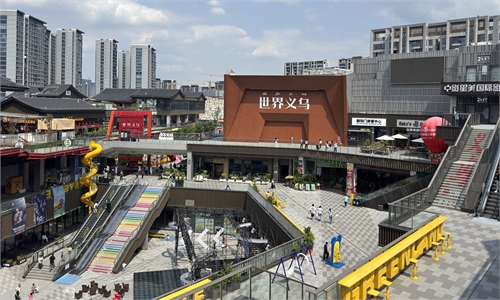
International buyers inquire about products from a vendor at the Yiwu International Trade Market in Yiwu, East China's Zhejiang Province, on April 25, 2026. Photo: Chen Qingrui/GT
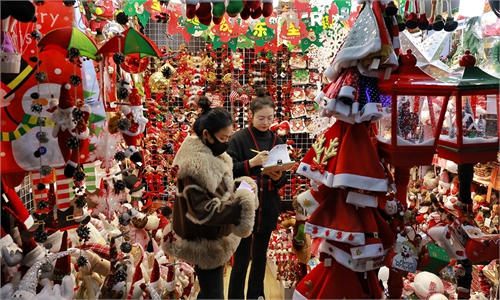
In Yiwu, the world's largest small commodities trade hub and a major global center for Christmas goods, the export season is already in full swing. Local merchants told the Global Times that overseas buyers are placing orders earlier each year, keeping businesses increasingly busy.
Yiwu Customs data showed that the city's Christmas goods exports totaled 2.14 billion yuan ($316 million) in the first half of the year, up 20.4 percent year-on-year, China Media Group reported on Sunday.
In the city where diversified foreign trade continues to shine, the steady stream of new designs and innovations offers a glimpse into the resilience and vitality of China's export sector.
For Yiwu businesses, the ability to quickly adapt to changing market demand has become a key advantage, as overseas buyers are placing orders earlier and seeking more diverse product designs this year.
Chen Xiaofang, head of Hao Hao Christmas Clothes Decoration in Yiwu, told the Global Times on Sunday that most of the company's orders have already been shipped, with deliveries expected to largely wrap up by the end of August.
In previous years, European buyers typically placed orders between June and August, while this year, purchasing started much earlier, as overseas customers sought greater certainty in supply chains, according to Chen.
"Customers are placing orders earlier and earlier each year," Chen said, noting that uncertainties surrounding international logistics and geopolitical tensions have prompted overseas buyers to leave more time for transportation and production.
Another Yiwu-based Christmas product manufacturer, Jiang Jiangping, has seen a similar shift after three decades in the industry. As head of Junhong Christmas Apparel & Gift Factory, Jiang told the Global Times that overseas buyers started visiting Yiwu and placing orders shortly after the Spring Festival, much earlier than usual, keeping the factory busy for most of the year.
Facing heavier order schedules than in previous years, Chen and Jiang have continued to push forward with product innovation. Overseas buyers are still picking up both classic designs and new arrivals, but it is the latest creations that often draw the most attention, Chen told the Global Times.
Jiang said that the company has built an eight-member design team to monitor overseas trends and integrate popular elements into new products. With the help of artificial intelligence (AI)-assisted design tools, the team can develop new products much faster, with more than 400 new designs launched this year alone.
Meanwhile, with more than 1,000 types of Christmas textile products, including hats ranging from low-cost basic items to higher-end designs, Chen's company has adjusted its offerings to meet different market preferences. The company's orders this year have mainly come from Latin America, Europe, Russia and Central Asia, while demand from India and Africa has also increased, Chen said.
From World Cup merchandise to the upcoming overseas holiday shopping season, Yiwu has continued to play a pivotal role in global trade supply chains this year.
The experience of Yiwu's festive goods sector reflects a broader trend in China's foreign trade: strengthening resilience through flexible supply chains, rapid innovation and diversified markets, Chinese experts noted.
China's strong manufacturing capacity and improving design capabilities are key factors behind the competitiveness of Chinese products in global markets, said Bian Yongzu, executive deputy editor-in-chief of Modernization of Management magazine. He told the Global Times on Sunday that while China previously focused more on manufacturing for overseas brands, Chinese companies have increasingly developed their own product design capabilities by gaining a deeper understanding of global cultures and consumer preferences. "This shift has enabled them to create products that better meet international demand, further strengthening the global appeal and market presence of Chinese goods."
Chinese experts said that the resilience of China's foreign trade has been built over years and is not a short-term phenomenon. Despite uncertainties in the global trade environment, they said that China can maintain active participation in international trade in the second half of the year.
Official data showed that China remains a major force in global trade despite persistent geopolitical uncertainty.
China's total goods trade exceeded 25 trillion yuan in the first half of the year for the first time, up 3.68 trillion yuan from the same period last year, Wang Jun, deputy head of the General Administration of Customs said during a press conference on July 14. Monthly trade topped 4 trillion yuan for four consecutive months, Wang said, noting that international data showed that China remained the world's largest trader in goods.
RELATED ARTICLES