Chinese EV maker Zeekr revises cross-border policies after a car’s smart features were locked out for 30 hours in Kazakhstan
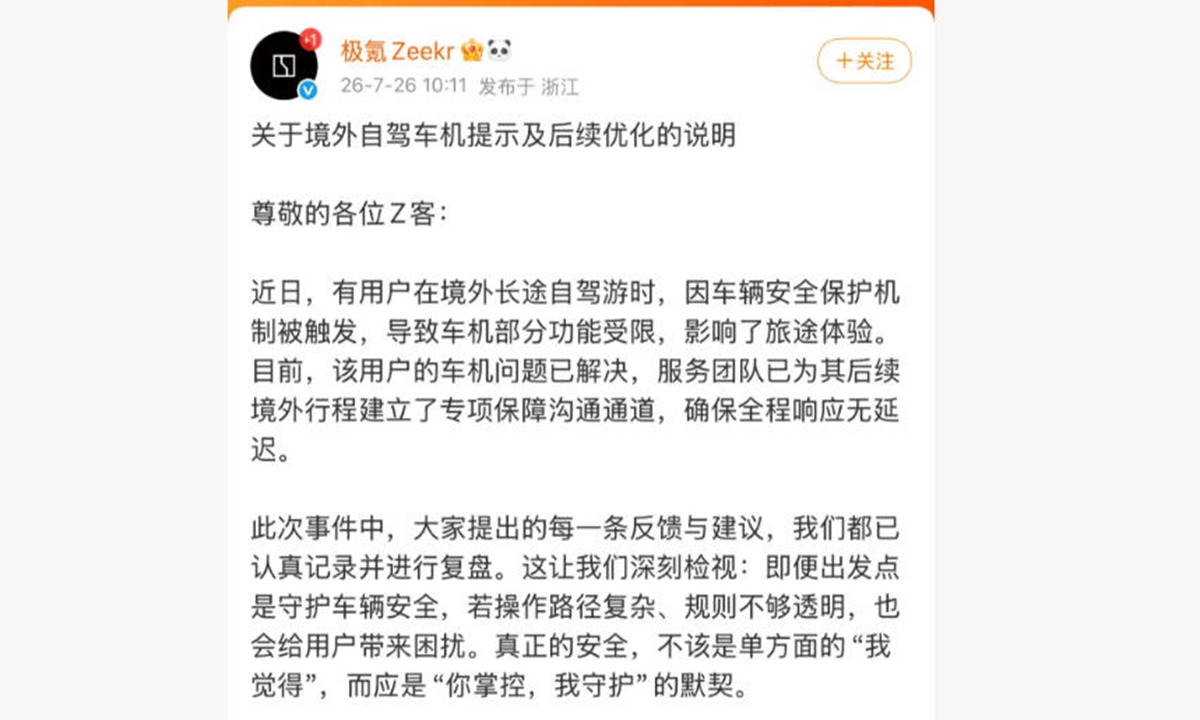
Chinese electric vehicle maker Zeekr has revised its cross-border vehicle policies on Sunday after a customer's car experienced a remote system restriction of up to 30 hours while overseas. Photo: Web
China's electric vehicle maker Zeekr has revised its cross-border vehicle-running policies after a car-owner experienced smart infotainment system restriction of up to 30 hours while overseas, sparking public debate over remote control mechanism in smart vehicles.
On July 16, a Zeekr owner surnamed Liu from Central China's Henan Province drove his Zeekr SUV into Kazakhstan during a self-planned trip to Europe. Shortly after crossing the border, the vehicle's infotainment screen displayed a "deactivation application" interface, after which restrictions remained in place for more than 30 hours. During this period, navigation, audio entertainment and the electronically controlled fuel tank flap became inaccessible. The vehicle retained basic driving capabilities, but the car owner believed the lockdown had affected his normal use of the car.
On Sunday, Zeekr issued a formal statement acknowledging that while the car's security mechanism was well intentioned, overly complex procedures and a lack of transparency had caused user inconvenience and the company announced immediate improvements including a self-service unlock feature launched on its app that allows drivers to obtain a verification code and complete the unlocking process.
The company is also developing a function for future over-the-air updates that gives car owners the choice to enable a "cross-border guardian" feature. The company decided to set up a 24-hour hotline to assist users now abroad or planning to travel overseas.
The incident was fiercely discussed on Chinese social media on Sunday. Some acknowledged the company's swift response and said they were reassured by the company actions. Others, however, said they are disappointed with the company for disabling functions without their consent and their driving rights were negatively affected.
The incident followed other cases in which the smart system in new-energy vehicles malfunctioned.
In February, a LYNK & CO owner crashed after the voice assistant mistakenly turned off the vehicle's headlights instead of the interior reading light while driving on an unlit road at night. The company apologized and installed a voice control fix and disabled shutting down of headlights via voice assistant during drive, according to the Securities Times.
Before the announcement on Sunday, Zeekr explained on July 23 that the restriction was caused by a built-in security mechanism activated when the vehicle's positioning system showed a sustained overseas location. The system is designed to prevent theft, illegal export, and smuggling, which the company said are standard measures adopted in the industry. The company emphasized that core systems including power, steering, and braking remained fully functional, according to the National Business Daily.
Liu Dingding, an industry analyst, told the Global Times on Sunday that the issue highlighted the need to clarify boundaries for EV makers so that they do not infringe upon consumer rights through remote control functions in the age of smarter vehicles.
"As intelligent functions advance at a faster pace, the industry needs to come up with solutions to prevent similar incidents from happening in the future," Liu said.
In recent years, the Chinese government has attached great importance to the OTA technologies used by intelligent and internet-connected vehicles with the aim to introduce a more rigorous, detailed, and user friendly policy framework.
RELATED ARTICLES