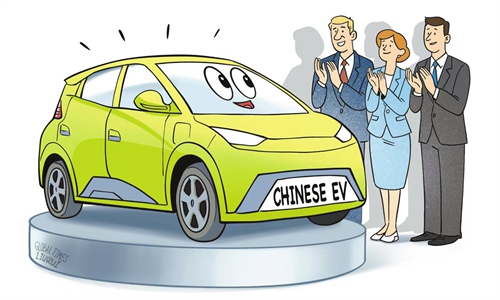
Do China's NEVs have an average lifespan of only 1.8 years?: Global Times editorial
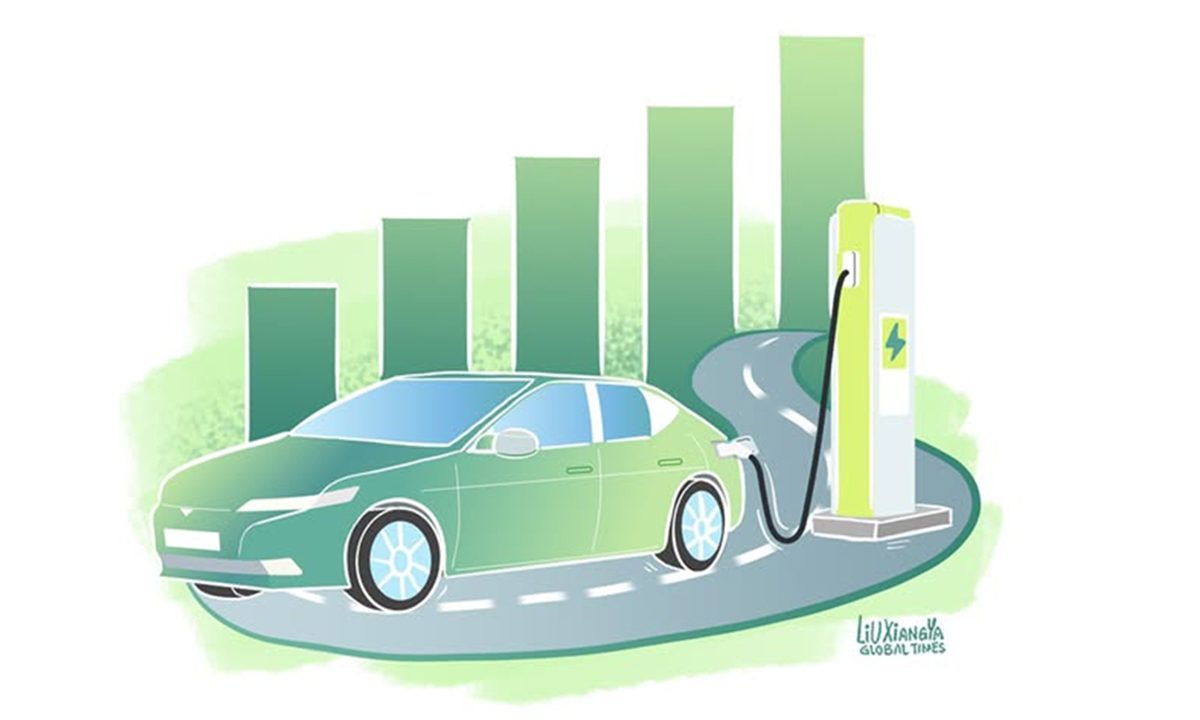
Illustration: Liu Xiangya/GT
Editor's Note:
Currently, China's economy is steadily advancing along the path of high-quality development, even as domestic and international circumstances become increasingly complex. Some Western media, due to misunderstanding or bias, have repeatedly questioned or even distorted China's economic development. Accordingly, the Global Times launches the "Q&A on China's Economy" column to publish opinion pieces to present facts and clarify perceptions.
Do China's NEVs have an average lifespan of only 1.8 years? Recently, some foreign media outlets and independent content creators cited partial data from the 2025 China Automotive Aftermarket Annual Development Report, claiming that "Chinese EVs are replaced faster than mobile phones," subsequently playing up the narrative that Chinese new energy vehicles (NEVs) have "short lifespans" and are "fast‑moving consumer goods," facing a "kill line" in terms of service life or mileage. These assertions are built on a series of conceptual misinterpretations of stock structure, consumer behavior and product longevity - not only misreading the data but also misjudging the prospects of NEVs.
The "1.8 years" mentioned in the report appears in the complete statement: "The average age of the overall stock of new energy passenger vehicles is about 1.8 years." Specifically, it refers to the average time since sale for all NEVs in China's vehicle stock as of the end of 2025. That is simply the average age of the vehicles on the road - it does not mean that "consumers replace their cars every 1.8 years on average," nor does it imply that the "average service life" of NEVs is only 1.8 years. In the US, the average age of battery electric vehicles in 2024 was about 3.5 years, yet no one concludes from that figure that their lifespan is just 3.5 years. Distorting "a young fleet" into "a short‑lived vehicle" fundamentally misrepresents the "youthfulness" caused by China's explosive growth in the NEV industry as accelerated obsolescence, thereby misleading consumers about the durability and long‑term value of NEVs.
With NEV sales recording rapid growth for many consecutive years, the continuous influx of newly sold vehicles into the statistical sample has inevitably lowered the average age of China's overall vehicle fleet. In 2015, China became the world's largest NEV market, with annual sales reaching 330,000 units. By 2021, that figure had surpassed 3.5 million units. In 2025, the domestic sales of new-energy passenger vehicles climbed to 13.875 million units in China, with the market penetration rate exceeding 50 percent, representing more than a 40-fold increase over the past decade. Data from the Ministry of Public Security show that China's NEV stock grew from 4.92 million at the end of 2020 to 43.97 million at the end of 2025. In 2025 alone, 12.93 million new NEVs were registered, accounting for 49.38 percent of all newly registered vehicles. For an industry where nearly 30 percent of the existing fleet was added in just that one year, the average vehicle age is naturally low. This is a basic issue of statistical structure, and it has no direct bearing on vehicle quality or scrappage rates.
Using the replacement cycle of fuel‑powered vehicles as a benchmark to judge whether NEVs are "durable" is probably outdated. In the past, the core technology of fuel vehicles lay in mechanical hardware such as engines and transmissions; automakers had little incentive for high‑frequency iteration, and consumers have naturally developed the ingrained habit of thinking that "a fuel car should be kept for at least seven or eight years." But the core competitiveness of NEVs lies in more powerful computing, longer range and more advanced intelligent driving functions. The development cycle for new NEV models in China has been compressed from the typical five years of traditional automakers to as fast as 18 months, with batteries, electrical/electronic architectures and intelligent functions being upgraded significantly faster. In addition, as Gen Y and Gen Z - who are highly sensitive to new things - become the mainstream consumers of NEVs, the car‑buying habits are inevitably undergoing a generational shift.
Rapid technological iteration is one of the defining features of the fast-growing NEV market. The accelerated speed of launching new products does not mean a shorter safe and reliable service life of vehicles. NEVs increasingly adopt platform‑based development, modular components and hardware‑software decoupling architectures, allowing multiple models to be derived from the same platform. Mobile phones are released annually with new models, but that does not mean the previous products immediately becomes useless; similarly, NEVs can improve functionality through over‑the‑air software updates. Rapid technological iteration also drives continuous progress in battery energy density, safety, energy management, intelligent driving and in‑cabin experiences, fostering competition among companies based on technology and user experience.
The fast innovation is not equal to "fast‑consumption." Whether NEVs are durable should be judged by safety standards, quality performance and long‑term operational data. Since 2016, China has required passenger car manufacturers to provide at least an 8‑year or 120,000‑kilometer warranty for core components such as batteries, motors and electronic controls. The Code of practice for NEVs safety operation inspection, implemented in March 2025, further includes battery, electrical system and drive motor in mandatory inspections. The first large‑scale batch of NEVs is now entering the eighth year and beyond of use; what truly needs to be observed are battery health, failure rates, maintenance costs and scrappage rates.
In judging vehicle lifespan, it is also important to distinguish between "technically unable to continue operating" and "voluntary replacement due to price, configuration or consumer preference": a vehicle that enters the second‑hand market because its owner wants to upgrade the smart cabin is not necessarily no longer usable; a drop in second‑hand prices does not directly prove a decline in safety or durability. At this stage, there is no authoritative data proving that the average lifespan of NEVs is only three to five years, nor can one deduce a "service life of 1.8 years" from an "average vehicle age of 1.8 years."
China's NEV sector has moved beyond the stage of simply establishing existence and is now entering the critical phase of addressing quality, durability and value. In the future, stricter durability standards, more transparent battery testing, more stable software services, and better second‑hand vehicles recycling systems will be needed to address consumer concerns. The Chinese automotive industry is by no means pursuing the goal of turning cars into fast‑moving consumer goods; rather, it seeks to make green mobility more reliable, more economical, more sustainable and more stylish.
RELATED ARTICLES