Sanitation workers' AC vests, phase-change cooling garments show care for people in urban governance
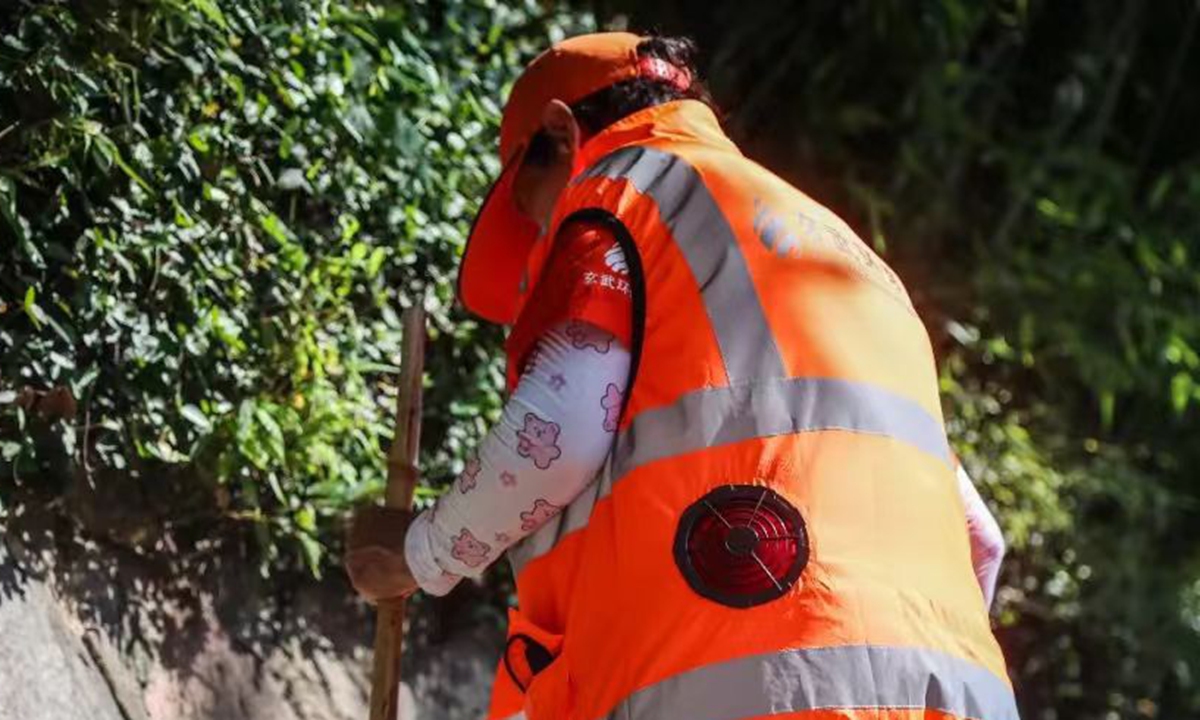
A sanitation worker in air conditioning vest Photo: CCTV News
Amid sweltering summer heat, some sanitation workers in Nanjing, East China's Jiangsu Province have recently been equipped with "air conditioning vests" which can make outdoor work in sanfu more comfortable. This has added to the high-tech toolkit that Chinese cities use to improve working conditions in summer.
Since the start of this year's sanfu season, more than 20 AC vests have been distributed to Xuanwu district in Nanjing. The high-tech vest looks much like a standard reflective uniform, and the key difference is that each side of the vest is fitted with a small, low-noise fan with three speeds. They can improve the air circulation inside the vest and dissipate body heat of the wearer, CCTV News reported Monday.
The fans are powered by a portable power bank and can be used continuously for three to four hours on a full charge. A recharge during the lunch break is sufficient to power workers through the afternoon.
Zhu Wenxian, among the first batch to try this vest, said that the garment significantly reduced heat stress by generating breeze from the waist and cooling the upper body. "The noise can barely been heard," Zhu said.
Nanjing's urban management bureau is promoting the AC vest citywide to equip more outdoor workers. And this vest is hailed by many netizens who call for nationwide promotion of the gear.
There are other innovative cool technologies. In Changzhou of Jiangsu Province, a local technology company has donated its 131 self-developed phase-change cooling vests to local sanitation workers. The phase-change cooling garment provides 2.5 to 4 hours of cooling, helping workers reduce heatstroke risks and work more safely in high-temperature conditions.
Li Rui, a representative of Carbon-Based company headquartered in Shenzhen which has developed phase-change cooling vest alongside cooling neck ring and cooling hat, told the Global Times that the key technology behind such products is phase-change materials. Such materials regulate temperature by absorbing and releasing large amounts of heat through physical state changes without significant temperature fluctuations of their own.
Like an "energy sponge," phase-change materials absorb heat at high temperatures and release it when temperatures fall, providing automatic temperature regulation while avoiding the risk of excessive cooling - such as the extreme cold from ice - that could overstimulate the neck and potentially trigger sudden health problems, Li said.
In Southwest China's Sichuan Province, a research team also developed a power-free cooling hat that can control internal temperature down to 28.4 C in contrast to 44.6 C inside a normal hat. The technology, through adjustments in material and structures, can control solar reflection and thermal radiation, enabling effective cooling without electricity, reported ynet.com which is affiliated with Beijing Youth Daily.
Indirectly, electricity workers are also using drones and electric lifting platforms to minimize human labor in power line check and maintenance. Climbing on such power pole needs one hour while the mechanical tools shorten that to 10 minutes with little human efforts in the process.
The workers can also use laser tools to remotely remove tree obstructions near power lines, eliminating the need for climbing or power shutdowns while improving grid safety and efficiency.
From tech-powered cooling gadgets to tools that help minimize outdoor laboring, the summer heat is testing operation of infrastructure and urban functioning, as well as the wisdom and care for people in city governance, observers said.
RELATED ARTICLES