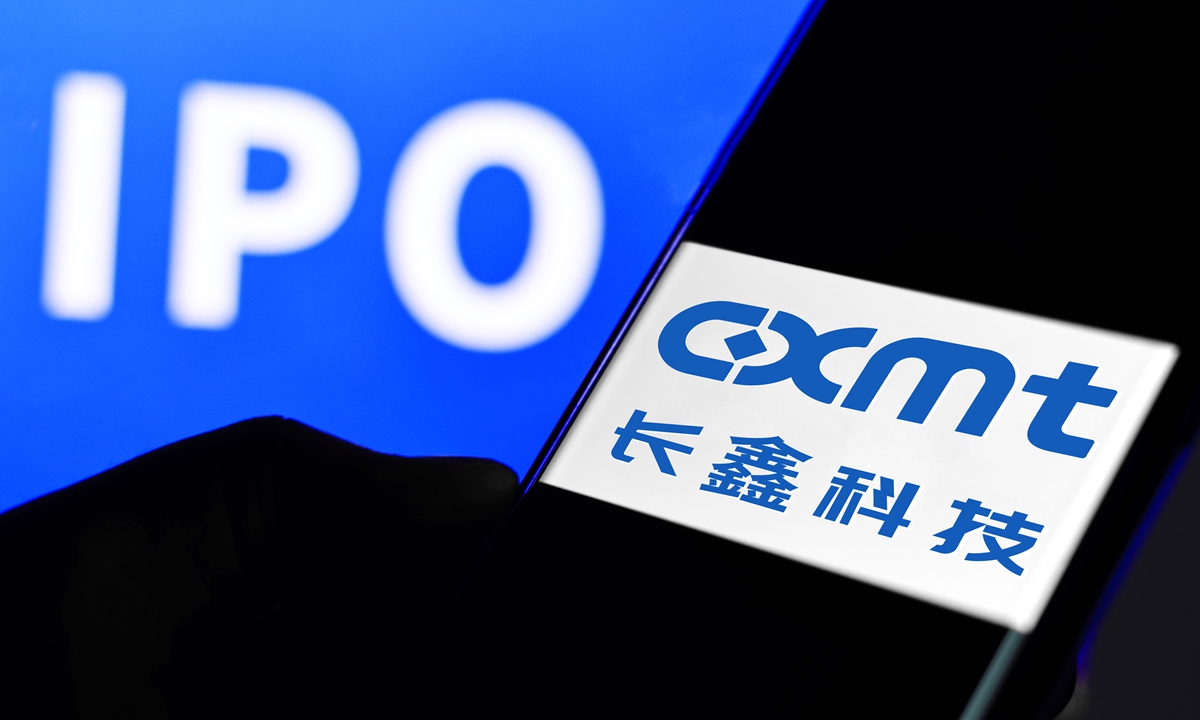
Chinese memory chipmaker CXMT File Photo: VCG
CXMT's market debut has drawn widespread international attention. A single technology company breaking through external constraints to catch up with, compete alongside, and even surpass global peers - while fostering an ecosystem of hundreds of upstream and downstream firms - is a story that is being repeated across China.Monday marked a historic day in China's capital markets. CXMT (ChangXin Memory Technologies), a leading domestic producer of dynamic random-access memory (DRAM) chips, officially debuted on the Shanghai Stock Exchange's STAR Market. On its first trading day, its shares skyrocketed by 465.82 percent, pushing its total market capitalization past 3.28 trillion yuan and propelling it to the top of the A-share market cap rankings. CXMT not only became the first A-share stock to break 100 billion yuan in single-day trading volume, but it is also the first semiconductor hard tech enterprise to claim the top spot in A-share market capitalization in its 35-year history. This phenomenal debut sends a clear and strong signal to the outside world: Hard tech is taking center stage in China.
Memory chips are the fundamental "industrial grain" of the digital age. CXMT has achieved independent, large-scale mass production of DRAM, breaking the long-standing monopoly held by overseas giants. Its impressive performance in the capital markets serves as a symbolic example of China's breakthrough in the field of high-end semiconductor manufacturing. For a long time, the global DRAM market was dominated by three giants: Samsung, SK hynix, and Micron, which together accounted for around 90 percent of the global market share. CXMT is the fourth enterprise globally, alongside these three, with the full capability for independent DRAM research, development, and production. Over the span of a decade, CXMT has bridged the gap from zero to one, leaping from mass production of DDR4 to DDR5.
This journey mirrors the evolution of China's semiconductor industry from scratch to catching up and running neck-and-neck. It reflects the capital market's optimism toward the development of China's semiconductor industry, as long-term investments of patient capital begin to yield returns on hard-core technology.
CXMT's market debut has drawn widespread international attention, largely because it symbolizes not only the direction of China's economic transformation, but also the remarkable momentum and vitality of the country's technology companies. A single technology company breaking through external constraints to catch up with, compete alongside, and even surpass global peers - while fostering an ecosystem of hundreds of upstream and downstream firms spanning equipment, materials, packaging, and testing - is a story that is being repeated across China. From advanced computing and industrial software to new energy and high-end manufacturing, a growing number of innovation-driven companies are continuing to expand, strengthening the foundations of the real economy. Today, technology firms account for nearly half of the top 10 companies on China's A-share market by market capitalization, reflecting a fundamental shift in how investors value the market. Behind today's Chinese capital market lies a new narrative of high-quality economic development centered on technological self-reliance and innovation-driven growth. It points to a deepening integration of capital and technological innovation that will continue to provide lasting momentum for greater industrial self-reliance and strength.
The changing composition of the A-share market's largest company also reflects the continuous evolution of China's economic growth drivers. In the past, market leaders derived their value primarily from resource endowments and economies of scale. Today, investor attention is increasingly focused on advanced manufacturers tackling critical core technologies. With consistent policy support, patient industrial capital, and an increasingly sophisticated talent pipeline, multiple forces are working together to foster a stronger virtuous cycle between the capital market and the real economy. Abundant capital is being converted into the financial resources that technology companies need to sustain their growth, enabling advanced manufacturers to continuously invest in process improvements, capacity expansion and breakthroughs in frontier technologies. This gives them greater confidence to compete head-to-head with global industry leaders in the international chip market and to strengthen the foundations of China's domestic industrial chains amid intensifying global competition.
At the same time, enthusiasm should be tempered with realism. The memory chip industry is highly cyclical, and it remains uncertain whether the surge in prices and demand fueled by the current global AI boom can be sustained. Moreover, CXMT still trails leading US and South Korean competitors by roughly two to three technology generations in the most advanced manufacturing processes, while external constraints, including restrictions on access to EUV lithography equipment, continue to pose significant challenges. The company's soaring valuation reflects not only investors' high expectations for domestic technological substitution but also a degree of short-term market exuberance. For CXMT, reaching the top of the market capitalization rankings is a milestone - but also the beginning of a new stress test. The real challenge for this hard-tech company lies in sustaining R&D investment through industry cycles, keeping pace through architectural innovation despite equipment restrictions, and establishing a firm foothold in the market with competitive products.
The road ahead is long, but the direction is unmistakably clear. The title of China's most valuable listed company may change with market cycles, but the country's transition toward an innovation-driven economy will not. At a time when economic globalization is facing headwinds and technological competition is becoming increasingly complex, only by securing control over core technologies can we navigate future industrial competition with stability and achieve long-term success.
We look forward to seeing more "hard tech" companies tackling "bottleneck" challenges thrive with the support of the capital markets.
RELATED ARTICLES