China's CAS Space advances reusable rocket tech; Lihong-2 set for maiden flight this year as firm builds space-to-ground transport
By Published: Jul 28, 2026 11:39 AM

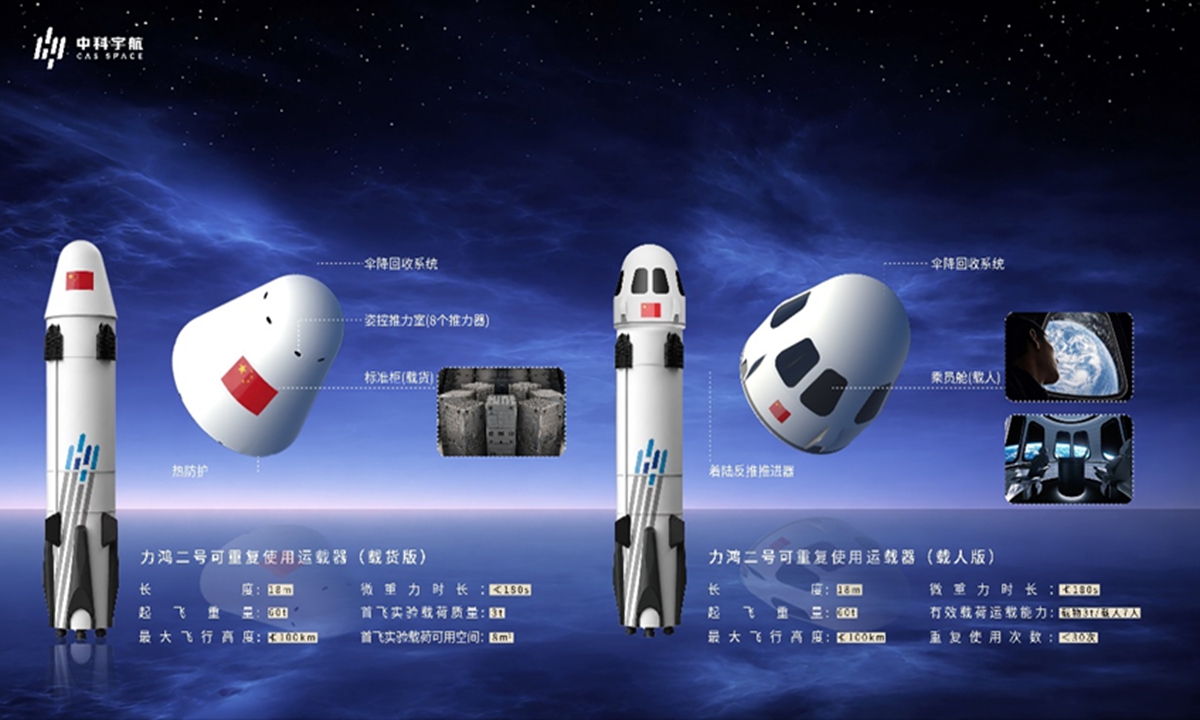
An illustration of the Lihong-2 reusable spacecraft Photo: courtesy of the CAS Space
Chinese commercial aerospace company CAS Space, in partnership with the Institute of Mechanics of the Chinese Academy of Sciences, has co-founded a key laboratory of engineering mechanics and flight control, the Global Times has learned from the CAS Space on Tuesday. Such setup, per the firm, aims to break through the core technologies of reusable launch vehicles and building a collaborative industry-academia-research stronghold to support commercial spaceflight.
Currently, CAS Space's rocket recovery and reuse technology is transitioning from key technology breakthroughs and ground testing to flight verification, read a statement the firm provided to the Global Times on Tuesday. Leveraging the Lihong series of reusable launch vehicles, the company is building round-trip space-to-ground transportation capabilities.
The Lihong-2 reusable launch vehicle serves primarily as a platform for verifying key rocket recovery and reuse technologies, as well as for microgravity experiments. It is used to conduct technology validation for rocket recovery and reuse, scientific experiments, and preliminary technology verification for space manufacturing. The vehicle has completed the design phase and has fully entered the engineering development stage. Large-scale ground tests are currently underway, with the first flight and hundred-kilometer-class recovery verification planned for this year, according to the statement.
Wang Yingcheng, Executive Vice President of CAS Space Innovation Research Institute, told the Global Times on Tuesday that the upcoming maiden flight of Lihong-2 will carry a space pharmaceutical payload - a fully automated space protein crystallization device.
Focused on drug development for major diseases such as lung cancer and cardiovascular conditions, the mission will evaluate the device's fully automatic operation and the adaptability of its crystallization process to the space environment, according to Wang.
The flight will also carry an unattended robotic system to verify the robot's operational performance and stability in typical space environments, including microgravity and high vacuum. In addition, wearable monitoring devices for space tourism will be tested. These devices will collect and analyze simulated human physiological data generated by digital vital signs simulators, issue abnormal alerts, and provide early technical validation and data support for passenger health and safety monitoring in future space tourism missions, he further elaborated.
The Lihong-3 spacecraft, on the other hand, is oriented toward long-term in-orbit scientific experiments and space manufacturing missions. It focuses on building capabilities for payload upload, in-orbit operations, unmanned experiments, re-entry and return, and sample recovery. Its maiden flight and in-orbit verification are scheduled for 2028, the CAS Space revealed.
Together, the Lihong-2 and Lihong-3 products will provide the space-to-ground transportation capabilities required for space manufacturing and space applications. They will gradually form a closed capability loop of "suborbital verification - orbital testing - return analysis - iterative improvement," laying a reliable foundation for future space manufacturing and space applications.
It is worth noting that the main propulsion system of Lihong-2 is equipped with the Liqing-1 pin-injector liquid oxygen/kerosene engine, independently developed by CAS Space.
To meet reusability requirements, the R&D team deeply investigated the wide-range dynamic spray combustion mechanism of pin-injector engines, established an atomization combustion simulation platform, and combined data-driven algorithms to optimize control strategies.
This enables continuous deep throttling from 40 to 100 percent with a thrust regulation accuracy of up to 1 percent. The engine supports multiple reliable restarts, features fast dynamic response and precise thrust control, and can meet both ascent mission demands and perform sustained powered deceleration, trajectory correction, and vertical landing buffering during the return phase. It provides critical power support for multi-condition flight of reusable rockets and ensures core power assurance for safe and controllable recovery missions.
Earlier in January, the CAS Space has completed its suborbital flight test mission in Northwest China. Using a parachute-recovery system, the recoverable payload capsule landed safely and was retrieved at the Jiuquan Satellite Launch Center. Designated Lihong-1 Y1, the spacecraft can reach altitudes of approximately 120 kilometers. It has low launch costs, a high level of flexibility, and the capability to recover experimental payloads.
RELATED ARTICLES