Takaichi slammed for ‘playing word game’ in remarks on ‘communicating’ with China, and evading source of tension
By Published: Jul 28, 2026 12:52 PM

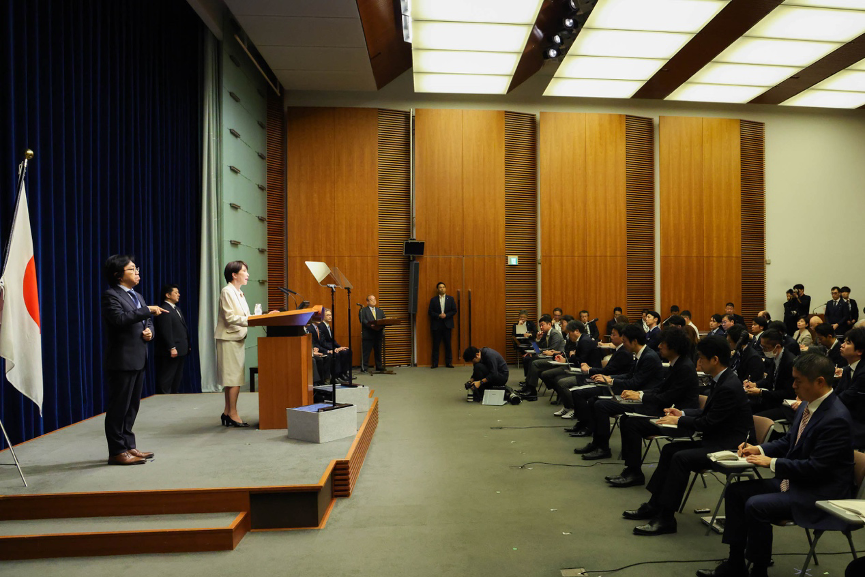
Japanese Prime Minister Sanae Takaichi holds a press conference at the Prime Minister's Office in Tokyo on July 27, 2026. Photo: Japanese Prime Minister Office
Japanese Prime Minister Sanae Takaichi's latest remarks that Japan would "continue communicating" with China and that she was "looking forward to the APEC leaders' meeting" were dismissed by a Chinese expert as lacking sincerity and rhetorical maneuvering aimed at deflecting mounting domestic criticism on her government's stalled bilateral relations with China. The expert said Takaichi continued to evade the source of the tensions - her provocative, erroneous remarks on China's Taiwan - and noted that hype of possible bilateral meetings with China cannot mask that reality.
Takaichi held a press conference at the Prime Minister's Office in Tokyo on Monday to explain her government's policies on domestic issues, including inflation. During the question-and-answer session, a reporter from TBS News asked what specific steps Takaichi intended to take to improve strained Japan-China relations. The reporter also noted that an APEC leaders' meeting is scheduled to be held in China in November and asked about the current status of preparations for a possible meeting with Chinese leader, according to a video released by the Prime Minister's Office on YouTube.
In response, Takaichi claimed that, since taking office, her government had "consistently promoted a strategic mutually beneficial relationship with China and built a constructive and stable relationship." She also claimed that "I look forward to the APEC leaders' meeting."
However, Lü Chao, a professor at the Liaoning Academy of Social Sciences, said the exchange between Takaichi and the Japanese reporter was filled with misinformation and Takaichi was "playing word games" to mislead the public and shift blame.
Takaichi's erroneous remarks on the Taiwan question last November crossed China's red line and triggered the downward spiral in bilateral relations. China has continued to demand that Takaichi formally retract her remarks and apologize.
Yet Takaichi continues to evade this core issue and refuses to change her provocative stance. As long as that position remains unchanged, no amount of rhetorical gymnastics, wordplay or hyping foreign ministers' "exchanges" can obscure the truth or shift the blame, Lü told the Global Times on Tuesday.
During the Monday press conference, the TBS reporter claimed in his question that Japanese Foreign Minister Toshimitsu Motegi "had held talks" with his Chinese counterpart on the sidelines of ASEAN-related foreign ministers' meetings in the Philippines and this appears to suggest that "dialogue between the two foreign ministers might be resuming."
While in her response, Takaichi claimed that "Japan was engaging with China at various levels, including through Foreign Minister Toshimitsu Motegi," and would continue communicating with the Chinese side while responding "calmly and appropriately" from the perspective of Japan's national interests.
However, Chinese Foreign Ministry spokesperson Lin Jian had made it clear on both July 23 and July 27 that no contact had taken place between the two foreign ministers.
"I answered this question last week. To put the record straight, I repeat, Foreign Minister Wang Yi did not meet with the Japanese side in Manila and never scheduled such a meeting. No contact or exchange of words ever took place there," Lin said on Monday.
This is not the first time Takaichi government has publicly floated the prospect of meeting with the Chinese side. In November 2025, despite repeated statements from the Japanese side that it remained open to dialogue and contact with China, the Chinese Foreign Ministry said Chinese Premier Li Qiang had no plans to meet with the Japanese leader on the sidelines of the G20 summit.
"The Japanese side should show some self-respect," Foreign Ministry spokesperson Mao Ning said at the time.
Lü said that the deterioration in China-Japan relations has also taken a toll on Japan's exports and tourism industry, leaving ordinary Japanese people to bear tangible economic losses. However, Takaichi's professed willingness to communicate with China and improve bilateral ties amounts to little more than empty rhetoric aimed at deflecting domestic criticism. Her statements have not shown any genuine sincerity or concrete intention to ease tensions, the expert said.
"The root cause of the downturn lies in the Takaichi administration's anti-China policy and her efforts to rally Japan's far-right forces in pursuit of renewed militarism," the expert said. "No amount of rhetoric can change the fact that its provocative approach has driven bilateral relations into a downward spiral."
RELATED ARTICLES