China completes first in-orbit test of 400V space power system, paving way for future high-power spacecraft missions including manned lunar exploration
By Published: Jul 28, 2026 02:49 PM

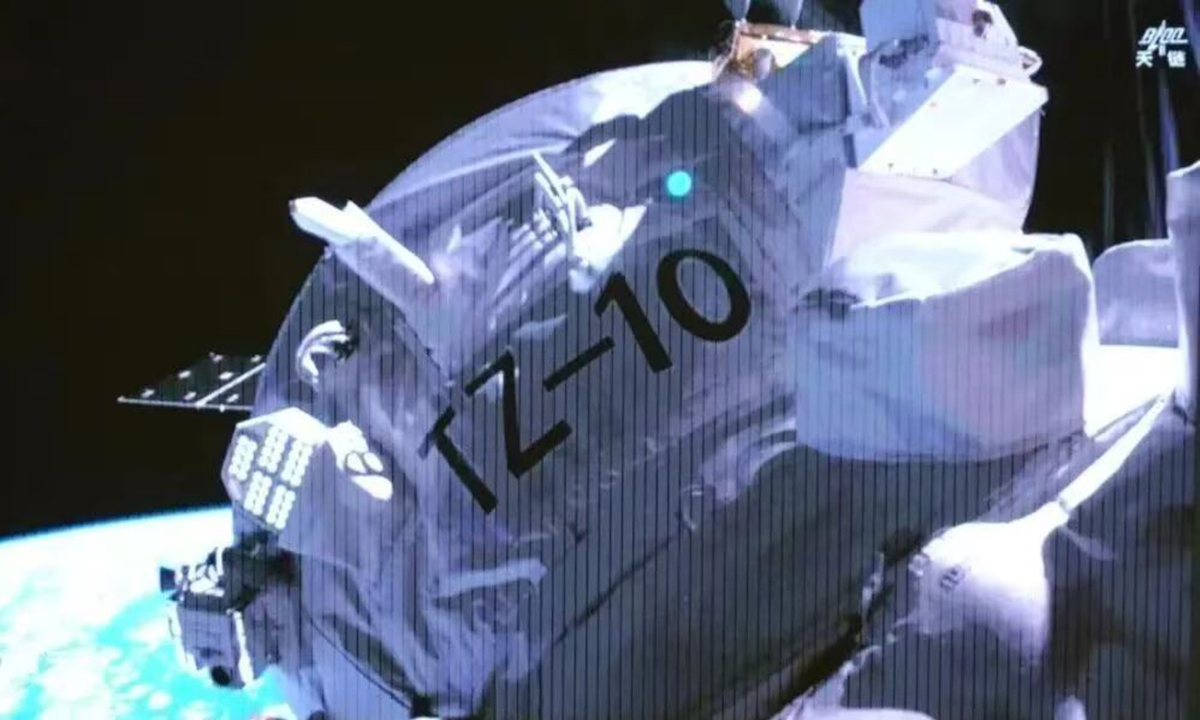
Tianzhou-10 cargo spacecraft orbits the Earth. Photo: courtesy of the China Academy of Spacecraft Technology (CAST)
A new-generation space power system developed by China has successfully completed all in-orbit tests aboard the Tianzhou-10 cargo spacecraft, marking the first time worldwide that a 400-volt (400V) bus power system has been applied in orbit, according to the system developer.The project was led by the Institute of Manned Space System Engineering under the China Academy of Space Technology (CAST), also known as the Fifth Academy of China Aerospace Science and Technology Corporation (CASC), with participation from multiple research institutes and industry partners.
All test results met the designed technical requirements, with the system operating stably in orbit, demonstrating the feasibility and reliability of the new power architecture, the developer said.
According to a Chinese senior space technology expert, such new power system would likely serve as a fundamental energy platform for major aerospace ventures including manned space exploration and building of lunar research center.
Space power systems serve as the "energy heart" of spacecraft, with their performance directly affecting payload capacity, operational lifespan and the expansion of mission capabilities. As major space programs advance rapidly, spacecraft are increasingly moving toward higher power output, greater reliability, longer-duration operation and stronger adaptability to complex environments, per the developers.
Traditional low-voltage power bus systems are becoming insufficient to meet the growing energy demands of next-generation spacecraft, according to the project team.
To address these challenges, CAST has identified high-voltage, high-power power control technology as a key area under its core technology development program and launched research and in-orbit validation efforts.
During the development process, the team overcame a number of technical challenges, including high-voltage insulation protection and system reliability in the space environment. Multiple performance indicators of the system have reached internationally advanced levels.
After the Tianzhou-10 spacecraft entered orbit, the verification system conducted two dedicated in-orbit tests, which comprehensively validated its reliability and environmental adaptability in space.
The project has achieved independent control over the complete technology chain and core components of the 400V space power system, covering power generation, energy storage, control, distribution and transmission, the CAST highlighted.
The project team said it will continue optimizing system performance and strengthen China's space energy technology foundation, supporting major future missions including crewed lunar exploration programs.
Senior space science expert Pang Zhihao said that this 400V bus-based space power system has significant advantages over traditional low-voltage power supply architectures of 28V and 100V.
Pang, who is also a retired researcher from the CAST, explained that under the same transmission power, it can substantially reduce current, thereby significantly lowering the weight of spacecraft power cables and reducing power losses in transmission lines. It also greatly eases thermal management requirements. By leveraging silicon carbide (SiC) components to improve energy conversion efficiency, the overall power system can be made smaller and lighter, freeing up more space for payloads. With supporting technologies including solid-state power distribution and high-voltage insulation protection, the system can withstand space radiation and extreme temperature variations, while offering greater stability and fault tolerance for high-power electricity supply, enabling the continuous operation of megawatt-level equipment.
This technology serves as a fundamental energy platform for crewed lunar exploration, Pang told the Global Times on Tuesday. "It can provide efficient and sustained power for high-power electric propulsion systems on lunar spacecraft, lunar lander equipment, and lunar rovers. Its significant weight reduction can lower rocket launch costs and increase payload capacity for lunar missions."
Pang added that the system is also compatible with future lunar research station construction, meeting the long-term high-power electricity demands of lunar scientific instruments and astronaut life-support systems. The world's first in-orbit verification of this technology has overcome a key bottleneck in high-power supply for deep-space missions, laying a solid energy technology foundation for crewed lunar exploration and lunar base development, while also establishing the power supply framework for future missions to more distant destinations such as Mars, Pang said.
RELATED ARTICLES