Six arms at once, welding on vertical walls: Chinese robots step into real work sites
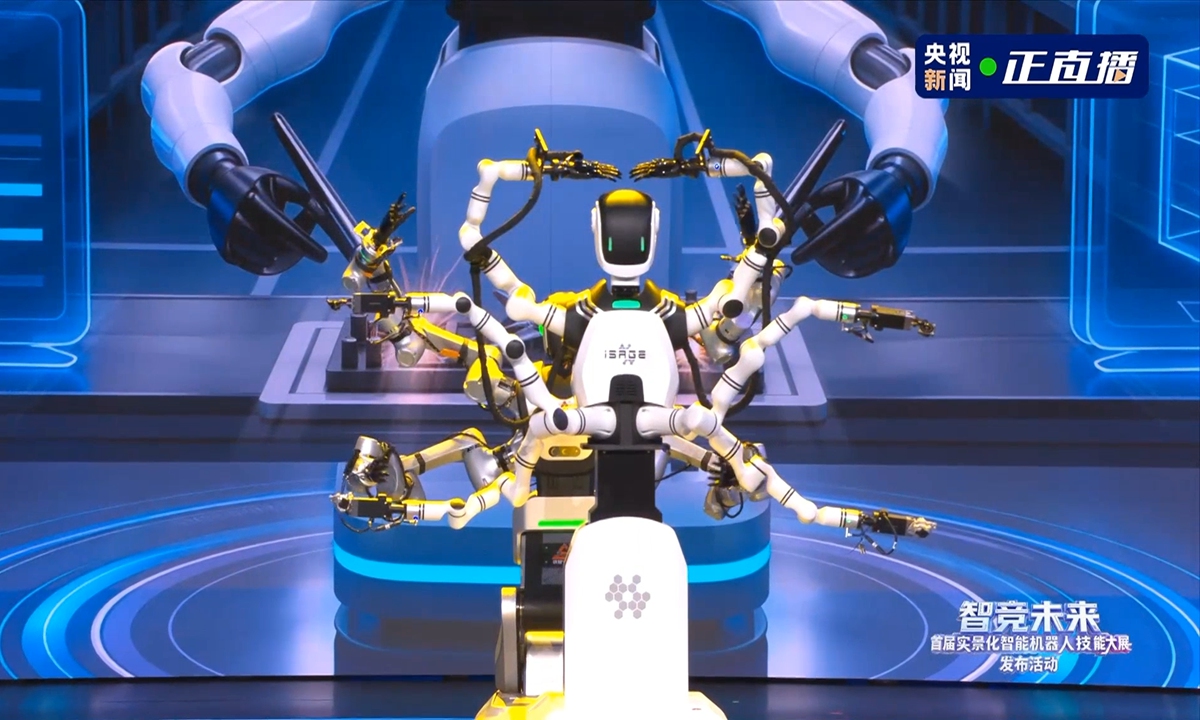
The hexa-armed embodied-intelligence robot "MAHAKBOT" Photo: Courtesy of iSAGEBOT
A robot working six arms at once, another scaling vertical walls to grind and weld, and a third repairing live power lines 10 meters above the ground took center stage in Beijing on Tuesday, as China puts a generation of domestically developed machines already deployed at real work sites on public display.
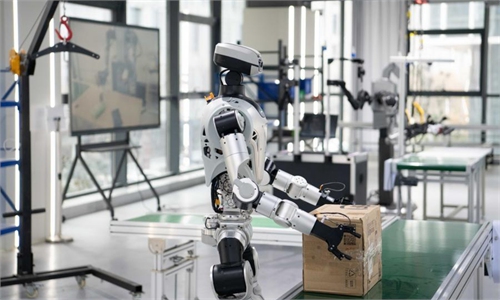
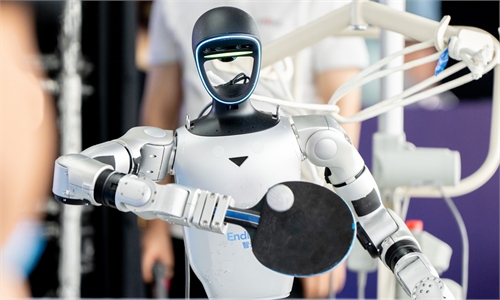
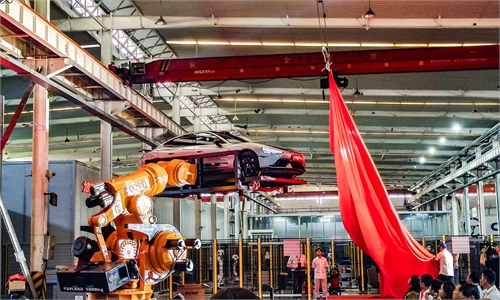
The machines were showcased at the launch event of China Media Group's (CMG) first intelligent robot application skills exhibition, which highlighted a shift in robotics sector from technology demonstrations to deployment on production and maintenance front lines.
Among them was MAHAKBOT, a hexa-armed embodied-intelligence robot developed by Shanghai-based iSAGEBOT. Guided by what the company calls a process-aware brain, it allocates its six arms according to the production line it serves, simultaneously handling loading and unloading, cable plugging and screw assembly with extremely fine precision, and it can take over jobs that expose workers to hazardous conditions.
What sets the robot apart is a heterogeneous spatial layout that gives each arm its own interference-free working envelope, the company told the Global Times. The arms can be grouped in multiple configurations - four to the front, four to the rear, three to each side, or two above and four below - to achieve collaboration across the full working space. A telescoping lift structure adds 300 millimeters of vertical adjustment.
"The world is tailor-made for humans," the company said, explaining that the robot keeps roughly human height while the extra range covers scenarios where that falls short. The machine offers up to 120 degrees of freedom body-wide when all end effectors are dexterous hands, and uses seven-axis force-controlled arms that combine rigidity with precision. Target applications span automotive and auto parts manufacturing, 3C electronics and the energy and power sector, the company said.
Also on display is China's first embodied-intelligence special-operations robot, which combines humanoid dual arms, magnetic wall-climbing capability and large-model intelligence. It can grind with one hand while welding with the other on the exterior walls of chemical storage tanks, ships and energy facilities, with operators wearing virtual reality goggles and holding a remote-control device to carry out high-risk tasks from a safe distance.
In power grid maintenance, a robot named "Antelope" can complete a full set of operations on its own, keeping technicians away from high-voltage risks, while a live-working distribution robot called "Sea Dragon" extends its arms to perform complex sequences on power lines 10 meters above the ground.
Robots are not a new concept, but the past two years have brought explosive growth driven by a convergence of factors - advances in materials and manufacturing, progress in artificial intelligence, supportive national policies and an inflow of capital, Liu Dingding, a veteran tech industry analyst, told the Global Times on Tuesday. The fundamental reason, the expert said, is that robots can now perform concrete work in specific scenarios.
In vehicle and new-energy manufacturing, some production chains now operate with almost no workers on the floor, relying on robotic arms, automated forklifts and material handling equipment, the expert said. On the consumer side, coffee-making robots and household machines are entering small-scale validation. Two humanoid robot marathons held over the past two years showed the industry that robots can reach into everyday work and life, Liu added.
"A robot is not a single brand," Liu said. "It is the result of materials science, artificial intelligence and industrial manufacturing coming together, backed by hundreds to thousands of supply chain companies working in concert. It reflects a country's comprehensive strength."
Behind these deployments is the rapid expansion of China's robotics industry. Chinese industrial robot exports have surpassed imports for the first time, with products sold to 156 countries and regions, according to a report released by the China Machinery Industry Federation and CMG at the event.
Domestic-brand industrial robots are now used across 253 sub-categories of China's national industrial classification system, a coverage rate that has risen by 12 percentage points over the past five years, said Song Xiaogang, secretary-general of the federation. Sales of domestic brands in the Chinese market have grown at an average annual rate of 29 percent over that period, taking a market share of more than 60 percent, with nearly 1 million units entering industrial use during the 14th Five-Year Plan (2021-25) period.
Real-world settings are becoming the proving ground for iteration. CCTV News announced it will launch the world robot Mount Tai climbing competition together with the city of Tai'an in East China's Shandong Province, using the stone stairway from Hongmen to Zhongtianmen as the course to test robots' perception, decision-making, execution, environmental adaptation and operational reliability.
RELATED ARTICLES