Newspaper features on Wang Hong’s Fields Medal win spark rare print-media craze, inspiring young Chinese
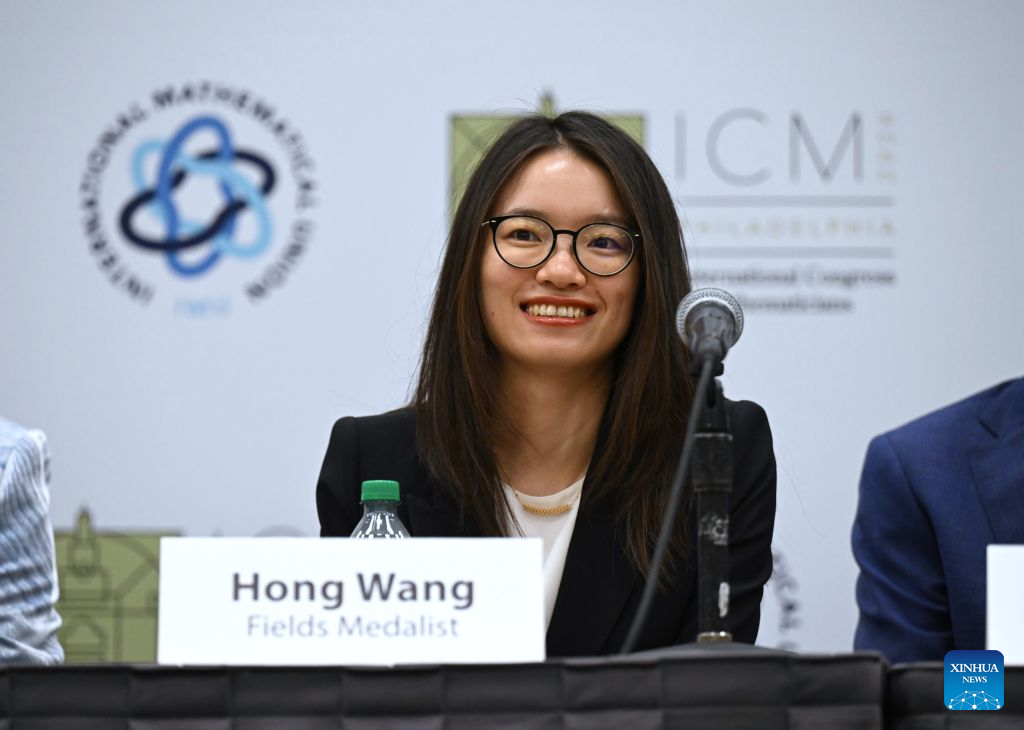
Chinese mathematician Wang Hong attends a press conference after the opening ceremony of the 2026 International Congress of Mathematicians in Philadelphia, the United States, July 23, 2026. Chinese mathematicians Deng Yu and Wang Hong were awarded the Fields Medals at the opening ceremony of the 2026 International Congress of Mathematicians held here on Thursday, marking the first time Chinese mathematicians have won the prestigious honor. The other recipients of the 2026 Fields Medals are American John Pardon and Canada's Jacob Tsimerman. (Xinhua/Li Rui)
A pair of front-page special reports honoring Chinese mathematician Wang Hong's historic Fields Medal victory have ignited an unprecedented nationwide scramble for physical newspapers, triggering a rare revival of print media in China's digital age.Wang was awarded the prestigious Fields Medal on July 23 at the opening ceremony of the 2026 International Congress of Mathematicians in Philadelphia. On July 25 and July 27, the Guangxi Daily published two prominent front-page special reports profiling her under the headline "Wang's Conjecture." In Chinese, the character "Wang" (王) is both her surname and the word for "king" or "queen," fittingly symbolizing her status as the "queen of mathematics."
The special coverage has fueled a frenzy among readers. Secondhand sellers have reportedly listed the two print issues at marked-up prices ranging from 20 to 100 yuan ($2.9 to $14.7) per copy, while internet users have dubbed the phenomenon a rare "print-media spectacle" in an increasingly digital world.
The July 25 edition of Guangxi Daily devoted nearly half of its front page to the feature story "Wang's Conjecture." On the newspaper's official Weibo account, comment sections were flooded with pleas for reprints and online purchase links, as brick-and-mortar outlets had completely sold out.
Xu Mingfan, a netizen based in Nanning, capital of Guangxi, told the Global Times that official online sale channel of the newspaper had crashed amid overwhelming visitor traffic, prompting her to hunt for vendors across secondhand trading platforms.
In her view, the public frenzy over the newspaper stems far beyond mindless speculation. "Wang hails from Guangxi. As ordinary folks and her fellow townsfolk, we yearn to preserve this shining milestone for a Chinese mathematician," she said.
Xu noted that she has never witnessed such an outpouring of grassroots enthusiasm for an international academic award. "In the past, winning global honors was viewed as an exclusive affair confined to academic circles. Today, we can feel the public has drawn much closer to science, cheering wholeheartedly for cutting-edge breakthroughs," Xu added.
In response to the overwhelming demand, the Guangxi Daily replied to readers' comments that its printing machines were working at full capacity to meet the surge in orders. The newspaper explained the public craze in a social media statement: "These pages record far more than Wang Hong's Fields Medal glory. They document a genuine life journey proving that one can still reach the finish line by going slowly and taking detours."
The profound resonance of the feature lies in Wang's life story. The 35-year-old mathematician hails from Guilin, South China's Guangxi Zhuang Autonomous Region. She was admitted to Peking University at age 16 and later pursued advanced studies in France and the US. Currently a permanent professor at France's Institut des Hautes Études Scientifiques, she collaborated with Joshua Zahl to solve the century-old Kakeya set conjecture in three dimensions in 2025 - a long-standing puzzle that had stumped the global mathematics community.
Her inspiring journey has touched a deep nerve among readers. Many praised the newspaper for putting top scientists on the front page, calling the gesture a powerful societal endorsement of basic scientific research and respect for knowledge. The reports have also sparked widespread discussion about the enduring value of written storytelling. As one popular social media comment put it, "Truly great journalism reminds people of the real power of words."
Xu said media outlets nowadays elaborate on the prolonged, solitary grind endured by researchers behind every breakthrough, enabling readers to foster sincere reverence for research and intellectual pursuit while dispelling the perception that scientists are distant figures far from ordinary people.
The emotional impact was particularly pronounced among younger readers. Many shared that Wang's approach to life helped ease their anxieties about career uncertainty. One netizen wrote: "When I felt lost about my future due to a perceived lack of talent, Wang's mindset - 'If an approach doesn't work, I will reconsider my choices in five years' - reminded me that even mathematical geniuses rely on trial and error."
Readers also applauded the newspaper for its warm, inclusive portrayal of young people, describing the coverage as profoundly comforting. "I hope everyone can find a path they truly love and stick to it," one widely shared comment concluded.
However, industry observers also call for audience to avoid overheating and to take a rational view of the phenomenon.
Xu said this climate will gradually nurture generations, turning earnest pursuit of knowledge into a new social norm, and motivating more young people to dedicate themselves to research.
RELATED ARTICLES