When technology takes on fate: Paralyzed patient builds brain-controlled wheelchair using self-taught AI skills, hopes to help others
When technology takes on fate

Wang Ning and his wife Xianggu showcase the prototype version of their brain-controlled wheelchair at an AI product competition held on May 26, 2026. Photos: Courtesy of Wang
Imagine you have built a thriving career and have a devoted partner who has stayed faithfully by your side for years. Just as you are poised to embark on a brand new chapter of life, a life-threatening spinal tumor forces you to undergo two major surgeries and remain paralyzed for three years with no curative treatment available. Faced with the rest of your life, how would you then choose to move forward?For Wang Ning, 33, wallowing in self pity or resigning himself to fate was never an option. Instead, he built a brain-controlled wheelchair. As he lifted his hands from the wheelchair's control panel, the device glided forward. He had built it in just 48 hours through self study and with the help of artificial intelligence (AI).
Seated in the wheelchair, he wore a hoop-shaped black headband around his forehead, reminiscent of the golden circlet worn by the Monkey King in the Chinese classic Journey to the West. Yet this was not a restraint like in the novel, but his own answer to fate.
Nonfatal, yet excruciating
Before his illness, Wang enjoyed an exceptionally smooth life. He landed his dream job right after graduation, and his first entrepreneurial venture grew steadily. Together with his soon-to-be wife, he ran a chain of children's art education institutions in Shenzhen, South China's Guangdong Province, which grew to more than a dozen outlets at its peak. Later, they leased two large venues to build themed education complexes and invited outside merchants to settle in.
While Wang was fully immersed in scaling his business, fate dealt him a devastating blow. Just two days before his wedding reception, a medical examination revealed that he had a spinal tumor. Doctors urged him to complete hospital admission procedures for the surgery immediately and warned him that even a sneeze or a minor fall could leave him permanently paralyzed from the neck down, or even cost him his life.
"The tumor was lodged in my cervical spine and measured 13 centimeters in length and 1.1 centimeters in diameter. It almost occupied my entire spinal canal," Wang recalled to the Global Times. Faced with such a life-or-death threat, he said he had "no other choice."
The first operation left lasting neurological complications. Three fingers on Wang's right hand suffered complete loss of tactile sensation, paired with unbalanced grip strength. He also endured a brief period of full paralysis, and it took roughly three months before he gradually regained the ability to walk.
Yet disaster struck again soon after. "During a follow-up scan, a second tumor was found in my thoracolumbar region, measuring about 12.8 centimeters. It had already bent my lumbar spine, and I needed another surgery to remove it," Wang told the Global Times.
What terrified Wang most after the second procedure was the complete loss of physical pain perception, a clear sign that he had become paralyzed. "During the first surgery, luck was on my side, yet I received no such mercy during the second," he said.
Later, Wang visited every reputable hospital he could find, yet the diagnosis he received from all the doctors regarding his spinal cord injury was unsettlingly uniform: No available treatment could repair the damage.
"There was a period when I thought if I had two buttons in front of me - one to continue living as I am now, the other for a painless death - I would have pressed the latter without the slightest hesitation," Wang confessed.
Wang recalled that during a period when he grew sensitive about his appearance brought about by his disability, his wife Xianggu comforted him gently: "Have you ever thought that you're not limping? It's just that the path you've traveled has been far more rugged than most people's?" Those words made Wang realize that he should not torment himself over external changes, and he began to throw himself more actively into rehabilitation.
Unable to find a reliable recovery plan, he started searching for answers in academic papers and foreign case studies, and then carried out targeted, meticulous training on his own. By 2023, the third year after he was paralyzed, Wang could finally stagger forward without crutches. "This meant the world to me. I could walk on my own again," he said.
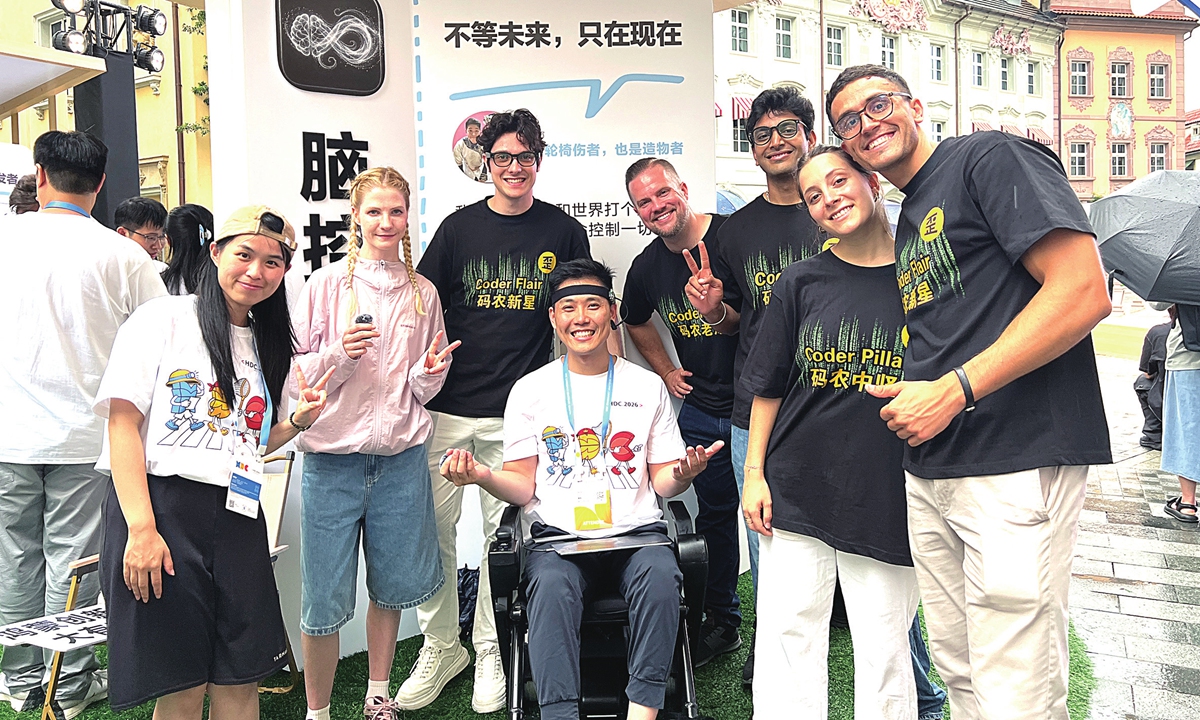
The couple present their brain-controlled wheelchair to a visiting overseas team at the Huawei Developer Conference (HDC) in Dongguan, South China's Guangdong Province, on June 12. The conference was held from June 12 to 14, 2026.
Battling fate with AIDuring his long recovery, he also developed products to meet his own needs, such as a mirror that could analyze rehabilitation movements, an exoskeleton to assist with leg lifting exercises, and insoles designed to stimulate the nerves in his toes.
Although he does not come from a technical background, Wang had picked up basic programming skills during his entrepreneurial years, which proved to be of help. He also taught himself embedded development, circuit soldering, 3D printing and AI algorithms entirely from scratch. In the prevailing age of AI, he also leverages large language models to build his devices.
"When I was paralyzed, the one thing I wanted most was to communicate with the world through my mind," Wang said.
At a hackathon held earlier this year, an event during which participants develop technology products within a limited timeframe, Wang, together with his wife, built a brain controlled wheelchair in just 48 hours. The device allows people with limited mobility to wear a headset that captures brainwave signals, enabling them to maneuver the wheelchair using brain signals alone. Their creation went on to win first prize in the hackathon.
"We are not making this device as a high-tech gimmick, it is simply to open a window for those who are utterly unable to express themselves," Wang said.
At the hackathon, Wang's brain-controlled wheelchair could only move in a straight line. After three months of upgrades, the device has improved functions such as turning, which was demonstrated at the recently concluded 2025 World AI Conference (WAIC) in Shanghai.
He also added that the success of the product benefits from the thriving domestic "One Person Companies" (OPCs) ecosystem, where AI takes charge of execution while humans make only key decisions. The model saw explosive growth across China in early 2026.
Guangdong, Wang's home province, recently launched an action plan to foster AI-based OPCs, aiming to build 10 leading ecological communities this year and 100 by 2028, the Xinhua News Agency reported.
Wang said that he feels fortunate to be in an environment where OPC is now thriving, and that it has made him more optimistic.
"Because an ordinary person driven by his own needs can, using AI, build a product that he himself requires, and then discover that it happens to be what others need as well. That is something genuinely magical," he said.
Looking ahead, Wang plans to establish a rehabilitation center equipped with technologies such as electrical stimulation suits and exoskeletons. "I hope to use AI to help more people with disabilities in their tug of war with fate," Wang said.
RELATED ARTICLES