ARTS / CULTURE & LEISURE
Stone tools reveal human traces in Xizang over 8,000 years ago
Plateau site sheds light on prehistoric technology
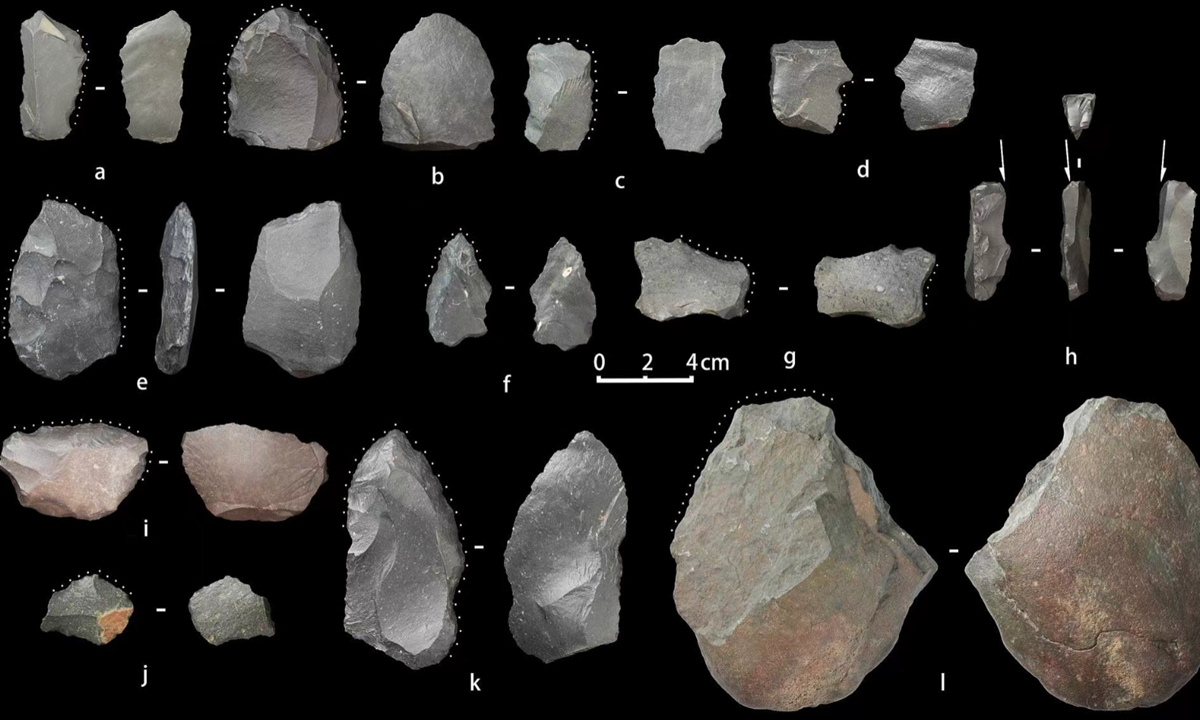
Photo: Courtesy of Vertebrate Paleontology and Paleoanthropology (IVPP), Chinese Academy of Sciences (CAS)
Chinese researchers have uncovered new evidence showing that humans occupied the western Qinghai-Xizang Plateau during the Early Holocene (about 11,700 to 8,200 years ago), with a stone tool assemblage from the Kali site offering fresh insights into how prehistoric people adapted to one of the world's most challenging environments, according to the Institute of Vertebrate Paleontology and Paleoanthropology (IVPP), Chinese Academy of Sciences (CAS).The study, titled "Early Holocene human occupation of the Western Qinghai-Xizang Plateau: New evidence from the Kali site," was recently published in the international journal Archaeological Research in Asia.
Located at an elevation of 4,700 meters, the Kali site sits on an alluvial fan along the right bank of the Yarlung Zangbo River in Daxiong township, Ali prefecture, Southwest China's Xizang Autonomous Region. The site contains large quantities of knapped stone artifacts scattered around the surface.
The 272 stone artifacts analyzed in this study were all recovered through surface collection at the Kali site. The assemblage contains a diverse range of raw materials, with flint accounting for the largest proportion, followed by quartzite and siliceous rocks.
Lithic artifacts include cores, flakes, microblades, retouched tools and a small number of fragments and chunks. These artifacts represent different stages of stone tool production, from preparing raw materials to making and modifying tools.
Cores can be divided into ordinary cores and microblade cores, including specimens from the preparation stage.
Flakes are predominantly complete, with secondary flakes accounting for the majority of those found. The toolkit is technologically and typologically diverse, comprising scrapers, notches, points, borers, burins and choppers.
Analysis of the stone tools shows that prehistoric people at the Kali site used two different approaches to making tools: simple core-flake technology characterized by platform-oriented flaking for producing flakes, and a microblade production system dominated by wedge-shaped microblade cores for producing small blade-like stone tools known as microblades.
The microblade production system preserves evidence from multiple stages of tool making, including preparation, production and discarding, suggesting that the site contains a relatively complete record of how these tools were produced, according to the study.
Combining archaeological evidence with regional environmental data, researchers suggest that the Kali site likely formed after a period of extensive lake expansion, when more habitable land surfaces became available. Based on current evidence, the assemblage may be provisionally attributed to the Early to Middle Holocene.
During the phase of maximum lake expansion, some low-lying areas may have been submerged, limiting opportunities for sustained human occupation.
As the lakes retreated and more usable land became available, habitable spaces at high elevations gradually expanded, creating favorable conditions for prehistoric groups to enter and utilize the interior of the western Qinghai-Xizang Plateau. The formation of the Kali site was likely associated with this process of environmental change.
The lithic assemblage at the Kali site further bridges the technological connections between the western Changtang Plateau and the Ali region, providing crucial support for understanding the evolution of prehistoric lithic technologies across these high-altitude regions.
According to the study, the site preserves not only a simple core-flake technological system characterized by platform-oriented flaking aimed at maximizing flake production, but also a relatively complete microblade production sequence, encompassing products from the preparation, production and discard stages.
The findings expand the known distribution of microblade cultural remains in western Xizang and provide new evidence for reconstructing the development of prehistoric stone tool technologies in the region.
According to IVPP, the study shows that the Kali site preserves a stone tool assemblage featuring the coexistence of core-flake technology and microblade technology, providing new archaeological evidence for understanding human activities on the western Qinghai-Xizang Plateau during the Early Holocene.
With the discovery of more stratified sites and advances in dating research, the chronological and spatial framework of prehistoric human activities on the western Qinghai-Xizang Plateau is expected to be further refined.
RELATED ARTICLES