Anhui, home to CXMT, emerges as economic hot spot
Local H1 GDP growth rates paint vivid, diversified picture
By and Zhang Weilan Published: Jul 29, 2026 10:33 PM

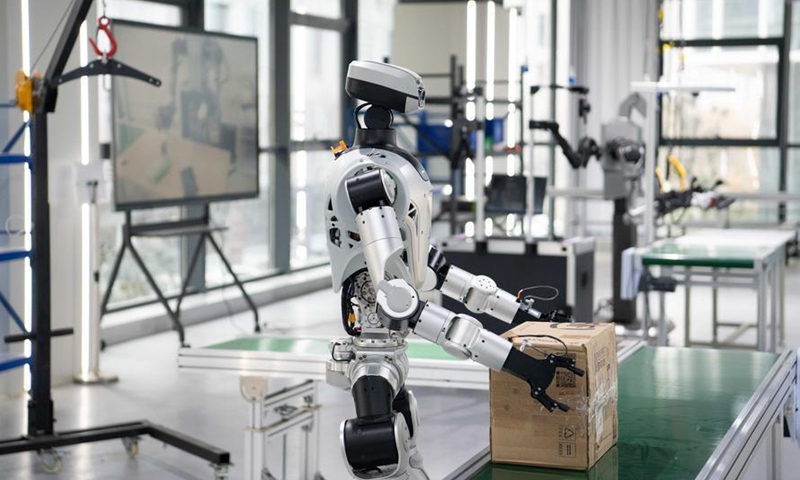
A humanoid robot conducts box-carrying training at a data collection pre-training center for humanoid robots in Hefei, East China's Anhui Province, on December 4, 2025. Photo: Xinhua
First-half GDP figures have been released by 31 Chinese provincial-level localities, with economic powerhouses such as South China's Guangdong and East China's Jiangsu, Shandong and Zhejiang provinces continuing to play a vital role, while certain provinces such as East China's Anhui, the home base of newly listed memory chip giant ChangXin Memory Technologies (CXMT), emerging as economic hot spots.Analysts said that the trend paints a vivid and diversified picture of the new Chinese economic landscape, where emerging industries such as high-tech manufacturing, semiconductors, artificial intelligence (AI) and humanoid robots channel new dynamics into the country's high-quality development trajectory, and different regions tap into their development potential based on local factor endowments.
During the first half, a major change from the year-earlier period was that Anhui's economic output jumped 5.6 percent to 2.74 trillion yuan ($404.7 billion), making it the 10th largest economy among all the 31 Chinese provincial regions.
Anhui's impressive rise was partly driven by the high-tech emerging industries, in particular the semiconductor and new-energy vehicle sectors, exemplified by the landmark IPO of CXMT on Monday, which is now the most valuable listed company in China, Tian Yun, a Beijing-based veteran analyst, told the Global Times on Wednesday.
"In addition to CXMT, the province's semiconductor industry has been expanding rapidly, having moved from single-point breakthroughs to the rise of a complete industrial chain covering design, manufacturing, packaging and testing, as well as equipment and materials," Tian said.
Li Chang'an, a professor at the Academy of China Open Economy Studies at the University of International Business and Economics, told the Global Times on Wednesday that Anhui's economic development epitomizes the important role that technological innovation, emerging industries and manufacturing upgrades play in high-quality development.
Anhui's success in seizing the historic opportunity in developing new quality productive forces will play a demonstration role for other regions seeking transformation, Li said.
In terms of total economic output, Guangdong ranked first with GDP of 7,228 trillion yuan, followed by Jiangsu, Shandong, Zhejiang and Southwest China's Sichuan Province. In terms of GDP growth rates, Southwest China's Xizang Autonomous Region was the champion with growth of 6.3 percent, followed by Zhejiang, Shandong, Shanghai and Anhui, which all outpaced the national GDP growth rate of 4.7 percent, according to reports.
Analysts pointed out that provincial GDP growth has displayed a pattern of "stable major pillars and prominent new quality productive forces."
For example, economic powerhouses such as Zhejiang and Jiangsu have continued to serve as the "ballast stones" for stable growth, recording robust expansion not only in high-tech manufacturing and the digital economy but also in foreign trade.
The services sector also played a crucial role in boosting growth. Nationwide, the value-added of the services sector reached 41.4 trillion yuan, up 5.2 percent year-on-year, 0.5 percentage points faster than the overall economic growth rate. The contribution of the services sector to economic growth reached 66.1 percent, serving as the primary driver of economic growth, data released by the National Bureau of Statistics (NBS) showed.
"The services sector will emerge as new growth point of the national economy, as areas such as leasing and business services, information transmission, software as well as information technology services are also important components of new quality productive forces," Li said.
With regard to overall growth in the second half, Wen Bin, chief economist of China Minsheng Bank, told the Global Times that China's economic powerhouses will continue playing a driving and stabilizing role, while central and western regions such as Anhui and Xizang will continue to take advantage of regional resources to speed up development.
Meanwhile, certain provinces with strengths in advanced manufacturing, the digital economy and export competitiveness will continue to provide support for industrial upgrading and foreign trade growth, according to Wen.
RELATED ARTICLES