Japan to establish a new 'Special Higher Police' on July 31 - its intentions are despicable: Global Times editorial
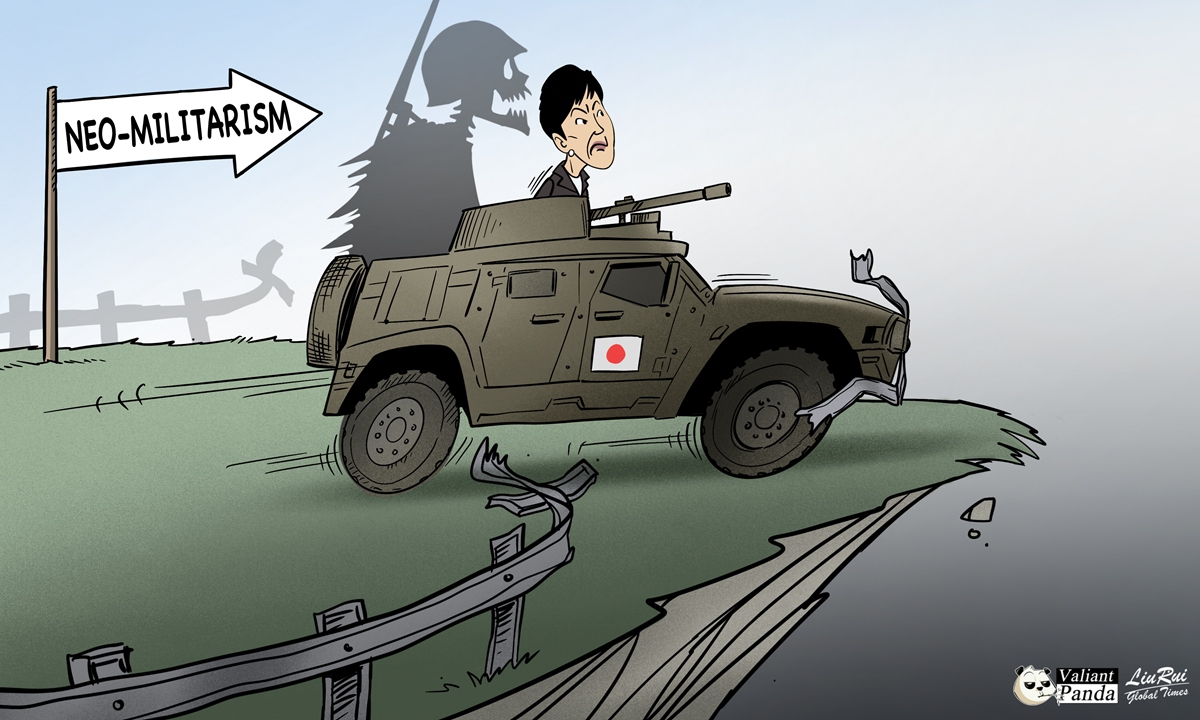
Illustration: Liu Rui/GT
Choosing July 31 as the launch date for Japan's new "national intelligence bureau" is a brazen challenge to the post-WWII international order posed by Japan's right-wing forces. As Japan once again raises the banner of centralized intelligence authority and removes yet another post-WWII restraint imposed by its "pacifist constitution" and the principle of an exclusively defense-oriented policy, countries across Asia and the broader international community must not remain silent."731" - a designation that once stood for the Japanese military's atrociously inhumane germ warfare unit - will become the "birthday" of a new Japanese intelligence agency. On July 31, a "national intelligence bureau" will officially be established in Japan, and the "national intelligence council," chaired by Prime Minister Sanae Takaichi, will convene its inaugural meeting on the same day. While the Japanese government claims this move aims to consolidate intelligence capabilities and counter "foreign espionage," external observers widely view it as a resurrection of the Tokko - Japan's notorious Special Higher Police prior to and during World War II (WWII).
That the specter of militarism embodied by the Tokko comes back to life on July 31 is a coincidence, yet not entirely so. For more than 80 years since the end of WWII, Japan's intelligence architecture was deliberately maintained in a decentralized state - partly to prevent the resurgence of militarism, and partly due to the deep-seated fear within Japanese society of pre-WWII militarist secret police and the repressive Peace Preservation Law. However, starting from Shinzo Abe, Japan steadily moved toward untying and unifying its intelligence system.
Upon taking office, Takaichi rapidly pushed through institutional reforms and legislative changes, attempting to build an intelligence apparatus centered around the "national intelligence council" as its core and the "national intelligence bureau" as its executive arm. This has created a centralized, top-down chain of command led directly by the Prime Minister's Office. Under this setup, the daily interactions, political expressions, and anti-war activities of ordinary citizens fall under surveillance - all without parliamentary checks, judicial oversight, or third-party monitoring. Its institutional design is a carbon copy of the Tokko.
The ambitions of this new system extend far beyond Japan's domestic shores. The Japanese government has explicitly signaled its intention to enact an anti-spy law, expand wiretapping, and explore establishing a foreign intelligence agency modeled after the US Central Intelligence Agency. The newly established organization's "national intelligence strategy" will directly serve the Self-Defense Forces' so-called counterstrike capabilities - meaning the ability to attack enemy bases - signaling a shift in intelligence work from passive defense to proactive reconnaissance and preemptive strikes. Simultaneously, Japan's Ministry of Defense is pushing to create a new bureau-level unit, rapidly pivoting the country's entire security architecture toward an offensive posture. Intelligence centralization and military expansion work hand in hand, tightly locked in step.
Setting the stage through intelligence was once the standard blueprint for Japan's aggressive wars. During its invasion of China, the Imperial Japanese Army relied precisely on a comprehensive intelligence network to thoroughly infiltrate Northeast and North China before launching unbridled military operations. Today, as Japan rebuilds a centralized, highly efficient intelligence machine, its focus is clear enough: targeting regional security hot spots to lay the information groundwork for potential military intervention. At the same time, Japan is actively seeking to join the "Five Eyes" alliance to share intelligence with the US, Australia, and others, positioning the "national intelligence bureau" as a central node connecting to Western intelligence networks. The integration of US-Japan intelligence will heighten confrontation in the Asia-Pacific and directly undermine regional peace and stability.
Historically, Japan's right-wing forces have often signaled their intent to break away from the post-WWII order and revive militarist traditions by deliberately crossing historical red lines through symbolic gestures. In 2013, then-prime minister Abe visited an Air Self-Defense Force base, climbed into a training aircraft bearing the number "731," smiled for the cameras and gave a thumbs-up. During his time in office, Abe also shouted "long live the emperor" at a ceremony marking the "Restoration of Sovereignty Day," and threw the ceremonial first pitch at a baseball game wearing jersey No.96 - a clear nod to his push to revise Article 96 of Japan's constitution. Takaichi, meanwhile, has long maintained close ties with the notorious Yasukuni Shrine.
With such incidents over the years and as Japan advances constitutional revision, expands military spending, develops long-range strike capabilities, relaxes arms export restrictions and strengthens intelligence powers, these "coincidences" cease to be coincidences. The revival of militarism is unlikely to come through a wholesale restoration of the old system. Rather, it is more likely to take shape gradually through the rewriting of concepts, the expansion of state powers, the downplaying of history, and carefully calibrated symbolic provocations that prepare society psychologically.
Choosing July 31 as the launch date for Japan's new "national intelligence bureau" is a brazen challenge to the post-WWII international order posed by Japan's right-wing forces. "731" is inseparable from the atrocities committed by Japan's militarist regime, making it unsurprising that Japan's right-wing forces remain fixated on the number. Abe's triumphant pose inside the "731" aircraft and Takaichi's insistence on launching the new intelligence hub on "731" reveal the political message behind the symbolism all too clearly. As Japan once again raises the banner of centralized intelligence authority and removes yet another post-WWII restraint imposed by its "pacifist constitution" and the principle of an exclusively defense-oriented policy, countries across Asia and the broader international community must not remain silent.
July 31 is more than a date - it is a wake-up call, warning the world that Japan's neo-militarism is becoming an increasingly tangible threat. Choosing "731" is itself a provocation, but the real provocation goes far beyond a symbolic date. Those behind it should not celebrate too soon: The memory of history shared by the peoples of Asia and the world, and their determination to safeguard peace, cannot be challenged. No amount of rebranding institutions or amending laws will erase the countless crimes committed under Japanese militarism. Any attempt to return to that path offers Japan no future. The world will not accept it, and history will not forgive it.
RELATED ARTICLES