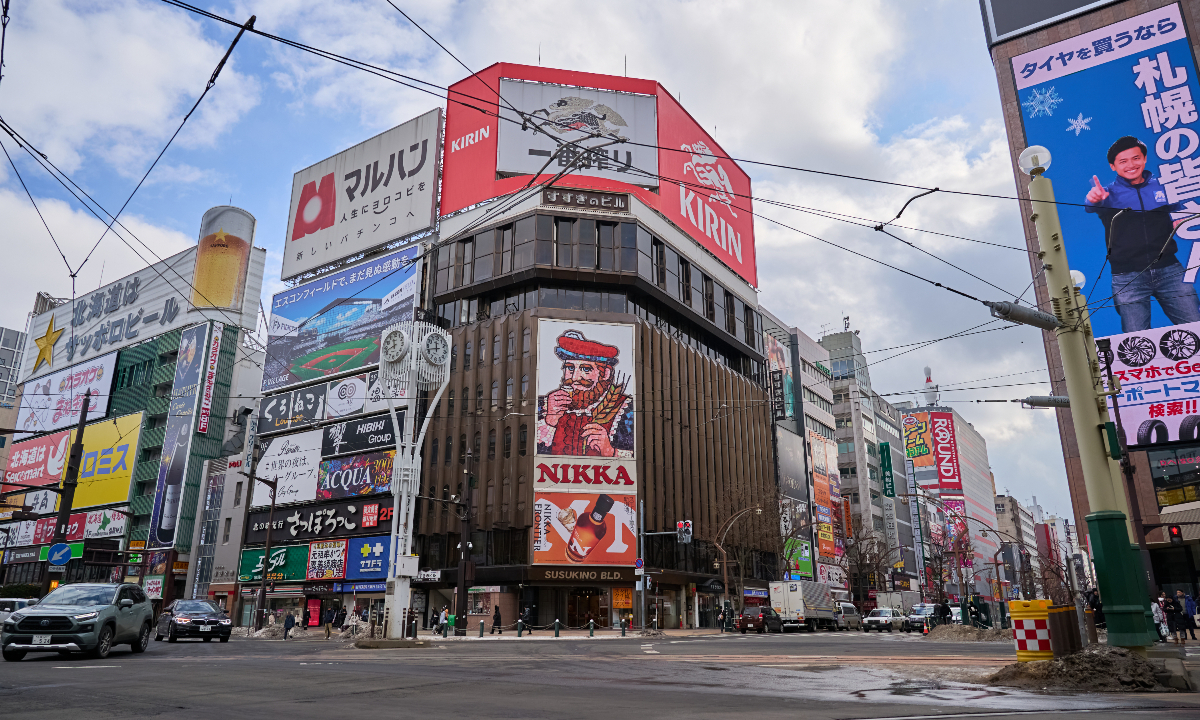
A commercial street in Sapporo city, Hokkaido, Japan Photo: VCG
Former Japanese foreign minister Takeshi Iwaya said on Wednesday that he would seek to arrange an early delegation visit to China after taking the helm of a major Japanese trade promotion organization, adding to a growing chorus of Japanese business groups calling for renewed engagement with China amid strained bilateral relations.
China welcomes friendly people-to-people and business exchanges, but commercial engagement cannot replace political correction, and Tokyo must recognize and rectify its erroneous actions concerning China's red lines, Chinese analysts said.
Iwaya was appointed the eighth chairman of the Association for the Promotion of International Trade, Japan (JAPIT) on Wednesday, succeeding former House of Representatives speaker Yohei Kono, who died in June at 89, according to Iwaya's official website.
"The association has served as a key channel for Japan-China economic exchanges for nearly 70 years, even before the normalization of diplomatic relations. I will do my utmost to help improve and further develop the currently difficult Japan-China relationship, starting with economic exchanges," he said.
"Following my appointment, my first priority will be to work toward an early visit to China by the association - a trip that was postponed following Mr Kono's passing," he said.
A delegation led by Iwaya is anticipated to pay a four-day visit to China beginning around September 20, Kyodo News reported on Wednesday, citing people familiar with the arrangements. Whether and when the visit will take place has yet to be finalized.
Like Kono, Iwaya is widely seen in Japan as favoring engagement with China. His appointment comes as Prime Minister Sanae Takaichi's erroneous Taiwan-related remarks last November and Tokyo's provocative military and security moves have pushed bilateral relations to one of their lowest points in decades.
As a former foreign minister, Iwaya has firsthand experience in high-level China-Japan communication, said Chen Zilei, director of the Research Center for Japanese Economics at the Shanghai University of International Business and Economics.
"His remarks reflect the Japanese business community's strong desire to swiftly restore normal economic cooperation with China and help improve bilateral relations," Chen told the Global Times on Thursday.
They also highlight a sharp contrast between Japanese businesses' practical need to maintain cooperation with China and the Japanese government's erroneous political words and actions that have repeatedly damaged bilateral ties, Chen added.
According to JAPIT's website, its vice chairmen include senior executives and advisers from major Japanese manufacturers, banks, trading houses and logistics companies, such as Mitsubishi Heavy Industries, Sumitomo Electric, MUFG Bank, Sojitz, ANA and Hitachi.
The organization regularly sends delegations to China. In June, a smaller delegation led by acting chief Gaku Hashimoto attended the fourth China International Supply Chain Expo (CISCE), during which Chinese Vice Foreign Minister Hua Chunying met the group and reiterated China's position on bilateral relations and Takaichi's erroneous remarks on Taiwan, according to the Chinese Foreign Ministry (FM).
"Whether the proposed September visit will take place remains uncertain, as economic engagement ultimately depends on whether the Japanese government genuinely corrects its erroneous words and actions toward China," Chen said.
The current difficulties differ fundamentally from past political frictions, as Takaichi's Taiwan-related remarks contravened principles established in the four China-Japan political documents and damaged the foundation of bilateral relations, the expert noted.
The Chinese side has repeatedly made clear that the root cause of the serious difficulties in bilateral relations lies in the Japanese authorities' erroneous remarks and actions on Taiwan and in the fields of military and security.
Speaking to reporters following his appointment, Iwaya said he wanted to "first revitalize economic exchanges and cooperation" and help bring about high-level dialogue between the two governments, according to the Kyodo News report.
In addition to JAPIT, several Japanese business groups, including the Kansai Economic Federation, the Japan External Trade Organization (JETRO) and the Japan-China Trade Promotion Association, have recently expressed interest in visiting China, highlighting the business community's growing urgency to improve bilateral relations.
Such appeals also reflect Japan's substantial commercial interests in China. In the first half of 2026, the Chinese mainland accounted for nearly 17 percent of Japan's total exports and about 24 percent of its imports, according to calculations based on data released by Japan's Finance Ministry on July 22.
"These figures demonstrate the importance of Chinese market to Japanese companies," Chen said. "Losing access to China's market or to critical products and intermediate inputs would impose costs that many Japanese companies could not easily absorb."
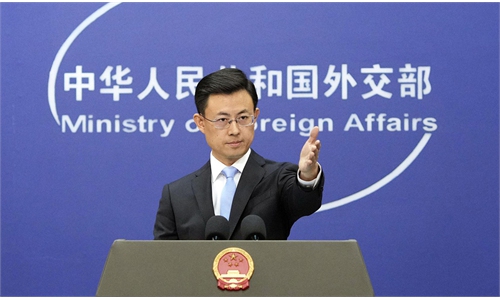
Commenting on Japanese business delegations' active participation in the CISCE in June, Foreign Ministry spokesperson Guo Jiakun urged the Japanese government to heed and take seriously calls from the business community…engage in serious reflection and correction, demonstrate their sincerity in improving relations with China through concrete actions, and create the necessary conditions for normal exchanges between the two countries.
"Tokyo should not expect China to soften its position over time or assume that business exchanges can resolve political disputes," Chen said. "There is no room for bargaining on issues involving China's sovereignty or the political foundation of bilateral relations. Only when the Japanese government fully recognizes and corrects its mistakes can bilateral relations improve."
RELATED ARTICLES