Illustration: Chen Xia/GT
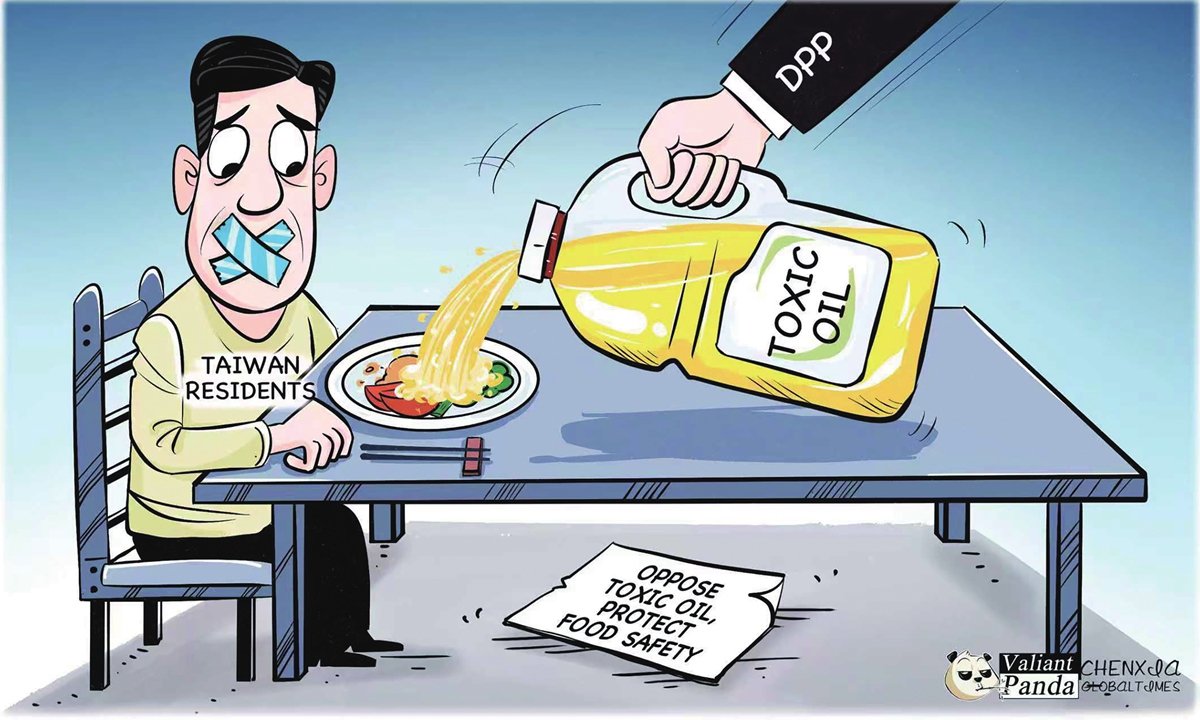
Food safety is supposed to be the most basic bottom line of people's livelihood. However, as a result of the political calculations of Taiwan's Democratic Progressive Party (DPP), it has repeatedly been sacrificed. The Lai Ching-te authorities' recent arrogance and negligence in the "toxic oil" incident once again reveal its long-standing habit of politicizing livelihood issues.As one sharp comment put it: Taiwan residents have been poisoned every single day during the 11 years of the DPP's rule.
At the State Council Taiwan Affairs Office's regular press conference on Wednesday, a spokesperson commented on the large-scale anti-toxic-oil demonstration in Taiwan region, saying that the DPP authorities, driven by self-interest, have completely disregarded the vital interests and well-being of Taiwan compatriots and placed themselves squarely against public opinion on the island. He added that their incompetence in governance and indifference to people's livelihood have been fully exposed.
Over 200,000 Taiwan residents braved the scorching heat and took to Ketagalan Boulevard in Taipei, holding banners that read "oppose toxic oil, protect food safety," shouting slogans like "I am human, I oppose poisoning Taiwan" on July 25. The demonstration underscored the deepening public discontent with the DPP authorities.
Several factors explain why the turnout far exceeded outside anticipation. The most direct cause was deep dissatisfaction with the Lai authorities' handling of the "toxic oil" case. According to media reports, a total of 2,600 tons of the "tainted oil" produced in April and May had already entered the market and been supplied to major food processors across the island before the government released the report in early July. Had the authorities simply carried out their regulatory duties and responded properly, the crisis could have been contained quickly.
Instead, the Lai authorities deliberately covered it up and failed to remove the products from the market in time. As a result, oils and downstream products containing carcinogens spread across the island for nearly three months, even entering the food supply of primary and secondary school students - the group the public cares about most.
What angered people even more was the authorities refusing to admit their wrongdoing, apologize or take any responsibility. DPP politicians even claimed that no one had forced people to eat it. This cold and arrogant attitude completely ignited public disappointment and fury.
The rally fell close to the anniversary of the DPP's great recall movement and judicial prosecution against opposition parties, which was a sweeping purge that violated normal political logic and public expectations on the island and ultimately ended in humiliating failure. The timing appeared to serve as a pointed reminder of that debacle.
It also carried the flavor of payback for the DPP's aggressive attacks during the 2014 Ting Hsin toxic oil scandal. Back then, the Ma Ying-jeou authorities apologized, immediately recalled the products and punished the company, yet the DPP, then opposition party, still launched fierce attacks that forced the then chief administrator and health chief to resign, driving Ma's approval rating into single digits. This time, the DPP adopted the opposite approach: no apology from Lai, and no official held accountable. How could such a stark contrast not provoke anger?
The deeper root of the protest lies in the DPP's long-term, self-serving politicization of livelihood issues. Since taking office in 2016, the DPP has relied on its control of the authorities and a large online troll army, believing it can always muddle through by perfunctory responses or by shifting blame onto the Kuomintang. This has created a bad habit of treating people's livelihood matters as political tools.
What has especially angered the public is that in recent years, in order to win support from the US and Japan for "Taiwan independence," the DPP authorities opened the market to American pork containing ractopamine, allowed food from Japan's nuclear disaster zones to be sold on the island and relaxed pesticide residue standards for agricultural products from the US and Japan. These moves have seriously damaged Taiwan's food safety system and given local food businesses the illusion that they can do whatever they want.
The DPP therefore bears unavoidable responsibility for the latest "toxic oil" scandal. On top of that, Taiwan's political donation database shows that a number of senior DPP officials had received money from the companies involved in the scandal, raising serious public suspicions of collusion between officials and business.
The large-scale demonstration may appear to be about the "toxic oil" incident, but underneath it shows Lai authorities' moral and governance failures as well as the further intensification of political struggle on the island. It also signals that the year-end local elections and Taiwan's future political direction will be filled with even greater uncertainty.
The author is a research fellow at the Institute of Taiwan Studies under the Chinese Academy of Social Sciences. opinion@globaltimes.com.cn
RELATED ARTICLES