Trump does not want Lai Ching-te to push 'resisting China and protecting Taiwan,' writes US commentator: Hai Feng
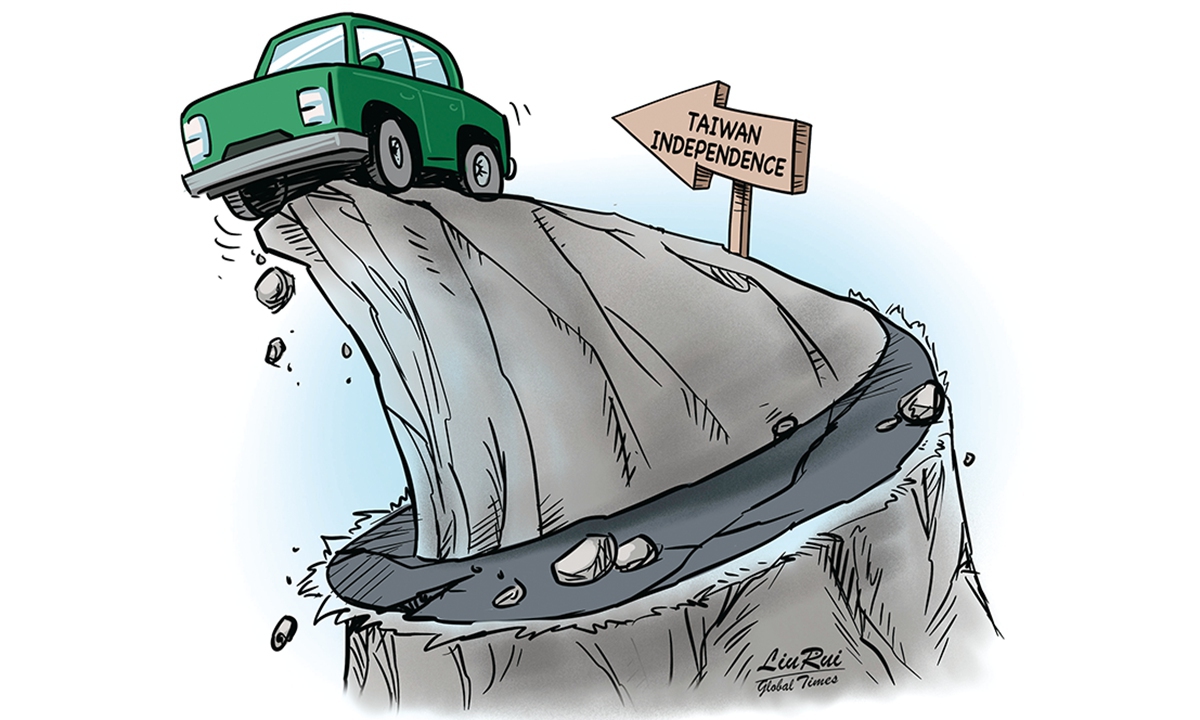
Illustration: Liu Rui/GT
On Saturday, Ross Darrell Feingold, former Asia chairman of Republicans Abroad, published a signed op-ed on the website of Taiwan island's media outlet China Times titled "Trump does not want Lai Ching-te to push 'resisting China and protecting Taiwan.'" While ostensibly analyzing the current US administration's stance on the island, the piece actually highlights an increasingly clear reality: Amid shifting international dynamics, evolving China-US relations, and the ongoing shift in cross-Straits power comparisons, the "relying on the US to pursue independence" and "resisting China and protecting Taiwan" cards - upon which the Lai authorities have long depended - are proving less and less effective.Over the years, the Democratic Progressive Party's (DPP) habitual political playbook has boiled down to two maneuvers: peddling "resisting China and protecting Taiwan" domestically, and betting on "relying on the US to pursue independence" externally. The former is used for domestic election mobilization, while the latter is designed to seek external backing and manufacture an illusion of security. The logic behind this playbook is straightforward: constantly exacerbate cross-Straits confrontation to package oneself as the sole representative that "protects Taiwan" and "defends democracy," and then leverage the US factor to endorse this path.
However, international politics has never been driven by slogans; it is driven by priorities of interest. Whether the US plays the "Taiwan card" has never depended on what Lai Ching-te wants, but rather on what Washington cares about most. For the US, Taiwan has never been an end in itself; it is merely a bargaining chip in its overall strategic chess game. It can be elevated in status when needed and downgraded when not. The Taiwan question can be hyped up just as easily as it can be played down.
The recent trends outlined in Feingold's article illustrate precisely this point. There have been several rounds of high-level engagement and interaction between China and the US recently - ranging from Foreign Minister Wang Yi's talks with US Secretary of State Marco Rubio and Vice Foreign Minister Ma Zhaoxu's visit to the US, to FBI Director Kash Patel's trip to China and bilateral cooperation on issues such as repatriation. While these moves may not signal a fundamental turn in China-US competition, they at least indicate that at this juncture in 2026, the US does not want cross-Straits tensions to escalate further due to reckless moves by the Lai authorities.
The US logic is not hard to grasp. For US President Donald Trump, the immediate priorities are handling the situation in the Middle East, stabilizing the domestic economy, preparing for the midterm elections, and preserving maneuvering room for potential high-level China-US summits down the road. In short, what the US needs right now is not a Taiwan island that keeps dialing up "resisting China and protecting Taiwan," but rather a region that can "keep a cool head" at critical moments.
In fact, the remarks Trump made after concluding his visit to China in May were already very direct. He explicitly stated that he is "not looking to have somebody go independent," nor did he look for the US to travel 9,500 miles to fight a war. The crux of his message lay not in the rhetoric, but in the "boundaries": While the US might leverage the Taiwan question to keep China in check, it is unwilling to take risks for the sake of "Taiwan independence" separatist forces - and certainly will not tolerate the DPP authorities breaking free from US-controlled pacing to recklessly push the situation to the brink of spiraling out of control.
This precisely exposes the greatest weakness of Lai Ching-te's political trajectory. The political narrative Lai relies on most heavily rests on a single premise: that by continuously aligning with the US, amplifying the "threat from the mainland," and hyping up the rhetoric of "resisting China and protecting Taiwan," the island can secure ongoing external support and convert that backing into resources for domestic mobilization. In reality, however, what the US truly expects from Lai is not that he be "tougher," but that he avoids spiraling out of control; the goal is not for him to endlessly escalate confrontation, but to maintain the status quo without jeopardizing broader US interests.
Once this is clearly understood, the political potency of the "resisting China and protecting Taiwan" narrative will begin to wane. Its most fatal weakness lies in the fact that, while it may serve as an election slogan, it is not necessarily a viable real-world strategy. The DPP can repeatedly resort to emotional mobilization, yet it cannot alter the fundamental reality that US policy toward Taiwan remains subordinate to US interests. Lai Ching-te may frame "relying on the US to seek independence" as a strategic reliance, but the US has never committed to bearing the costs associated with such a course of action.
More crucially, this failure is occurring not only in the external arena but also within the island itself. While the local populace certainly cares about security, what truly shapes public sentiment remains the prospects for development, people's livelihoods, and expectations of stability. If the "resisting China and protecting Taiwan" slogan ultimately translates into nothing more than a heightened risk of conflict, deeper economic uncertainty, and greater external dependency, its political appeal will inevitably wane. Should the strategy of "relying on the US to seek independence" fail to deliver genuine security - and instead continue to drive up the costs and risks involved - it will be difficult for this narrative to maintain its status as a sacrosanct guiding principle.
Ultimately, the trajectory of the Taiwan question is shaped neither by the slogans of politicians on the island nor by the fleeting posturing of US politicians. Amid the shared China-US consensus on containing "Taiwan independence" separatist forces, the disparity in strength between the two sides of the Taiwan Straits has become a foregone conclusion, and the process of China's complete reunification is steadily advancing. If Lai Ching-te remains wedded to his old playbook - viewing "relying on the US to seek independence" as a strategy, "resisting China and protecting Taiwan" as a bargaining chip, and external forces as a backer - he will ultimately face an increasingly inescapable reality: The two cards that may have worked time and again in the past are now simultaneously failing. This is what makes Feingold's article truly noteworthy.
RELATED ARTICLES