Lai Ching-te's predicament (Part 2): Appearing tough while sinking deeper into trouble
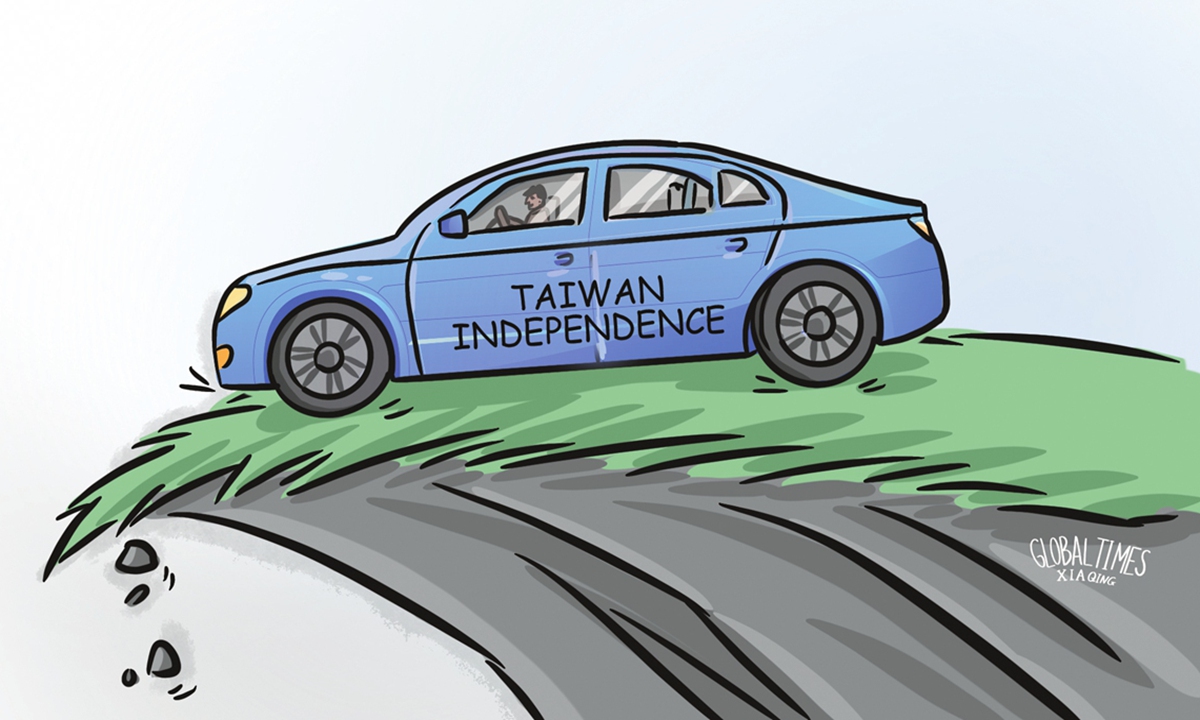
Illustration: Xia Qing/GT
If the "10 most egregious records" highlight Lai Ching-te's various erratic performances, then the "five major predicaments" describe his increasingly heavy and constrained political reality. On the surface, Lai continues to project an image of assertive governance, with a hardline posture and a strong public presence. Yet beneath this appearance, what he faces is no longer ordinary governing pressures, but rather a structural quagmire formed by the stacking of multiple contradictions.
This predicament is not caused by isolated missteps, but the inevitable result of internal imbalance, strategic deviation, and excessive political manipulation. Lai now finds himself trapped within five encircling walls: intra-party woes, inter-party deadlock, the island's internal tensions, cross-Straits impasses, and international isolation. These five walls intersect and reinforce one another, steadily limiting his room for political maneuver.
I. Intra-party woes: intensifying factional struggles
Although Lai serves as both the leader of the Democratic Progressive Party (DPP) and the regional leader of Taiwan, he is often forced into compromise amid complex factional competition within the DPP. As disputes over resource allocation, policy direction, and power balance accumulate, internal friction within the DPP has become increasingly visible. Surface-level unity cannot conceal underlying struggles over interests and influence.
In particular, Lai has been vigorously promoting his own faction in DPP leadership elections and the nomination of candidates for local mayoral race, while sidelining other factions, sparking discontent within the party. His promotion of a hardline "Taiwan independence" separatist agenda and major adjustments in energy policy have also drawn intra-party criticism. As a result, a significant amount of Lai's political energy must be devoted to internal coordination, appeasement, balancing, and containment - an accurate reflection of his intra-party predicament.
II. Inter-party deadlocks: escalating party confrontation and unprecedented shrinkage of space for negotiation
If intra-party woes refer to the difficulty in uniting one's own ranks, then inter-party deadlocks reflect the growing inability of different political parties to reach consensus. Since Lai took office, political rivalry in the island has shown a marked deterioration. Mutual trust between the ruling and opposition parties has eroded, policy coordination has become increasingly difficult, and many public issues have rapidly been transformed into instruments of partisan struggle.
This divide is especially evident in issues related to cross-Straits relations and people's livelihoods. Lai tends to draw ideological lines and has launched the "great recall movement" and "judicial prosecution" against opposition parties, while adopting a strategy of "refusing to countersign" legislative decisions, thereby escalating tensions between the ruling and opposition camps. These actions have further compressed the space for rational dialogue, making an already complex political environment even more rigid and confrontational.
Once the minimum level of mutual trust between parties is lost, the island's politics becomes mired in perpetual infighting, and Lai is a driving force behind this worsening trend. The more strained the inter-party relations, the higher the cost of governance, the greater the political risks, and the higher the walls that trap him grow.
III. The island's internal tensions: growing public disillusionment
For political figures, what ultimately determines their political survival is public support and trust. Lai's most serious risk at present is the growing wave of public disappointment he is facing. Since taking office, the Taiwan society has not experienced a clearer development outlook. Instead, it has seen heightened uncertainty, intensified anxiety, and deeper social fragmentation.
Taiwan residents' living conditions have shown little improvement, while social divisions have further intensified. Governance has not improved, and political confrontation has continued to escalate. Opposition has always existed, but what is more notable now is the steady rise in public disillusionment. What Lai is losing is not merely momentary popularity, but a deeper layer of social trust.
IV. Cross-Straits impasses: strategic space continues to narrow
The most difficult challenge for Lai lies in cross-Straits relations. Over time, he has attempted to maintain a fragile balance between political rhetoric and practical interests: seeking to preserve the political dividends of a "Taiwan independence" narrative while avoiding its associated costs; strengthening ideological mobilization internally while hoping the situation could remain controllable in practice. However, this is inherently a high-risk and low-return strategy. The Chinese mainland's position on opposing "Taiwan independence" is clear, firm, and leaves no ambiguity or room for negotiation. As long as Lai continues down this erroneous path, cross-Straits tensions will not ease, nor will the strategic pressure he faces diminish.
More problematically, it has become increasingly difficult for Lai to reverse course. Further escalation would invite greater practical pressure; any adjustment or moderation would be criticized by his supporters as "concession." This is a classic situation of being caught in a bind - unable to advance or retreat, trapped in self-imposed constraints. This is Lai's cross-Straits predicament.
V. International predicament: verbal support without real backing
The Lai authorities have long sought to package the so-called "international support" as an important political resource, using it both to mobilize internal public opinion and to bolster external posturing. However, the real substance of such "support," its durability, and whether it can be relied upon in critical moments remain highly questionable.
International politics is driven by interests. Some politicians may verbally express "support for Taiwan," but when core interests are at stake, the region can still be treated as expendable. No one is willing to bear unconditional costs for the island, nor to serve as a guarantor for Lai's "Taiwan independence" agenda. Reliance on external forces for a sense of security ultimately amounts to a fleeting illusion. The more Lai "seeks independence by relying on external support," the more passive his position becomes and the more clearly his vulnerabilities are exposed.
Taken together, the five layers of predicament clearly demonstrate that Lai has chosen the wrong path: intra-party stability is difficult, inter-party cooperation has broken down, public trust is eroding, cross-Straits tensions are intensifying, and international "support" remains uncertain.
When the direction is wrong, the faster one runs, the further one moves from the exit. Lai's most awkward predicament lies in this: the more actions he takes, the deeper the entrapment; the louder the rhetoric, the weaker the foundation; the higher the posture, the colder the reality becomes. This is the "predicament of Lai Ching-te." It is not a temporary blockage, nor a momentary misstep, nor a simple phase of governance adjustment, but a structural predicament that is getting worse.
Unless this erroneous course is fundamentally abandoned and replaced with a path that serves the well-being of Taiwan's residents and promotes peaceful development of cross-Straits relations, these five encircling walls will only grow higher and tighter, leaving no room for escape.
RELATED ARTICLES