China's implantable BCI tech helps quadriplegic patients return to work with latency below 50 ms
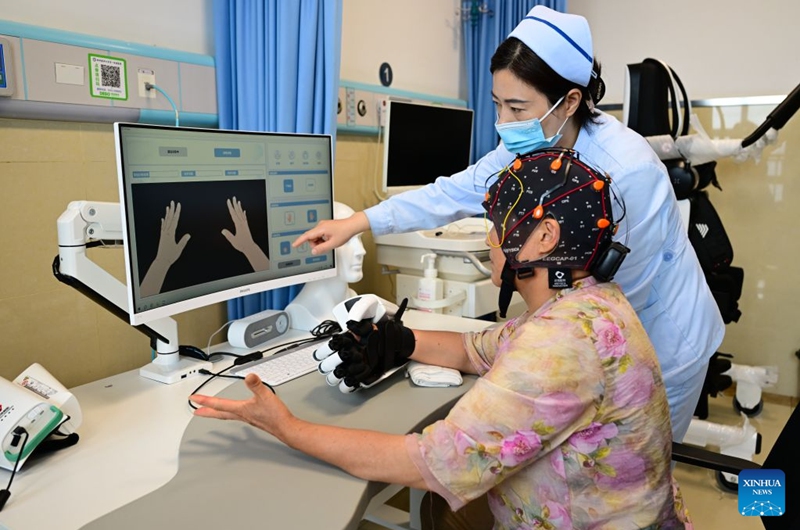
A medical worker guides a patient to use a brain-computer interface (BCI) device for hand rehabilitation at a hospital in Bengbu, east China's Anhui Province, July 17, 2026. Photo: Xinhua
China's implantable brain-computer interface (BCI) technology has made substantial progress in clinical trials, enabling multiple patients with high-level quadriplegia to return to work, with command latency below 50 milliseconds, the Global Times learned from Shanghai-based medical technology firm StairMed on Thursday.
This is not only a breakthrough in clinical application of BCI, but also a milestone in using advanced technology empowers patients to regain control of their lives and reintegrate into society. The high signal quality and operational stability demonstrated by the system also mark that implantable BCI technology has achieved a major leap from the laboratory to daily life, the company said.
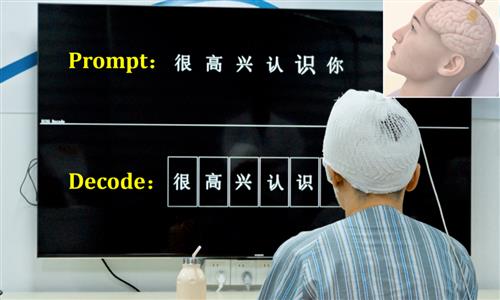
Three patients with high-level quadriplegia have recently gained the ability to smoothly control computer cursors using only their thoughts through implantable BCI technology. After training, one patient surnamed Zhang can now proficiently make phone calls through e-commerce logistics backend. He can communicate with customers, confirm orders, and ensures that goods are delivered on time. Meanwhile, the other two patients, surnamed Li and Zhao, performed backend service work for vending machines, annotating data on items purchased by customers by watching videos.
Among various technological approaches, the fully implantable route directly accesses the cerebral cortex, and signals are not affected by the skull and meninges, enabling the capture of high-quality, high-precision neural signals. This lays a strong foundation for accurately decoding the brain's motor intentions.
The implantable BCI system independently developed by the company uses proprietary ultra-flexible electrode technology, can directly record single-neuron signals, allowing patients to control computer cursors with their thoughts - moving them smoothly and rapidly across the screen to complete various tasks.
Currently, patients' ability to control computers using their brains has reached or even surpassed the level achieved by able-bodied people using their hands. The information transfer rate between the subjects and the computer has reached 380 bits per minute, close to that of common people using hands. The company has also reduced the latency from signal acquisition to execution to under 50 milliseconds - significantly shorter than the average human reaction time of 200 milliseconds.
According to the company, its BCI system significantly reduces the burden on patients, enabling them to work continuously for three to four hours while completing tasks efficiently and with sustained concentration. At present, the system can integrate seamlessly with mainstream operating systems such as Windows and iOS, delivering a convenient plug-and-play experience.
StairMed's technology reflects the country's efforts to advance smart rehabilitation through BCI. According to the China Disabled Persons' Federation (CDPF), China will advance need-driven real-world applications of brain-computer interfaces for people with disabilities, including smart rehabilitation devices incorporating non-invasive brain-computer interface technology during the 15th Five-Year Plan period (2026-2030).
"BCI technology is still at an early stage of development. Currently, it focuses on improving the quality of life of people with disabilities and helping them regain some motor functions. It has promising prospects," Pan Helin, a member of the Information and Communication Economy Expert Committee of the Ministry of Industry and Information Technology, told the Global Times on Thursday.
Pan said the greater long-term potential lies in the fact that BCI can provide a valuable platform for research involving neuroscience, surgical robotics, and biological signal processing, which could help strengthen the country's scientific research capabilities.
The BCI sector was designated as a future industry in this year's Government Work Report. It was also included in the outline of the 15th Five-Year Plan (2026-30) period as the country aims to cultivate it as a new engine of growth.
China's BCI market is projected to reach 6.14 billion yuan (around $904.3) by 2028, with a compound annual growth rate of 17.7 percent from 2024 to 2028, according to CCID Consulting under China's Ministry of Industry and Information Technology.
RELATED ARTICLES