Why China wins over African youth as 95 percent view its influence positively in survey
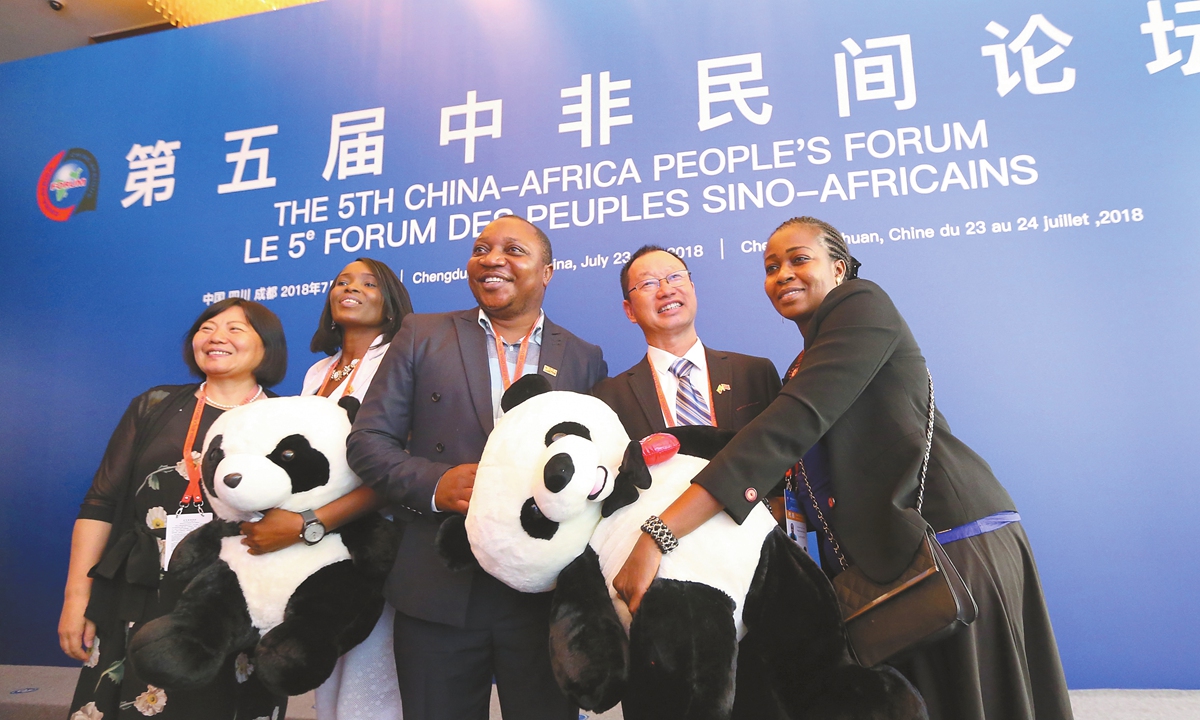
On July 23, 2018, participants of the Fifth China-Africa People's Forum take group photos with panda mascots at the venue in Chengdu, capital of Southwest China's Sichuan Province. Photo: VCG
A new survey has found that 95 percent of respondents who regarded China as influential in Africa viewed its impact positively, marking the second consecutive edition in which China ranked as the continent's most positively perceived foreign power.What has China done right to earn such strong approval among African youth? Chinese observers said that it is due to its development-focused cooperation with Africa, particularly in infrastructure, industrialization and respect for African countries' right to choose their own development paths — an approach that closely reflects young Africans' aspirations for growth and opportunity.
The biennial survey, conducted for the Ichikowitz Family Foundation and released on Wednesday, showed that perceptions of foreign influence have generally strengthened since 2024. The US was identified as influential by 81 percent of respondents, while China followed closely at 79 percent. Although China and the US are regarded as having broadly comparable levels of influence, young Africans expressed markedly more favorable opinions of China's impact.
Some 95 percent of young Africans who identified China as influential viewed its impact on the continent positively, compared with 85 percent who held a favorable view of US influence, according to the survey.
A survey released by the foundation in 2024 also identified China and the US as the two most influential countries in Africa, with 82 percent of respondents viewing China's influence positively, compared with 79 percent for the US.
The foundation's 2022 survey found that 76 percent of 4,507 young Africans named China as the "foreign power" with a positive influence on their lives, while the figure for the US was 72 percent. In 2020, 83 percent of the respondents saw the influence of the US as positive, compared with 79 percent for China.
The findings broadly echo a Pew Research Center survey released in July, which showed that China was viewed more favorably than the US in most of the 36 countries surveyed, including South Africa, Nigeria and Kenya.
The results have attracted some international attention, with some media outlets framing them primarily through the lens of growing competition between China and the US in Africa. Chinese observers said the more important question is not simply why China continues to be gaining an advantage, but how the Africa policies pursued by China, the US and Europe in recent years have shaped the everyday experiences and perceptions of African youth.
Tangible cooperation
The latest survey polled 4,901 people aged 18 to 24 across countries ranging from Chad and Kenya to Zimbabwe. It contains five parts, sharing the views of African youth on Afro-optimism, foreign relations and influence, the multilateral order, democracy and governance and safety, security and extremism.
On foreign relations and influence, the survey found that perceptions of foreign influence remain broadly positive among African youth, even as the landscape continues to shift. Perceived influence from China and India has grown since 2024, with China increasingly viewed as a more favorable partner than the US - a sentiment shaped in part by the return of the Trump administration.
Some 43 percent of respondents identify economic and infrastructure investment as the most important quality in an international ally. About one-third prioritized democratic values and human rights and non-interference in domestic affairs (34 percent).
For Jiang Jiang, the survey findings were unsurprising. Jiang served as director of the Confucius Institute at Ethiopia's Technical and Vocational Training Institute and taught at the Luban Workshop under Tianjin University of Technology and Education from 2011 to 2025.
"Chinese cooperation is visible everywhere — from cities to remote villages in trade, education, technology and infrastructure," Jiang said. "Vocational teachers, agricultural experts and medical teams reach local communities like capillaries, providing hands-on support rather than one-off donations. African youth see and experience these practical results firsthand, which helps explain China's appeal."
As of July 2026, the workshop had trained more than 1,600 students through a model combining talent development with technology transfer, according to Jiang.
Talent development is only one small part of the broader China-Africa cooperation. According to data from a Xinhua News Agency report in January, China has applied zero tariffs to all African countries with which it has diplomatic ties, and supported the construction or upgrading of nearly 100,000 km of roads, over 10,000 km of railways, nearly 1,000 bridges and close to 100 ports on the continent, contributing to Africa's modernization and coordinated economic development.
African youth increasingly viewing China's influence in a positive light is a result driven by years of pragmatic development cooperation and China's consistent policy toward the region that has delivered tangible progress across the continent. By constructing vital infrastructure like bridges, ports, and airports, China has helped integrate Africa into interconnected global value chains, laying a solid foundation for sustainable growth while unlocking vast economic opportunities, Song Wei, a professor at the School of International Relations and Diplomacy at Beijing Foreign Studies University, told the Global Times.
By matching China's development experience with Africa's needs, practical cooperation has delivered tangible, shared gains. The message is clear: whatever the global landscape, China remains Africa's trusted friend, steadfast development partner and firm advocate on the world stage, said the expert.

On August 31, 2023, Africa Technology Challenge (ATC) Season 8 successfully holds the closing ceremony in Nairobi, Kenya. The photo shows Chinese and African trainees celebrating a birthday party together. Photo: Courtesy of AVIC
More practical viewsBloomberg published a report on Wednesday titled "China Bolsters Its Influence Over Africa's Youth, Survey Shows." The report was also republished by The Japan Times and the Indian newspaper Business Standard. The Times ran a report under the headline "China or America? Young Africans Have a Clear Favorite."
Some African media outlets, however, focused on findings beyond. Top African News, for example, highlighted the survey's finding that African youth are more optimistic than at any time since the pandemic, while continuing to demand more jobs and cleaner government.
"Democracy remains strongly supported, with 73 percent saying democracy is always preferable, but 56 percent say Western-style democracy is not suitable for Africa and that a new African model is needed," according to the report.
Song said that the survey findings clearly show that African youth are highly pragmatic. They want to secure more opportunities for the continent, break free from long-standing patterns of dependency and pursue an independent path of development. Rather than empty ideological rhetoric, they value tangible progress they can see and experience in their daily lives.
The growing appeal of China and India among African youth also reflects a wider shift: their rise from development conditions like Africa's offers young Africans both practical lessons and confidence in their own future, said Song.
African youth do not want their continent turned into a chessboard for major-power rivalry or become trapped once again in dependence. They want more choices through Global South cooperation and stronger ties with emerging economies, ultimately charting their own development path. China never treating Africa as a geopolitical battleground has also struck a chord with many young Africans, said Song.
The Chinese Foreign Ministry has repeatedly rejected attempts to frame China's engagement with Africa in geopolitical terms. On July 28, responding to reports that the US State Department planned to spend hundreds of millions of dollars to counter China's growing influence in the Americas, Africa and Asia, spokesperson Lin Jian said China's cooperation with other countries and regions is not about wooing or rivaling anyone, but for global peace, prosperity, international order and a community with a shared future for humanity.
Having witnessed Ethiopia's rapid growth over the past decade, Jiang said he remains confident in Africa's future. "Rather than simply copying Chinese technology, African students are encouraged to adapt it to local conditions and build solutions of their own," Jiang said. Many graduates have done just that — joining local firms, launching startups and developing apps tailored to domestic needs.
With education and economic development reinforcing each other, and China-Africa cooperation expanding into fields such as artificial intelligence, the continent's young and confident population will be a powerful driver of growth, Jiang said.
RELATED ARTICLES