New Zealand FM's 'go back' racist remark exposes cracks in country's democratic image
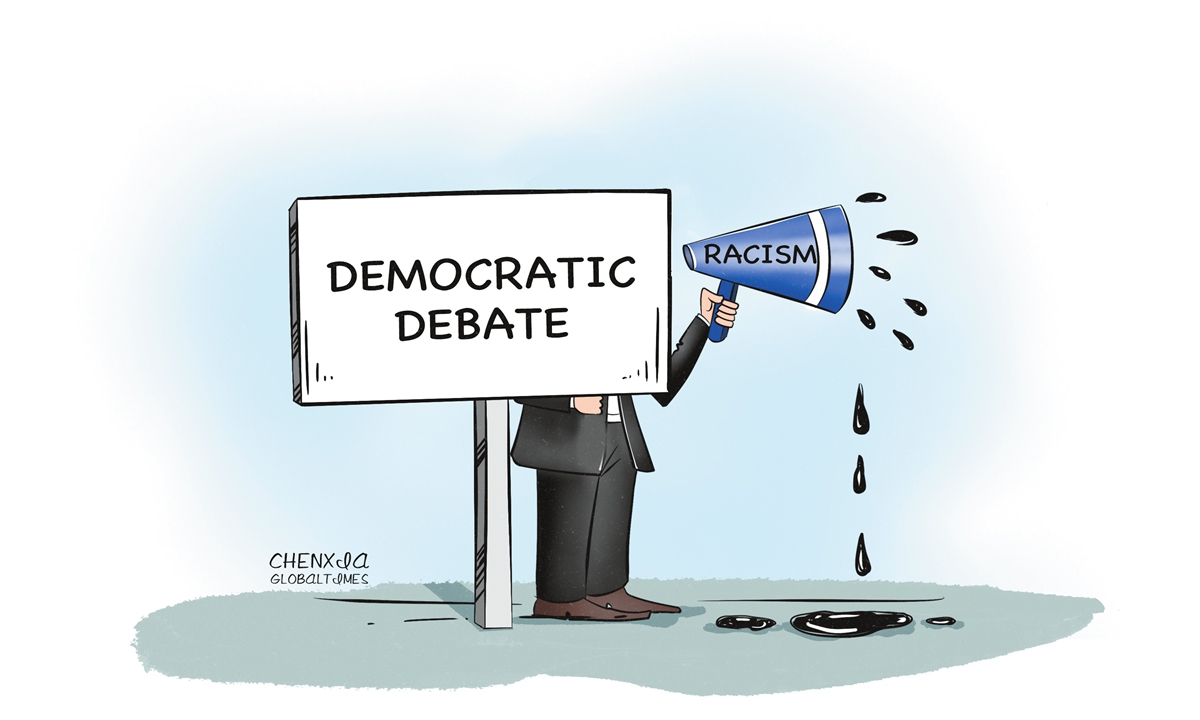
Illustration: Chen Xia/GT
New Zealand foreign minister Winston Peters' recent racist remarks have given the world a glimpse of how concerning the behavior is among certain political figures in a country that prides itself on being "democratic," "diverse," and "inclusive."On Wednesday, during a parliamentary debate on New Zealand's Covid pandemic response, Peters, also leader of the populist New Zealand First party, told a Chinese-born lawmaker to "go back to your own country," while also mocking his command of English based on his place of birth. Although Peters later denied accusations of racism, turning a lawmaker's ethnic background into a political weapon goes far beyond ordinary partisan rivalry; it is a textbook racist attack.
Zhou Fangyin, professor at the School of International Relations at Sun Yat-sen University, told the Global Times on Thursday that the incident reflects "deep-rooted prejudice among some New Zealand politicians toward Asian immigrant communities. "Whenever elections approach and political pressure mounts, they resort to populist agendas that stoke anti-Asian xenophobic sentiments," he added.
Peters' remarks were neither an accidental "slip of the tongue" nor an isolated case. This is not the first time Peters and his party have been embroiled in controversy over racist comments. From his deputy Shane Jones' criticism that a free trade deal with India could risk a "butter chicken tsunami," to the remark of "sending the Mexicans home" directed at a Mexican-born MP, and now Peters' personal attack on the Chinese-born lawmaker, a pattern of politicizing ethnicity and immigration issues has become increasingly evident.
As New Zealand has grappled with economic stagnation and mounting pressures on people's livelihoods in recent years, some politicians have increasingly sought to take Asian immigrants as "scapegoats" for social problems, using anti-immigrant rhetoric to divert public attention from deeper challenges such as education and healthcare.
Such populist tactics may bring short-term political gains during election cycles, but their costs are clear. New Zealand is home to a multi-ethnic population, where Asian immigrants contribute to the country's business, education and technology sectors. Yet a Chinese-born lawmaker who was elected through democratic procedures was still told explicitly that he did not "belong" there. Peters' remarks have not only hurt the feelings of the Asian community in New Zealand but also risk fueling tensions among different ethnic groups and deepening social fragmentation.
More troublingly, Peters attempted to cloak his racist remarks in the guise of "democratic debate" - a sheer distortion of the very concept of democracy. Genuine democracy guarantees not only freedom of expression but also consensus-based decision-making, empowering all people to voice their views and vote for the policies they believe in, regardless of their origins. Peters' conduct in this parliamentary debate, however, reversed the logic of democracy: He completely sidestepped the question raised by the immigrant lawmaker and sought to undermine the legitimacy of his voice as an elected representative. The value of democratic debate lies in the exchanges of different views, not in allowing racism to disguise itself as "democracy."
A country that claims "zero tolerance" for racism saw its top diplomat openly tell an ethnic minority lawmaker in parliament to "go back." This has not only torn apart New Zealand's carefully crafted inclusive and multicultural image but also brought shame to the very word "democracy." At a time when the international community broadly rejects racism and calls for civilized dialogue, Peters' remarks reflect not merely personal arrogance, but a collective failure of some New Zealand politicians to uphold basic standards of civility amid the tide of populism.
As Peters is also New Zealand's foreign minister, his remarks therefore represent more than his personal views or those of his party - they are also seen by other countries as a window into New Zealand's political environment, social values and policy direction. Yu Lei, a professor at the Center for Pacific Island Countries Studies at Liaocheng University, told the Global Times that "when New Zealand's top diplomat attacks a Chinese-born lawmaker based on ethnicity, his remarks damage New Zealand's image among people around the world, including the Chinese people, and have a negative impact on public perceptions of the country's democratic system globally."
The incident has drawn criticism from across New Zealand's political spectrum, including Prime Minister Christopher Luxon, showing that it has gone far beyond a routine partisan dispute and has become a test of the country's political culture and democratic values. A truly confident democratic society does not need to prove its superiority by belittling ethnic minorities or stoking xenophobia.
RELATED ARTICLES