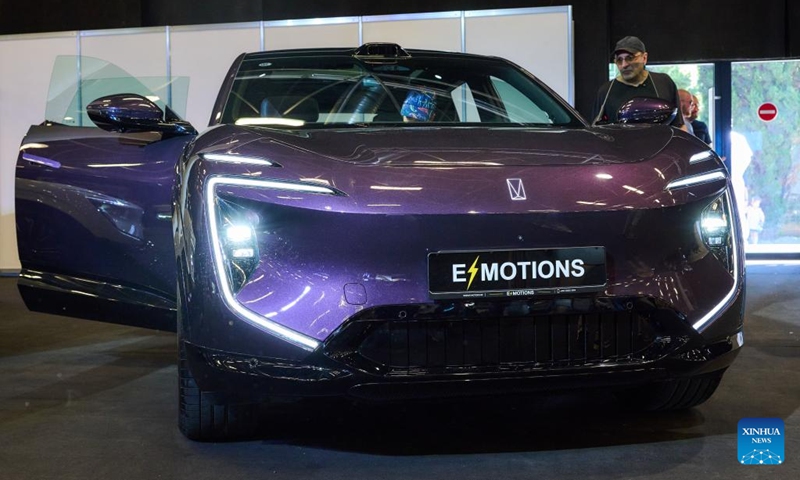
A visitor views an AVATR electric vehicle at Expo Georgia in Tbilisi, Georgia, June 13, 2026. This year's expo was held here from Saturday to Sunday. Chinese automakers including BYD, XPeng, AVATR and JAC Motors have made appearances with their products at the expo. (Photo: Xinhua)
A wave of Chinese entrants into Britain's car market is piling pressure on traditional manufacturers, Mike Hawes, CEO of the Society of Motor Manufacturers and Traders, the country's main automotive industry body, said on Thursday. Yet, he also acknowledged that Chinese competition was just one of several pressures facing Britain's automotive industry, also highlighting high energy costs, weak investment and regulations, Reuters reported.
Compared with the prevailing "China shock" rhetoric, his remarks at least puncture the one‑sided narrative that pins the industry's distress entirely on foreign rivals. The difficulties confronting the British automotive sector are by no means unique; they represent common challenges that the entire European car industry must navigate throughout the electrification transition. The key to addressing these challenges lies internally, not in erecting barriers.
The global vehicle industry is in the midst of a transition toward electrification, and such a technological shift inevitably brings market competition. As China's new-energy vehicle (NEV) supply chain has developed over the past decade, it is natural that many Chinese automakers would look overseas, making their way into the European markets. In recent years, however, some European politicians have amplified the so-called "Chinese shock" rhetoric as if blaming external rivals could somehow revive Europe's automotive industry.
This rhetoric may cater to protectionist sentiments aimed at shielding local industries, but it evades the far more uncomfortable questions that lie at home. To turn Chinese competition into a scapegoat for the sector's deep-seated pressures is merely a refusal to confront the real challenges of reform. It fails to resolve the genuine bottlenecks of local industries and contributes nothing to building a sound, orderly market ecosystem.
Europe boasts a solid foundation in automotive manufacturing, a mature consumer base and a complete supporting industrial system, granting it advantages to seize opportunities in the global EV revolution. Nevertheless, persistently high energy costs have continuously squeezed profit margins for local manufacturers. Uncertainties over the industry's transformation prospects have dampened investment enthusiasm, while extremely complicated regulations keep raising operational costs for car companies.
For instance, due to rising costs and deep structural change, some 24 percent of Europe's automotive suppliers forecast a deficit this year, industry body CLEPA said in March. More broadly, 76 percent expect margins below 5 percent, a level widely seen as insufficient to sustain investment in new technologies and production capacity, Bloomberg reported.
These lingering structural flaws have steadily eroded the core competitiveness of the European automotive industry in global market competition. Even if no Chinese EVs had entered the market, the industry would still be grappling with the immense cost pressures, technological leaps, and competition from other foreign players. Resorting to trade barriers to fend off external competitors only defers a response to industrial contradictions, rather than fundamentally reversing the decline of local industrial competitiveness.
The path forward for Europe's automotive industry is not to erect trade barriers or shut out competitors, but to address the entrenched structural issues that constrain its dynamism. Accelerating the energy transition to reduce industrial energy costs, streamlining regulatory frameworks to unleash innovation, and introducing robust investment incentives to channel capital into new energy research and development, battery supply chains, and intelligent vehicle technologies are the tangible moves that can genuinely expand the pie. Provided that Europe clears these policy hurdles and unleashes its full industrial capacity, the sheer size and sophistication of its market will be more than sufficient to accommodate robust competition. Competition is not a threat to industrial progress; it is its most effective catalyst.
What will ultimately determine the future of Europe's vehicle industry is not the presence of external participants, but the continent's own resolve and capacity for internal reform. History has repeatedly shown that the loss of industrial competitiveness is never simply caused by a strong external rival, but by internal problems. A healthy market ecosystem is never afraid of having too many competitors. Once the vitality and openness of the European market are genuinely revived, it will accommodate all global players and in that process, Europe can regain its industrial glory.
RELATED ARTICLES