Illustration: Chen Xia/GT
US Deputy Assistant Defense Secretary Alvaro Smith recently stated publicly that military-to-military communication between China and the US is "stronger than it has been in years," reiterating that Washington is not seeking "conflict with China." On the surface, this offers a clear signal of de-escalation. Yet, grounded in the realities of the Taiwan Straits, there is only one prerequisite for these words to materialize: The US must truly implement effective measures to curb "Taiwan independence."
The reasoning is straightforward. China and the US may engage in normal trade friction, technology competition, or geopolitical rivalry. No matter how sharp these friction points become, there remains room for maneuver. The Taiwan question, however, is fundamentally different. It is not an ordinary diplomatic disagreement in international relations, but the very core of China's core interests - the most sensitive, dangerous, and high-stakes matter in China-US relations. Should a crisis erupt across the Straits, bilateral relations would not merely face pressure; they could be pushed straight into a head-on collision.
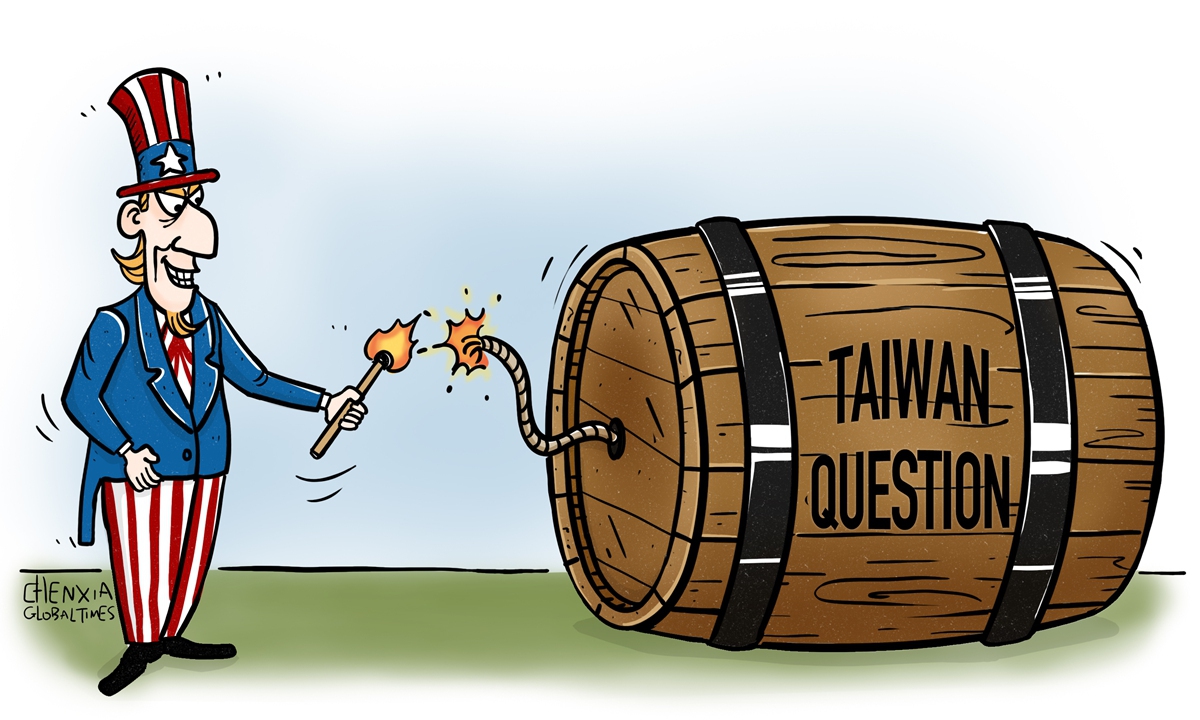
Thus, Washington's current emphasis on maintaining military communication, reducing miscalculations, and preventing misunderstandings is necessary, but far from sufficient. Communication can lower technical risks, but it cannot neutralize political provocations by individuals; it can prevent accidental engagement, but it cannot stop some forces from intentionally carrying sparks to a powder keg. The genuine danger in the Taiwan Straits today lies not in a lack of communication channels between Beijing and Washington, but in the fact that "Taiwan independence" forces on the island will make fresh strategic miscalculations fed by wrong signals from the US.
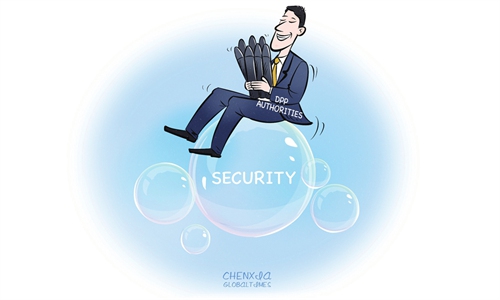
This is precisely the alert that needs to be sounded over the Straits. Even as the US side verbally emphasizes stability in relations, the American Institute in Taiwan posted a photo on social media featuring a US Coast Guard vessel alongside a sea patrol ship from Taiwan island, deliberately creating an aura of "collaboration." The photo specified neither time nor location, yet it was released to stir up political speculation in the public domain. The Democratic Progressive Party (DPP) authorities seized upon it as a windfall, swiftly exploiting the image to package this ambiguous maneuver as proof of an "upgraded" relationship between the island and the US.
This is the most dangerous aspect of the current situation: It is not that the US side has openly breached red lines, but that it repeatedly feeds false perceptions to "Taiwan independence" forces through ambiguous actions, mixed signals, and symbolic support. This lulls certain people on the island into the illusion that external powers will serve as their "ultimate backstop" for reckless gambles. Indeed, what emboldens "Taiwan independence" forces to repeatedly test boundaries is never their own strength, but their fantasy of external intervention.
The Chinese mainland's routine law enforcement patrols near the waters of Kinmen in accordance with the law send an unequivocal message through action: The Taiwan Straits is not a stage for political posturing, nor is it a platform for "Taiwan independence" forces to stir up trouble by leveraging foreign interference. For China, there is no room for compromise when it comes to safeguarding sovereignty and territorial integrity. Anyone attempting to hollow out the one-China principle or exploit grey zones to advance "Taiwan independence" will inevitably run headlong into increasingly firm countermeasures and constraints.
Therefore, if the US truly has no intention of colliding with China, it shouldn't preach stability while playing edge-ball tactics on the Taiwan question. It cannot stress respect while acquiescing to, or even emboldening, separatists on the island who seek independence by relying on Washington. Nor can it claim to oppose "Taiwan independence" in words while constantly supplying them with false hopes, generating illusions, and fueling their arrogance through actions.
Ultimately, only a stable Taiwan Straits can yield stable China-US relations. If the two countries are to avoid conflict, the key lies not merely in connecting hotlines or holding bilateral meetings, but in Washington turning off the wrong signals, rolling back dangerous moves, and suppressing fantasies of "Taiwan independence." If the US genuinely wishes to prove that it is not seeking "conflict with China," the most direct, effective, and persuasive way is to stop sending any misleading signals to "Taiwan independence" forces, and truly deliver on its commitment to keep them in check.