China’s 60-plus population reaches 323 million, accounting for 23 percent of population: official data
By Published: Jul 31, 2026 11:21 PM

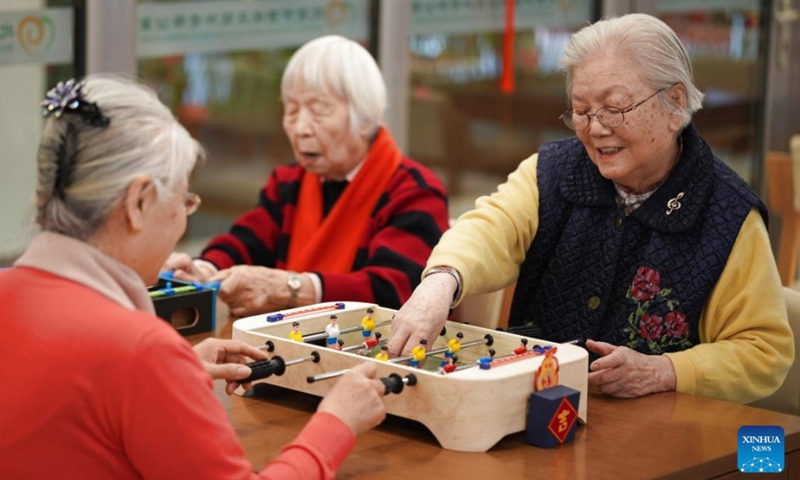
Elderly residents play games at a senior care center in Beijing, capital of China, Feb. 10, 2026. Photo: Xinhua
By the end of 2025, 323.38 million people in China were aged 60 and above, accounting for 23 percent of the country's total population. The number of people aged 65 and above reached 223.65 million, representing 15.9 percent of the total population, according to the latest data released by China's Ministry of Civil Affairs on Friday.The old-age dependency ratio for the population aged 65 and above stood at 23.1 percent, while China's average life expectancy reached 79.25 years, the data showed.
Coverage for welfare allowances and subsidies for older people has continued to expand. By the end of 2025, a total of 53.538 million elderly people nationwide were receiving various senior citizen allowances and subsidies.
China's entry into a moderately aging society is the result of a combination of factors, including the size of past birth cohorts and the continuous increase in life expectancy. It reflects a historical trend in demographic development rather than a short-term phenomenon, Yuan Xin, a professor at the School of Economics, Nankai University, told the Global Times on Friday.
Facing the aging population, a major challenge lies in mounting pressures on pension systems, healthcare and long-term care. At the same time, the country's large elderly population also represents enormous potential for the silver economy and human resources, the expert noted. "The key is to leverage institutional innovation to transform the potential opportunities brought by population aging into new drivers of economic and social development," he said.
According to China's 15th Five-Year Plan (2026-30), measures will be taken to expand elderly-oriented consumption, grow the silver economy and improve the consumption environment, according to the Xinhua News Agency.
According to data released by the ministry on Friday, the silver economy has continued to gain momentum, with market-driven forces showing robust growth. Elderly care services have increasingly integrated with other sectors, with a series of policy measures introduced to promote health consumption, domestic services and related industries.
For example, in 2025, China operated 2,485 tourism trains nationwide, with the number of elderly people participating in long-stay travel and retirement-oriented tourism exceeding 80 million person-times.
Of particular note, the generations born in the 1950s, 1960s and 1970s, who grew up during the period of reform and opening-up, are gradually entering old age. Compared with previous generations, they generally have higher incomes, stronger purchasing power, more free time and better health conditions, Yuan noted.
If the supply side can provide more personalized, high-quality and age-friendly products and services, this huge potential market can be transformed into real consumer demand and become a new driver of economic growth, he said.
RELATED ARTICLES