There is simply no ‘grey zone’ under the one-China principle: Global Times editorial
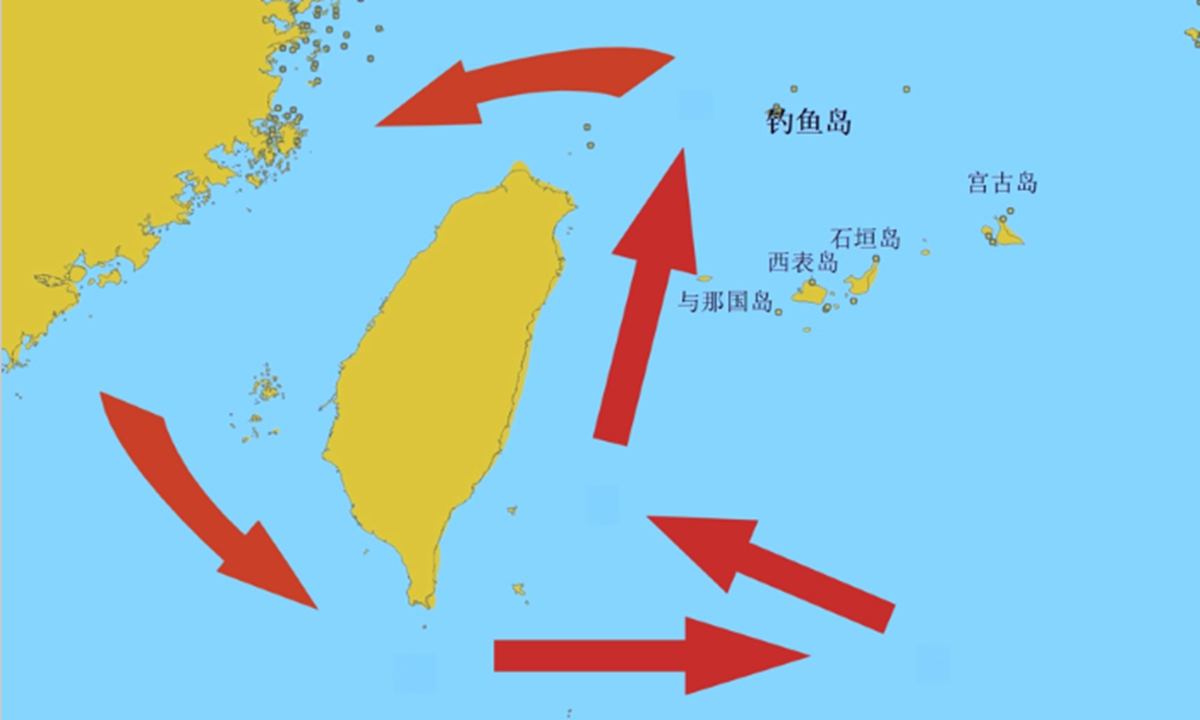
A schematic map of the special maritime traffic law enforcement and hydrographic survey operation in waters east of Taiwan island. Photo: Xinhua News Agency, courtesy of the Fujian Maritime Safety Administration
In the waters surrounding the island of Taiwan, CCG patrols should be conducted in accordance with the law, marine resources should be scientifically surveyed, shipping lanes should be effectively managed, and military training should be carried out on a regular basis. Only by fully exercising national sovereignty through law enforcement, scientific research, resource conservation, and security operations can concepts such as the "undetermined status of Taiwan," "international waters," and the "median line in the Taiwan Straits" ultimately be laid bare.It is not hard to see that as China's sovereignty protection and maritime governance become routine, some people in the US are growing anxious. Recently, several US lawmakers clamored to introduce legislative proposals to purportedly counter China's "activities through grey-zone tactics" in the Taiwan Straits and the Asia-Pacific region. This is not an isolated voice. Just last month, the US House Select Committee on China floated the phrase "grey-zone tactics," claiming that China's "intimidation" would only reinforce "the US' convictions" to stand with Taiwan island.
The so-called "grey-zone tactics" refer to the integrated use of diplomatic, economic, informational, and quasi-military means to advance national interests short of open warfare. Ironically, this concept is "Made in USA" through and through. It is nothing more than a slick repackaging of the shady, underhanded activities Washington employs to interfere in other nations' internal affairs - a concept for which the US military even published an official white paper back in 2015. Now, certain US lawmakers are weaponizing this term against China's lawful actions, accusing the country of "seeking regional hegemony." Does this not precisely illuminate what the US, as the primary producer and practitioner of this concept, has been doing all along in the Asia-Pacific?
There is simply no "grey zone" under the one-China principle. The fact that the island of Taiwan is an inalienable part of China's territory is not only a consensus of the international community, but also a basic norm governing international relations. In the waters east of China's Taiwan island, whether it is routine law-enforcement patrols conducted by the China Coast Guard (CCG), the marine environment survey by the Ministry of Natural Resources, or the fishery resource investigation by the Ministry of Agriculture and Rural Affairs, they all represent exercises of national sovereignty in accordance with the law.
Furthermore, China's actions are transparent in terms of the entities involved, the purpose of the actions, and the information provided, which is completely different from the US' "gray zone tactics," which are characterized by opaque actors, unclear intentions, and difficulty in assigning responsibility. The desperate attempts by the US and the Democratic Progressive Party (DPP) authorities to brand these operations as "aggression" only lay bare their deep-seated unease and anxiety over China's lawful exercise of sovereign rights and jurisdiction.
The decision by some US lawmakers to once again revive, amplify, and sensationalize the narrative of the so-called "grey-zone tactics" is closely tied to their collusion with the DPP authorities. According to media reports, these lawmakers have maintained close contacts with the DPP, and one of them even traveled to Taiwan island in early July to meet with Lai Ching-te. Around the same time, the American Institute in Taiwan tried to attract attention by deliberately posting a photo on social media featuring a US Coast Guard vessel alongside a sea patrol ship from Taiwan island. Such political theatrics, however, do nothing to advance the "Taiwan independence" agenda. Instead, they only expose the DPP authorities' growing anxiety in the face of mounting opposition on the island and the mainland's precision strikes against "Taiwan independence." The more some external forces try to boost morale, the more they expose the demoralization of the DPP authorities.
It is certain that whether these lawmakers' statements generate headlines or not, they will ultimately have little impact on the situation in the Taiwan Straits. China possesses the firm resolve and unwavering determination to safeguard its territorial sovereignty and maritime rights and interests. China's operations in the waters east of Taiwan island have already evolved from coast guard patrols alone into coordinated actions involving the coast guard, maritime safety, navigation support, and search-and-rescue authorities. These are all important manifestations of administrative jurisdiction and the inevitable path for the Chinese nation to continue moving toward reunification.
Meanwhile, the persistent hype surrounding the so-called "grey zone" by some in the US only underscores the necessity of China's continued efforts to strengthen governance of the waters surrounding Taiwan island. In the waters surrounding the island of Taiwan, CCG patrols should be conducted in accordance with the law, marine resources should be scientifically surveyed, shipping lanes should be effectively managed, and military training should be carried out on a regular basis. Only by fully exercising national sovereignty through law enforcement, scientific research, resource conservation, and security operations can concepts such as the "undetermined status of Taiwan," "international waters," and the "median line in the Taiwan Straits" ultimately be laid bare.
The real "grey zone" in the Taiwan Straits stems from Washington's contradictory approach of claiming to uphold the one-China policy while continuing to expand arms sales, promote official exchanges, and deepen military ties with the island. The more some US lawmakers attempt to constrain China through rhetorical constructs, the more China will rely on facts, law, and concrete actions to make the reality of the Taiwan Straits unmistakably clear.
There is no "grey area" when it comes to China's sovereignty, no room for ambiguity over national reunification, and absolutely no space for compromise on opposing external interference. The louder these manufactured narratives become, the more the world should recognize one fundamental reality: The true danger in the Taiwan Straits has never been China's legitimate action to safeguard its national territorial integrity in accordance with the law, but rather the disgraceful attempts by external forces to stick their dirty hands into China's internal affairs.
RELATED ARTICLES