Poll shows 76% in Japan support upholding Three Non-Nuclear Principles; Japanese society’s anti-nuclear sentiment remains strong despite Tokyo’s push to loosen policy: expert
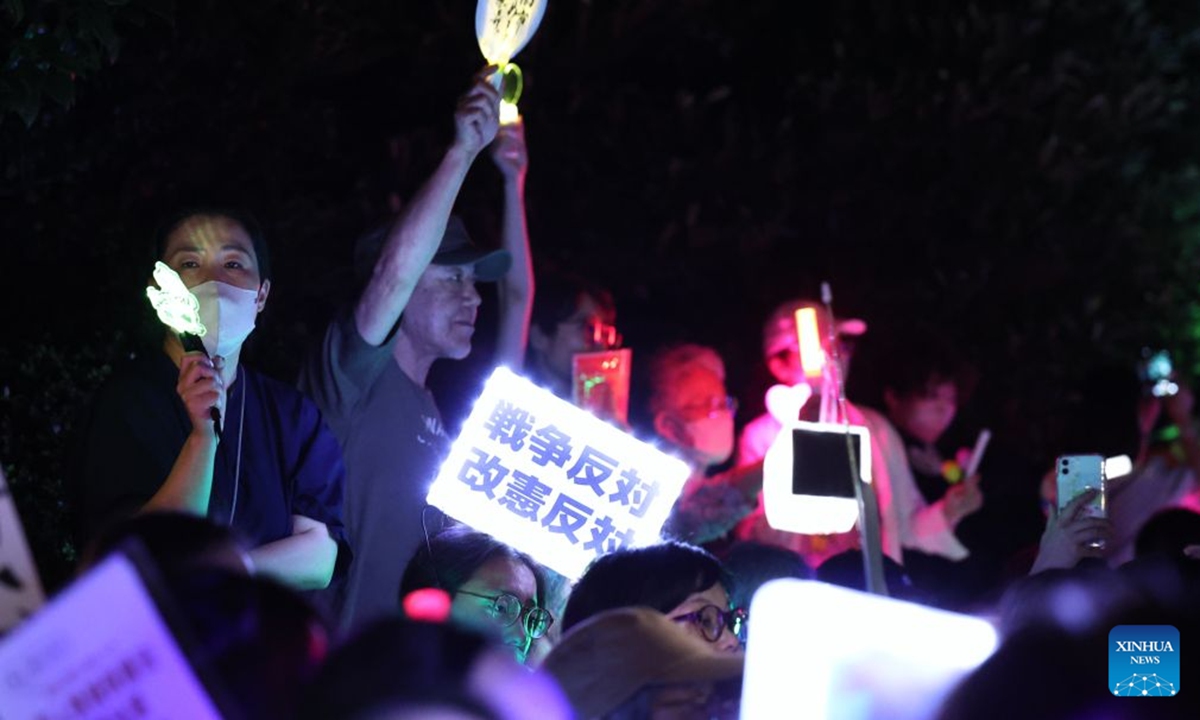
People holding signs attend a protest rally in front of the National Diet Building in Tokyo, Japan, July 10, 2026. A large number of Japanese citizens gathered in front of the National Diet Building in Tokyo on Friday evening to protest a series of dangerous policies and bills recently promoted by the government of Prime Minister Sanae Takaichi. Photo: Xinhua
Seventy-six percent of people in Japan support upholding the country's Three Non-Nuclear Principles of not possessing, not producing, and not permitting the introduction of nuclear weapons into its territory, Kyodo News reported Sunday, citing a nationwide opinion poll, according to the Xinhua News Agency.
A Chinese expert said the poll shows that the majority of the Japanese public remains highly wary of and firmly opposed to any form of nuclear armament or "nuclear sharing," reflecting that the country's Three Non-Nuclear Principles have become deeply rooted in Japanese society as a broad consensus for peace and a fundamental security red line.
According to the poll, which targeted 3,000 people aged 18 and above, conducted in June and July by the nationwide opinion poll organization Japan Association for Public Opinion Research, which is affiliated with Kyodo News, in addition to 76 percent of respondents said Japan should continue to uphold its Three Non-nuclear Principles, 77 percent said Japan should not pursue "nuclear sharing," under which US nuclear weapons would be deployed in Japan and jointly operated, the Ryukyu Shimpo reported on Sunday.
As debate continues over whether the Three Non-Nuclear Principles should be reviewed, the survey suggested that public opinion in Japan remains broadly in favor of maintaining Japan's non-nuclear stance, reflecting the country's identity as the world's only nation to have experienced atomic bombings in wartime, per the Ryukyu Shimpo.
Xiang Haoyu, a Chinese international affairs expert, told the Global Times on Sunday that Japanese society's strong anti-nuclear sentiment is deeply rooted in its historical memory as the world's only country to have experienced atomic bombings in wartime. The devastation of Hiroshima and Nagasaki has made the Three Non-Nuclear Principles not only a cornerstone of Japan's postwar pacifist principles, but also a safeguard against the country once again becoming a frontline in nuclear confrontation.
"As some right-wing politicians push to loosen defense restrictions and promote US-led 'nuclear sharing,' many Japanese fear such moves would undermine, rather than strengthen, the country's security," he said.
The poll result was released about two weeks after Japanese Defense Minister Shinjiro Koizumi made highly dangerous and provocative remarks on July 17 in a Japanese internet TV program "Genron TV," claiming that while nuclear weapons are a difficult issue for Japan to discuss, they are one the country cannot avoid addressing, and that Japan must discuss and "advance all policies without taboos." Japanese English media outlet the Japan Times also pointed to Koizumi's claims as "a rare instance of a sitting Cabinet member broaching the highly contentious issue."
In response to Koizumi's claims, both China's Foreign Ministry and Ministry of National Defense issued strong responses. Foreign Ministry spokesperson Lin Jian said it is extremely rare, provocative and dangerous after WWII for a sitting Japanese defense chief to make such remarks. Those running the Japanese government no longer hide the wild ambition to end the three non-nuclear principles and challenge the postwar international order.
Jiang Bin, spokesperson for China's Ministry of National Defense, said Japan's attempt to break away from its three non-nuclear principles seriously violates its international legal obligations under the Treaty on the Non-Proliferation of Nuclear Weapons, severely undermines the international nuclear non-proliferation regime, and poses a grave threat to the outcomes of the victory in World War II and the postwar international order.
Both spokespersons mentioned that Japan is an internationally recognized nuclear threshold state. It has long been deliberately maintaining the capability for a rapid nuclear breakout, stockpiling approximately 44.4 metric tons of separated plutonium - enough to produce a large number of nuclear warheads.
Tomoko Tamura, chairperson of the opposition Japanese Communist Party, urged Prime Minister Sanae Takaichi during a Lower House Budget Committee session on July 27 to clearly commit to upholding Japan's Three Non-Nuclear Principles, citing what she described as the government's apparent moves toward reviewing the policy as it revises its three national security documents. Takaichi reportedly declined to say whether the principles would be maintained, claiming it would be premature to prejudge the outcome of the review, and stopped short of committing to uphold the three non-nuclear principles, according to the party's website.
Tamura also referred to Takaichi's remarks at an Audit Committee of the House of Councillors meeting, where the prime minister said she would put on the table a proposal by the Japan Innovation Party to allow the introduction of nuclear weapons under Japan's Three Non-Nuclear Principles. Tamura said that permitting the introduction of nuclear weapons would turn Japan into a base for US nuclear strikes, making such a move absolutely unacceptable.
Xiang said the sharp contrast between the poll results and the Japanese authorities' recent dangerous moves exposes the ruling authorities' and right-wing forces' attempt to break away from the postwar framework, despite strong public support for peace and the Three Non-Nuclear Principles. By promoting discussions on nuclear weapons and "nuclear sharing" under the pretext of the so-called "security threats," Tokyo wants to loosen postwar constraints and advance its remilitarization.
Such moves, which run counter to the anti-nuclear views of more than 70 percent of the public, undermine the legitimacy of Japan's policymaking, challenge the international nuclear non-proliferation regime, and heighten regional security risks, Xiang said.
RELATED ARTICLES