Tech tourism boom turns China’s industrial strengths into drivers of service-sector growth
Why foreign visitors are embracing China’s technology tours?
Editor's Note:
With services now forming the bedrock of the Chinese economy, the country has elevated the sector's strategic importance to new heights. The 15th Five-Year Plan (2026-2030) has called for improving the service sector's quality, efficiency and competitiveness, underscoring its role in supporting industrial upgrading, meeting people's livelihood needs and driving job growth. To document the sector's rapid development, the Global Times has launched this special column - China Services Momentum. This piece focuses on how tech tourism has become a new trend among foreign tourists.
Chinese technology now permeates Phillips' work and daily life, from smartphones, drones and electric vehicles to artificial intelligence (AI)-powered healthcare, wearables and smart home devices. He told the Global Times that Chinese products now account for more than 90 percent of the technology products he uses, up from virtually none when he first arrived.
"One of the great advantages of living in China is that you often get to experience tomorrow's innovations before the rest of the world," Phillips said. That experience has inspired him to share China's technological advances through videos, attracting more than 750,000 followers in China and overseas.
Guidelines issued by the State Council in April called for expanding and upgrading China's service sector and fostering more "China Services" brands. The rise of technology tourism reflects this shift, turning manufacturing strengths into immersive experiences that allow foreign visitors to see Chinese innovation firsthand and rethink "Made in China," experts said.
From tourist to future explorer
Ram Niranjan Sharma, an Indian business consultant, has also noticed the shift. "In the past, people mainly travelled to China for its culture and history. Today, many foreign visitors come specifically to see what the 'world of the future' looks like," Sharma told the Global Times, predicting that technology tourism in China could become a new travel trend.
Phillips calls the technology itinerary he has explored and now recommends to other overseas visitors his "Future Technology Tour," with Shenzhen in South China's Guangdong Province usually the first stop. There, visitors can get a close look at drones, robotics, AI, electric vehicles, consumer electronics and advanced manufacturing.
"If Silicon Valley became famous for software innovation, Shenzhen demonstrates what happens when innovation, engineering and manufacturing come together within one extraordinary ecosystem," Phillips said. What sets the city apart, he noted, is not only its concentration of emerging technologies, but also its ability to rapidly turn ideas into mass-produced products.
He also recommends Guangzhou, the capital of Guangdong as a place to explore product development and manufacturing, and Yiwu in Zhejiang Province to experience the scale and efficiency of China's commercial supply chains. The city of Hangzhou, with its strengths in digital technology, AI, e-commerce and robotics, is another popular destination.
He often tells friends to "bring an empty suitcase" to China, where products ranging from smartphones and drones to AI translators, health wearables, robot vacuums and smart home devices are popular buys.
Russian tourist Sergei told the Global Times that he was impressed by smart mobility devices that assist with walking and climbing, as well as China's service robots. His favorite is the hotel delivery robot. "They're cute," he said, noting that robotic mobility aids remain uncommon in Russia.
Technology tourism is not new, but in many countries it has largely remained limited to visiting technology parks and taking photos, Wang Peng, an associate research fellow at the Beijing Academy of Social Sciences, told the Global Times. In China, by contrast, visitors can see how robots, AI and smart devices are already being used in hotels, shopping malls, factories, transportation and homes.
These real-world applications are a key draw of China's technology tourism, allowing visitors to understand not only what the technologies are, but also how they are commercialized, mass-produced and supported by the country's complete industrial supply chains, Wang added.
"You can watch the spectacle on a screen, but to truly understand it, you have to see it offline," German video blogger Thomas Derksen told the Global Times. In recent years, he has visited numerous Chinese companies, livestreaming hubs and technology exhibitions. "The main reason I have kept exploring China's technology sector over the past two years is simple: speed," Derksen said. "A technology may still be at the research-paper stage elsewhere, but in China it can be running on a production line six months later. There is no better place to observe where the future of manufacturing is heading."
Smart services reshape inbound tourism
China's strengths in technology, advanced manufacturing, supply chains and large-scale applications are turning technology tourism from an online trend into a mature travel product. As foreign visitors seek more hands-on experiences, travel agencies and platforms are rolling out increasingly interactive tours.
Zheng Xueda, an inbound tourism director at Spring Tour, told the Global Times that overseas visitors are showing growing interest in China's frontier technologies and increasingly seeking immersive experiences of the country's innovations.
Responding to the trend, Spring Tour has launched a drone technology route in Shanghai this summer, where visitors can try flight simulators, drone battles and drone football, watch formation shows and operate professional-grade agricultural drones.
Zheng said business-focused technology tours combining company visits, industry exchanges and hands-on experiences have strong potential as China's economic and technological ties with other countries deepen. Two Brazilian travel agency managers have already visited Shanghai to inspect the route, he said.
This summer, online travel platform Fliggy also launched customized inbound technology study tours for overseas visitors. Platform data shared with the Global Times showed that families and students made up a large share of participants, with foreign visitors particularly interested in large language models, AI hardware and humanoid robots.
Technology tourism generates spending far beyond the visits themselves. As foreign tourists enter factories, companies and technology venues, they also drive demand for accommodation, transport, dining, interpretation, exhibitions, business reception and customized tours, extending technology experiences into a broader service-consumption chain, Wang said.
More technology companies are turning their production lines, showrooms and experience centers into tourism products to showcase their brands, reach overseas clients and strengthen their global visibility.
Policy support is also deepening the integration of industry and tourism. A recently issued national tourism plan for the 15th Five-Year Plan (2026-30)period encourages eligible industrial companies to develop visitor experiences showcasing achievements in sectors such as aerospace, shipbuilding and automobile manufacturing, and to launch distinctive industrial tourism products and routes.
Wang said that although slots for visits to some popular companies are often snapped up as soon as they become available, technology tourism remains a fast-growing niche. There is still considerable room to improve product offerings, service standards, professional tour guides and services for international visitors.
By shifting from product displays to hands-on experiences, and from industrial manufacturing to tourism services, technology tourism is turning China's industrial strengths into new service-consumption scenarios. For many foreign visitors, it offers a new window into modern China; for the country's service sector, it opens a new avenue connecting tourism, education, business and technological exchange.
As Phillips put it: "Welcome to China. Welcome to the Future."
With services now forming the bedrock of the Chinese economy, the country has elevated the sector's strategic importance to new heights. The 15th Five-Year Plan (2026-2030) has called for improving the service sector's quality, efficiency and competitiveness, underscoring its role in supporting industrial upgrading, meeting people's livelihood needs and driving job growth. To document the sector's rapid development, the Global Times has launched this special column - China Services Momentum. This piece focuses on how tech tourism has become a new trend among foreign tourists.
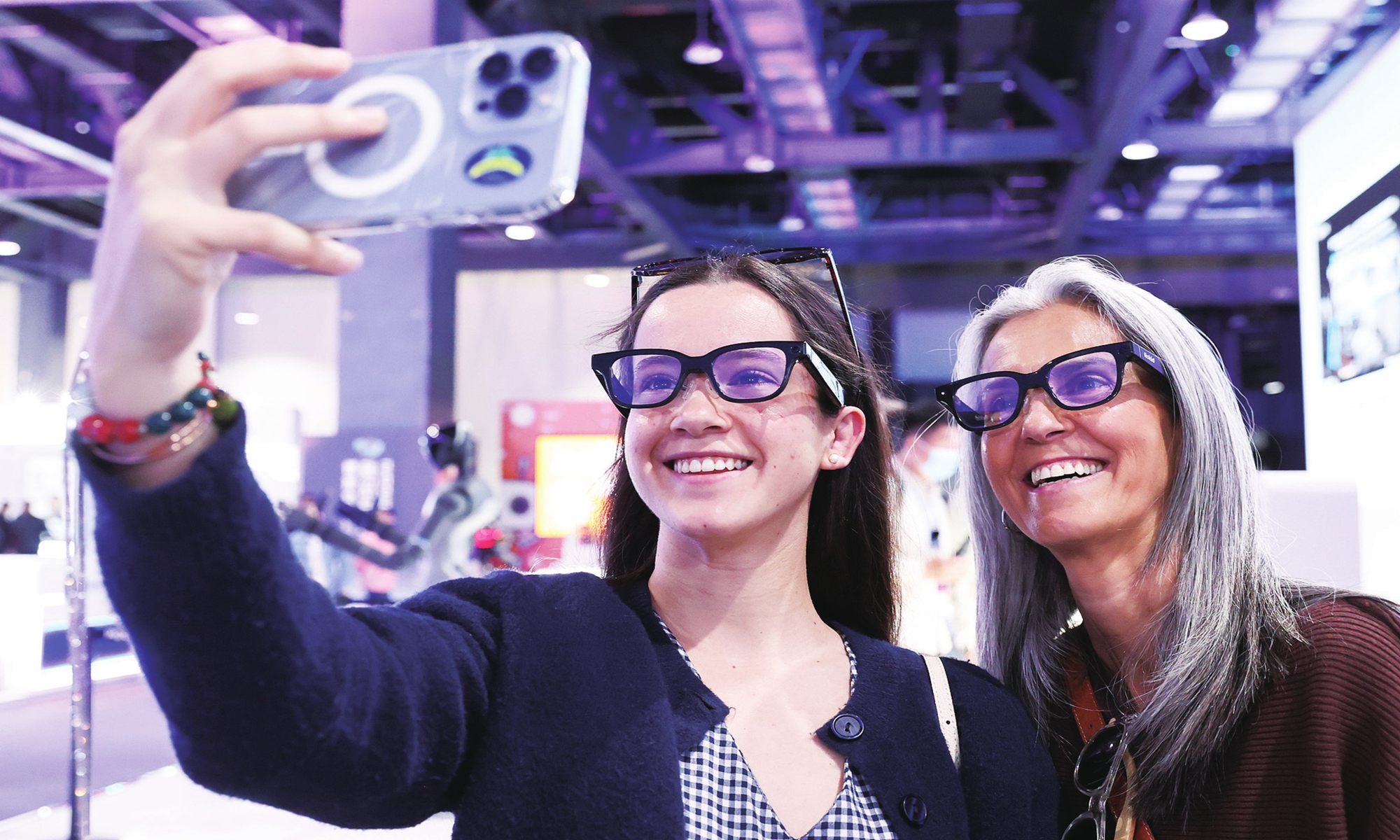
Two foreign visitors take a selfie while wearing AI-powered AR smart glasses at the 2026 China Science Fiction Convention in Beijing on March 27, 2026. Photo: VCG
When British content creator Simon Phillips first arrived in China in 1998, the country, as he remembers it, was still widely seen overseas as a manufacturing hub for global brands. Nearly three decades on, after years of shuttling between China and the UK, he has witnessed its transformation into a leading force in frontier technology and innovation — and a growing destination for foreign visitors eager to experience the future firsthand.Chinese technology now permeates Phillips' work and daily life, from smartphones, drones and electric vehicles to artificial intelligence (AI)-powered healthcare, wearables and smart home devices. He told the Global Times that Chinese products now account for more than 90 percent of the technology products he uses, up from virtually none when he first arrived.
"One of the great advantages of living in China is that you often get to experience tomorrow's innovations before the rest of the world," Phillips said. That experience has inspired him to share China's technological advances through videos, attracting more than 750,000 followers in China and overseas.
Guidelines issued by the State Council in April called for expanding and upgrading China's service sector and fostering more "China Services" brands. The rise of technology tourism reflects this shift, turning manufacturing strengths into immersive experiences that allow foreign visitors to see Chinese innovation firsthand and rethink "Made in China," experts said.
From tourist to future explorer
Ram Niranjan Sharma, an Indian business consultant, has also noticed the shift. "In the past, people mainly travelled to China for its culture and history. Today, many foreign visitors come specifically to see what the 'world of the future' looks like," Sharma told the Global Times, predicting that technology tourism in China could become a new travel trend.
Phillips calls the technology itinerary he has explored and now recommends to other overseas visitors his "Future Technology Tour," with Shenzhen in South China's Guangdong Province usually the first stop. There, visitors can get a close look at drones, robotics, AI, electric vehicles, consumer electronics and advanced manufacturing.
"If Silicon Valley became famous for software innovation, Shenzhen demonstrates what happens when innovation, engineering and manufacturing come together within one extraordinary ecosystem," Phillips said. What sets the city apart, he noted, is not only its concentration of emerging technologies, but also its ability to rapidly turn ideas into mass-produced products.
He also recommends Guangzhou, the capital of Guangdong as a place to explore product development and manufacturing, and Yiwu in Zhejiang Province to experience the scale and efficiency of China's commercial supply chains. The city of Hangzhou, with its strengths in digital technology, AI, e-commerce and robotics, is another popular destination.
He often tells friends to "bring an empty suitcase" to China, where products ranging from smartphones and drones to AI translators, health wearables, robot vacuums and smart home devices are popular buys.
Russian tourist Sergei told the Global Times that he was impressed by smart mobility devices that assist with walking and climbing, as well as China's service robots. His favorite is the hotel delivery robot. "They're cute," he said, noting that robotic mobility aids remain uncommon in Russia.
Technology tourism is not new, but in many countries it has largely remained limited to visiting technology parks and taking photos, Wang Peng, an associate research fellow at the Beijing Academy of Social Sciences, told the Global Times. In China, by contrast, visitors can see how robots, AI and smart devices are already being used in hotels, shopping malls, factories, transportation and homes.
These real-world applications are a key draw of China's technology tourism, allowing visitors to understand not only what the technologies are, but also how they are commercialized, mass-produced and supported by the country's complete industrial supply chains, Wang added.
"You can watch the spectacle on a screen, but to truly understand it, you have to see it offline," German video blogger Thomas Derksen told the Global Times. In recent years, he has visited numerous Chinese companies, livestreaming hubs and technology exhibitions. "The main reason I have kept exploring China's technology sector over the past two years is simple: speed," Derksen said. "A technology may still be at the research-paper stage elsewhere, but in China it can be running on a production line six months later. There is no better place to observe where the future of manufacturing is heading."
Smart services reshape inbound tourism
China's strengths in technology, advanced manufacturing, supply chains and large-scale applications are turning technology tourism from an online trend into a mature travel product. As foreign visitors seek more hands-on experiences, travel agencies and platforms are rolling out increasingly interactive tours.
Zheng Xueda, an inbound tourism director at Spring Tour, told the Global Times that overseas visitors are showing growing interest in China's frontier technologies and increasingly seeking immersive experiences of the country's innovations.
Responding to the trend, Spring Tour has launched a drone technology route in Shanghai this summer, where visitors can try flight simulators, drone battles and drone football, watch formation shows and operate professional-grade agricultural drones.
Zheng said business-focused technology tours combining company visits, industry exchanges and hands-on experiences have strong potential as China's economic and technological ties with other countries deepen. Two Brazilian travel agency managers have already visited Shanghai to inspect the route, he said.
This summer, online travel platform Fliggy also launched customized inbound technology study tours for overseas visitors. Platform data shared with the Global Times showed that families and students made up a large share of participants, with foreign visitors particularly interested in large language models, AI hardware and humanoid robots.
Technology tourism generates spending far beyond the visits themselves. As foreign tourists enter factories, companies and technology venues, they also drive demand for accommodation, transport, dining, interpretation, exhibitions, business reception and customized tours, extending technology experiences into a broader service-consumption chain, Wang said.
More technology companies are turning their production lines, showrooms and experience centers into tourism products to showcase their brands, reach overseas clients and strengthen their global visibility.
Policy support is also deepening the integration of industry and tourism. A recently issued national tourism plan for the 15th Five-Year Plan (2026-30)period encourages eligible industrial companies to develop visitor experiences showcasing achievements in sectors such as aerospace, shipbuilding and automobile manufacturing, and to launch distinctive industrial tourism products and routes.
Wang said that although slots for visits to some popular companies are often snapped up as soon as they become available, technology tourism remains a fast-growing niche. There is still considerable room to improve product offerings, service standards, professional tour guides and services for international visitors.
By shifting from product displays to hands-on experiences, and from industrial manufacturing to tourism services, technology tourism is turning China's industrial strengths into new service-consumption scenarios. For many foreign visitors, it offers a new window into modern China; for the country's service sector, it opens a new avenue connecting tourism, education, business and technological exchange.
As Phillips put it: "Welcome to China. Welcome to the Future."
RELATED ARTICLES