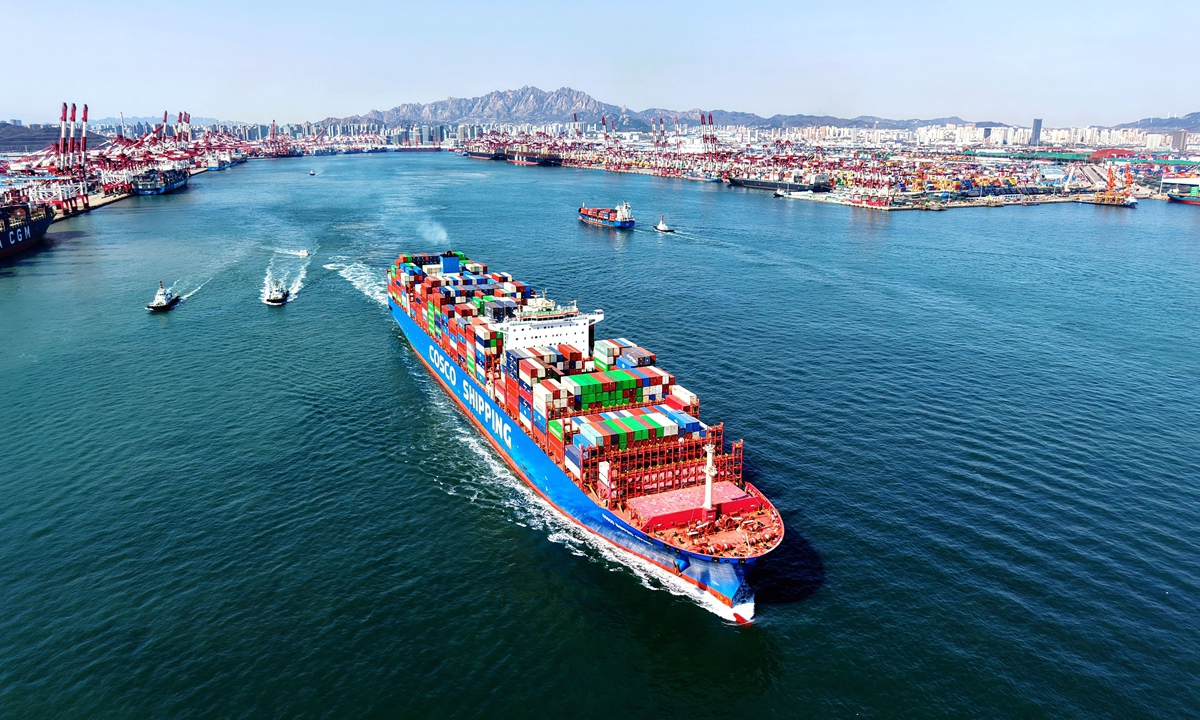
View of a container vessel near Qingdao port in East China's Shandong Province on April 7, 2026 Photo: VCG
The Federation of German Industries (BDI) reportedly warned that the growing problems with China are hitting the industry hard and across the board, claiming that it is "experiencing a China Shock 2.0." A Chinese expert said that Germany should face up to its own problems and enhance its competitiveness, noting that externalizing internal structural issues does not help truly solve the problems, nor will it promote win-win cooperation between China and Germany.German media outlet Frankfurter Allgemeine Zeitung (FAZ) reported on Monday that Tanja Gönner, chief executive of the BDI, told the German Press Agency that the BDI sees growing problems with China as a competitor.
Gönner claimed that China has a massive impact on industry including "dependencies on critical raw material, a significantly undervalued currency, and state-induced overcapacity." Added to this is China's ambition to become the global market leader in key technologies, Gönner claimed.
"Over the past two decades, Germany and other European companies in fields like the automotive and machinery have reaped profits by leveraging China's open market, complete supply chains and relatively low costs," Jian Junbo, director of the Center for China-Europe Relations at Fudan University's Institute of International Studies, told the Global Times on Monday.
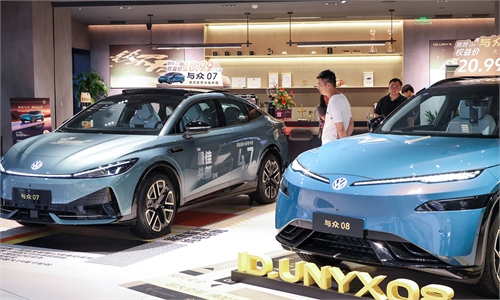
Now that China has upgraded its industries and built competitiveness in areas such as electric vehicles and photovoltaics, European countries including Germany turned to describe normal market competition as a "shock" and a "threat," Jian noted.
"China has maintained continuous investment as well as research and development in the field of critical raw materials. Its technological advantages and compliant export controls do not constitute barriers; hyping this issue and using it to pressure China into abandoning its own management systems is unreasonable," Zhou Mi, a researcher at the Chinese Academy of International Trade and Economic Cooperation, told the Global Times on Monday.
Zhou noted that the claim of "currency undervaluation" is even less tenable, as exchange rates are primarily determined by the market and economic fundamentals.
Regarding the issue of "overcapacity," China has responded on multiple occasions and issued a relevant white paper to provide a systematic explanation.
In specific periods and under particular market conditions, a certain degree of temporary imbalance between supply and demand may indeed arise. However, such imbalances should be jointly addressed by strengthening information sharing and enhancing transparency, rather than by erecting trade barriers or resorting to threats, Zhou said.
In early 2019, the BDI had called for a reorientation of German policy toward China in a policy paper. The market economy must be made "more resilient," it stated. China was described as a partner, but also increasingly as a systemic competitor. In the German government's 2023 China Strategy, China was designated as a partner, competitor, and systemic rival, the FAZ reported.
Jian said that Germany is experiencing growing pressure in its leading sectors. However, the primary root cause of the relative decline in German industrial competitiveness lies in internal structural problems, including high energy costs, excessive regulation and low efficiency in converting innovation into practical results. "Externalizing these internal structural issues does not help truly solve the problems," the expert said.
In the FAZ report, Gönner said that Europe needs to be more assertive toward China, but not completely isolate itself, adding that "We should try to uphold the rules-based order in many areas while at the same time considering how we can defend ourselves."
Last week, Bloomberg reported that Germany is mapping out vulnerabilities in China's supply chain in order to use this information as leverage against a possible trade war between Germany and China.
Jian said while Germany claims to uphold multilateralism and WTO rules, it is trying to resort to unilateral trade tools. In the long run, this will only accelerate the hollowing out of its industries - because truly competitive companies will continue to seek the optimal global allocation of resources.
According to an innovation report by the German Chamber of Commerce in China, 81 percent of companies from the automotive industry say that localizing their R&D in China has accelerated their development speed over the past two years, 79 percent of companies said localized R&D in China has reduced their R&D costs compared with Germany, while 70 percent credited innovation partnerships in China for further cost savings.
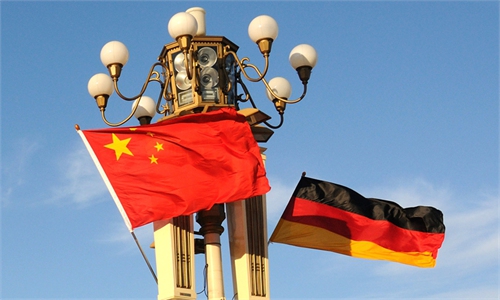
Jian noted that China-Germany relations have long been based on mutual benefit and win-win cooperation under the comprehensive strategic partnership, and competition between the two countries is a normal phenomenon in a market economy. The key lies in viewing bilateral competition with a rational and objective attitude, rather than treating it as a threat and resorting to unilateral, targeted measures that only further complicate the issues.
RELATED ARTICLES