IN-DEPTH / IN-DEPTH
Fijian student in China hopes to bring smart, green agriculture to Pacific islands amid mounting climate pressures
Farming future
By Published: Aug 03, 2026 09:30 PM

Editor's Note:
The youth are the vanguards of our time, showcasing boundless energy and vibrant personalities. Gen-Zers not only represent the makers of the future but also serve as agents of change in the present. With an open mindset and an international outlook, they actively integrate into the currents of globalization, engaging in deep exchanges, and collaborating with youth from around the world to explore pathways and strategies to address global challenges.
The Global Times launched the "Voice from Gen Z" series, which focuses on the proactive actions and innovative achievements of young people around the world in areas such as global governance, cultural exchange, environmental protection, and technological innovation. Through this column, we aim to showcase the unique charm and future leadership of global Gen-Zers.

"For example, in Fiji we have a lot of coconuts and the coconut husk is often treated as waste or something that we do not pay much attention to," she said. "But here in China, I learned that coconut coir can be a valuable agricultural resource and can be used in different ways including as a growing medium."
Her friends call her "Yezi," meaning "leaf" in Chinese. The 24-year-old Fijian student majors in smart agriculture at Liaocheng University in East China's Shandong Province.
From July 20 to 29, she joined 29 other young people from 10 Pacific island countries (PICs) studying at 13 Chinese universities at a training camp for youth from PICs in Shandong.
During the 10-day program, the trainees attended classes and visited farms and enterprises, learning about integrated water and fertilizer management, coconut coir recycling, smart plant factories, greenhouse cultivation and off-grid photovoltaic systems. They also discussed how these technologies could be adapted to the land, climate and production conditions of their home countries.
The closing ceremony was held at Liaocheng University on July 29. Bai Chenglin, Party secretary of Liaocheng University, one of the organizers, encouraged the trainees to take the practical technologies they had learned back to their home countries and use them to support local industries.
For Marama, this is not a distant prospect. Her interest in agriculture began not in a university laboratory, but on the land farmed by her father and grandfather.
An unexpected rainfall
In Marama's hometown, many families have plots where they grow their own crops. Root crops such as cassava and taro are common and provide an important source of food.
As a child, Marama enjoyed going to the farm with her father and grandfather and watching them grow crops. Her father carried much of the responsibility for planting, and she sometimes went to help him.
On one occasion, they were planting taro on a relatively large scale when the weather suddenly changed.
"In Fiji, we generally experience a rainy season and a hotter season, and around June or July, we would normally expect warmer weather," Marama recalled. "However, instead of having the expected dry and hot conditions, it suddenly started raining."
The unexpected rainfall disrupted the planting and affected her father's crops. Marama recalled the experience when discussing the effects of climate change on agriculture.
Marama's interest in agriculture gradually developed. "I became interested in understanding how the soil works, how crops grow and how we are able to harvest food from the land," she told the Global Times.
When she had an opportunity to study in China, she chose Liaocheng University. "When I had the opportunity to study in China, I chose Liaocheng University because it is located in Shandong, which is well known for its strong agricultural industry and is one of China's major agricultural regions," she explained.
Before beginning her bachelor's degree, she spent her first year in China studying Chinese. Learning the language helped her communicate with teachers and classmates and gradually feel more comfortable living in the country.
Yet her desire to learn modern agricultural technologies does not mean abandoning Fiji's existing farming practices. "These traditional methods have supported Fijian families for generations and are an important part of our identity and culture," Marama said. "With the increasing effects of climate change, we need to explore more efficient and resilient ways of producing food."
She said technologies such as greenhouse farming and other modern production methods could help Fijian farmers improve crop production and adapt to changing weather conditions.
Taking solutions home
During three days in Shandong's Weifang, Marama and the other trainees visited the headquarters of the Weifang National Agricultural Comprehensive Pilot Zone, a digital smart plant factory and a greenhouse project.
At the Leafman Digital Intelligent Plant Factory, the trainees saw a model for growing vegetables without soil or natural light. Earlier sessions had also introduced integrated water and fertilizer management and coconut coir recycling. These subjects were directly connected to Marama's concern: how modern technology could reduce the impact of changing weather on agricultural production while preserving Fiji's traditional farming practices.
The same concern was shared by students from other island countries.
"Our islands suffer severe weather disasters - typhoons often destroy all crops," Elena, a trainee from Solomon Islands, said in her closing remarks. She said the soilless farming model seen in Weifang, if adapted to island conditions, could help farmers cope with floods and droughts.
"Climate change is a grave challenge facing all humanity, and addressing it requires solidarity and cooperation among countries worldwide. I hope that when you return home, you will turn what you have learned from this training program into concrete action to advance green development in your own countries," Fang Zengfu, deputy Party secretary of Liaocheng University and director of the China-Pacific Island Countries Climate Action Cooperation Center, said during the event.
At a roundtable discussion during the training, the trainees further specified the needs of their respective countries. Samoan participants called for pilot cyclone-resistant greenhouse projects, training for local technicians and coconut shell-processing equipment. Tongan participants expressed interest in off-grid photovoltaic systems and smart agricultural technologies to address the threat of rising sea levels.
They also suggested adding more hands-on sessions to future training programs, including assembling drip irrigation systems, calibrating sensors and designing greenhouse plans tailored to the conditions of individual countries.
Marama expects to complete her bachelor's degree in 2028. If given the opportunity, she would consider remaining in China to pursue a master's degree and continue studying science, technology and agriculture.
"I would like to use the knowledge I have gained in China to develop agricultural businesses or projects in Fiji, and create opportunities for our farmers and communities," she said.
The youth are the vanguards of our time, showcasing boundless energy and vibrant personalities. Gen-Zers not only represent the makers of the future but also serve as agents of change in the present. With an open mindset and an international outlook, they actively integrate into the currents of globalization, engaging in deep exchanges, and collaborating with youth from around the world to explore pathways and strategies to address global challenges.
The Global Times launched the "Voice from Gen Z" series, which focuses on the proactive actions and innovative achievements of young people around the world in areas such as global governance, cultural exchange, environmental protection, and technological innovation. Through this column, we aim to showcase the unique charm and future leadership of global Gen-Zers.
Koroi Dionisia Puleiwai Lewanavanua Marama Photo: Courtesy of Marama
In Fiji, coconut husks are often treated as waste. After coming to China, Koroi Dionisia Puleiwai Lewanavanua Marama discovered another possibility for them."For example, in Fiji we have a lot of coconuts and the coconut husk is often treated as waste or something that we do not pay much attention to," she said. "But here in China, I learned that coconut coir can be a valuable agricultural resource and can be used in different ways including as a growing medium."
Her friends call her "Yezi," meaning "leaf" in Chinese. The 24-year-old Fijian student majors in smart agriculture at Liaocheng University in East China's Shandong Province.
From July 20 to 29, she joined 29 other young people from 10 Pacific island countries (PICs) studying at 13 Chinese universities at a training camp for youth from PICs in Shandong.
During the 10-day program, the trainees attended classes and visited farms and enterprises, learning about integrated water and fertilizer management, coconut coir recycling, smart plant factories, greenhouse cultivation and off-grid photovoltaic systems. They also discussed how these technologies could be adapted to the land, climate and production conditions of their home countries.
The closing ceremony was held at Liaocheng University on July 29. Bai Chenglin, Party secretary of Liaocheng University, one of the organizers, encouraged the trainees to take the practical technologies they had learned back to their home countries and use them to support local industries.
For Marama, this is not a distant prospect. Her interest in agriculture began not in a university laboratory, but on the land farmed by her father and grandfather.
An unexpected rainfall
In Marama's hometown, many families have plots where they grow their own crops. Root crops such as cassava and taro are common and provide an important source of food.
As a child, Marama enjoyed going to the farm with her father and grandfather and watching them grow crops. Her father carried much of the responsibility for planting, and she sometimes went to help him.
On one occasion, they were planting taro on a relatively large scale when the weather suddenly changed.
"In Fiji, we generally experience a rainy season and a hotter season, and around June or July, we would normally expect warmer weather," Marama recalled. "However, instead of having the expected dry and hot conditions, it suddenly started raining."
The unexpected rainfall disrupted the planting and affected her father's crops. Marama recalled the experience when discussing the effects of climate change on agriculture.
Marama's interest in agriculture gradually developed. "I became interested in understanding how the soil works, how crops grow and how we are able to harvest food from the land," she told the Global Times.
When she had an opportunity to study in China, she chose Liaocheng University. "When I had the opportunity to study in China, I chose Liaocheng University because it is located in Shandong, which is well known for its strong agricultural industry and is one of China's major agricultural regions," she explained.
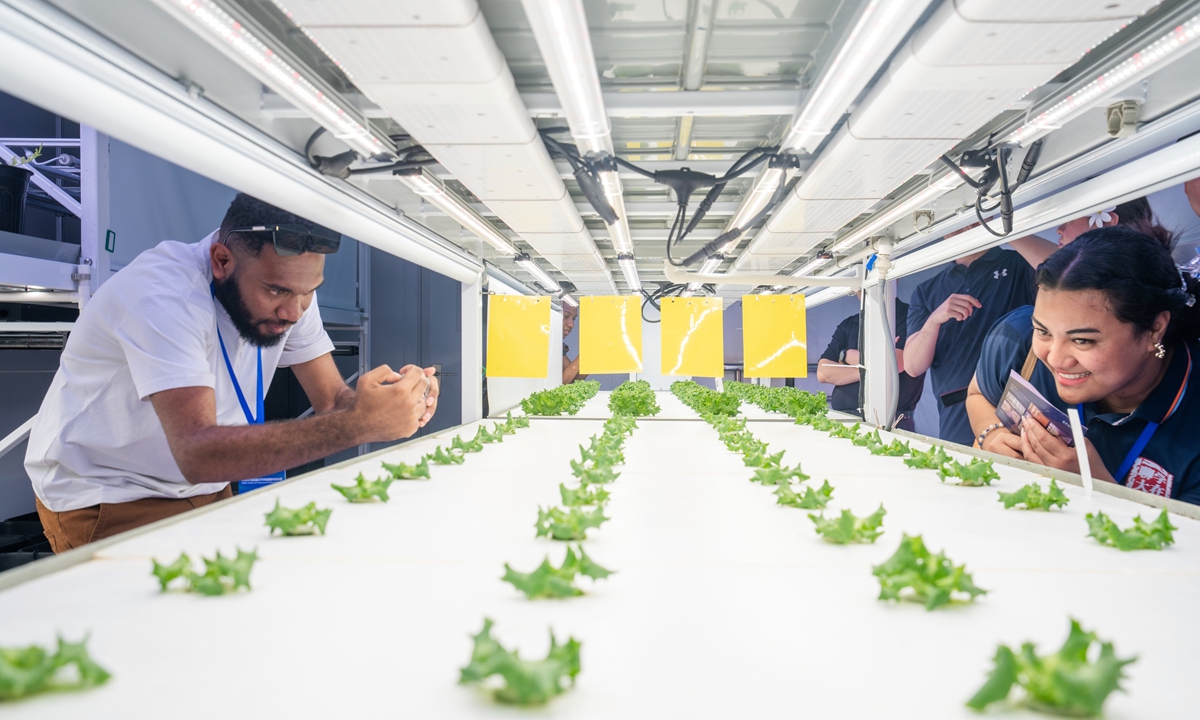
Students from Pacific island countries tour a modern farm in Liaocheng, East China's Shandong Province, in July 2026 Photo: Courtesy of Liaocheng University
Language was the first challenge. Before arriving in China, she could only say "ni hao" and a few other words. She also had to prepare herself mentally to adapt to life in a large and unfamiliar country.Before beginning her bachelor's degree, she spent her first year in China studying Chinese. Learning the language helped her communicate with teachers and classmates and gradually feel more comfortable living in the country.
Yet her desire to learn modern agricultural technologies does not mean abandoning Fiji's existing farming practices. "These traditional methods have supported Fijian families for generations and are an important part of our identity and culture," Marama said. "With the increasing effects of climate change, we need to explore more efficient and resilient ways of producing food."
She said technologies such as greenhouse farming and other modern production methods could help Fijian farmers improve crop production and adapt to changing weather conditions.
Taking solutions home
During three days in Shandong's Weifang, Marama and the other trainees visited the headquarters of the Weifang National Agricultural Comprehensive Pilot Zone, a digital smart plant factory and a greenhouse project.
At the Leafman Digital Intelligent Plant Factory, the trainees saw a model for growing vegetables without soil or natural light. Earlier sessions had also introduced integrated water and fertilizer management and coconut coir recycling. These subjects were directly connected to Marama's concern: how modern technology could reduce the impact of changing weather on agricultural production while preserving Fiji's traditional farming practices.
The same concern was shared by students from other island countries.
"Our islands suffer severe weather disasters - typhoons often destroy all crops," Elena, a trainee from Solomon Islands, said in her closing remarks. She said the soilless farming model seen in Weifang, if adapted to island conditions, could help farmers cope with floods and droughts.
"Climate change is a grave challenge facing all humanity, and addressing it requires solidarity and cooperation among countries worldwide. I hope that when you return home, you will turn what you have learned from this training program into concrete action to advance green development in your own countries," Fang Zengfu, deputy Party secretary of Liaocheng University and director of the China-Pacific Island Countries Climate Action Cooperation Center, said during the event.
At a roundtable discussion during the training, the trainees further specified the needs of their respective countries. Samoan participants called for pilot cyclone-resistant greenhouse projects, training for local technicians and coconut shell-processing equipment. Tongan participants expressed interest in off-grid photovoltaic systems and smart agricultural technologies to address the threat of rising sea levels.
They also suggested adding more hands-on sessions to future training programs, including assembling drip irrigation systems, calibrating sensors and designing greenhouse plans tailored to the conditions of individual countries.
Marama expects to complete her bachelor's degree in 2028. If given the opportunity, she would consider remaining in China to pursue a master's degree and continue studying science, technology and agriculture.
"I would like to use the knowledge I have gained in China to develop agricultural businesses or projects in Fiji, and create opportunities for our farmers and communities," she said.
RELATED ARTICLES