Illustration: Liu Rui/GT
There is an old Chinese saying: "he who has a mind to frame others can easily trump up some charges." Today, even Chinese sunflower seeds have fallen victim of US charges.
The products from China's snack-food producer Chacha Food, meant for ordinary consumers' tables, have been placed alongside politically loaded labels such as "national security" and "forced labor" in the official US documents. This bizarre juxtaposition once again exposes the absurd logic behind Washington's sanctions regime.
The US Department of Homeland Security (DHS) recently added 43 Chinese companies to the so-called "Uygur Forced Labor Prevention Act (UFLPA) Entity List." Following this expansion, the number of entities listed has risen to 187, marking the single-largest increase since the list was established.
A glimpse of the absurdity comes from a closer look at the list: Some Chinese consumer brands in the food and apparel sectors - including Chacha Food, Zhengzhou Synear Food and Septwolves - have also been placed on the list.
"Washington's inclusion of Chinese food and clothing companies on its sanctions list reflects the widening scope of its efforts to contain China," Xin Qiang, deputy director of the Center for American Studies at Fudan University, told the Global Times. "Such measures, driven not by facts but by speculation and political bias, are increasingly turning normal trade into a target of politicization," Xin added.
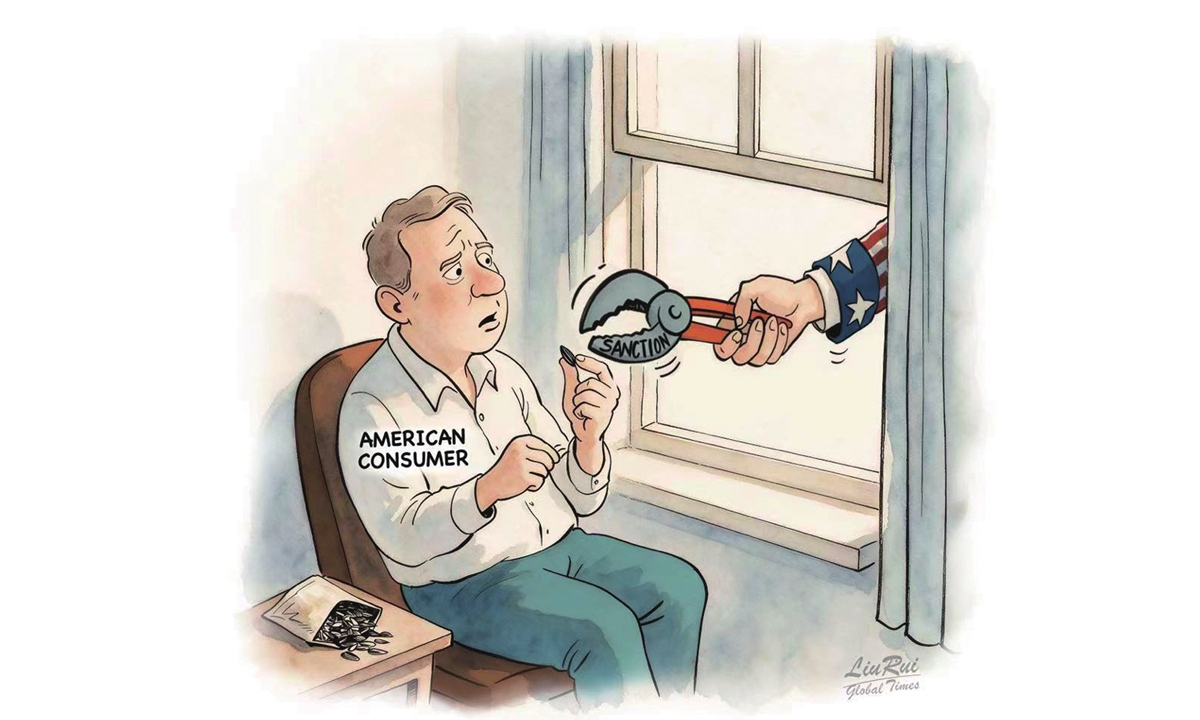
From garlic and tomatoes to sunflower seeds, the US sanctions have expanded from "choking the neck" in the tech sector to "choking the mouth" of ordinary consumers.
Let's examine Washington's playbook.
The US claims that the supply chains of the listed Chinese companies may involve sourcing materials from Northwest China's Xinjiang Uygur Autonomous Region with the unsubstantiated allegations of "forced labor," making such products problematic. The pattern is clear: Washington first fabricates a false presumption and places a "forced labor" label on Xinjiang, then expands the scope of restrictions through vague terms, forcing Chinese companies to prove their innocence.
Such an approach violates the basic legal principles of burden of proof and the presumption of innocence. Instead, it has become a practice of "proving your innocence or facing detention and blacklisting." This is nothing more than a form of political coercion and harassment targeting businesses around the world.
From chips to sunflower seeds, US sanctions targets are becoming increasingly "small," while Washington's abuse of the concept of "national security" and its weaponization of sanctions continue to expand. When the sanctions hammer is brought down on a humble sunflower seed, it reveals not strength, but the growing desperation behind Washington's campaign of pressure against China.
"Washington's widening use of "forced labor" allegations reveals the expansion of US unilateralism and hegemonic practices, while also demonstrating that its previous attempts to contain China have failed to deliver the desired results, pushing it to search for ever-new tools of suppression," said Zhou Mi, a researcher at the Chinese Academy of International Trade and Economic Cooperation.
For years, Washington's escalating technology restrictions have failed to undermine the foundations of China's development. Instead, they have accelerated China's pursuit of technological self-reliance and strengthened industrial resilience. Having achieved limited results in high-tech containment, some US policymakers have turned to broader sanctions, attempting to discredit Chinese companies through smear campaigns and political labeling.
Yet such moves are a case of Washington "lifting a rock only to drop it on its own feet in the end." The reckless expansion of sanctions lists and the rising compliance costs imposed on global supply chains will not come without consequences. These measures will ultimately drive up import costs and leave American consumers and small and medium-sized businesses to bear the burden. The use of "presumption of guilt" and "long-arm jurisdiction" may create temporary disruptions, but over the long term, it will only erode confidence in US trade rules and push businesses around the world to seek more stable markets with less political interference.
Repeating a lie does not make it true. Genuine employment records maintained by Chinese companies, market-based supply chains, and the reality that millions of workers voluntarily seek employment opportunities and improve their livelihoods in Xinjiang region cannot be erased by a blacklist issued in Washington.
A fabricated list cannot halt normal trade, nor can it stop Chinese companies from expanding globally. The more Washington turns ordinary goods into political targets, the more it exposes the weakness of its own approach. China will not be deterred by unreasonable suppression.
RELATED ARTICLES