To frame standardized entry and exit administration as ‘isolation’? Pure nonsense: Global Times editorial
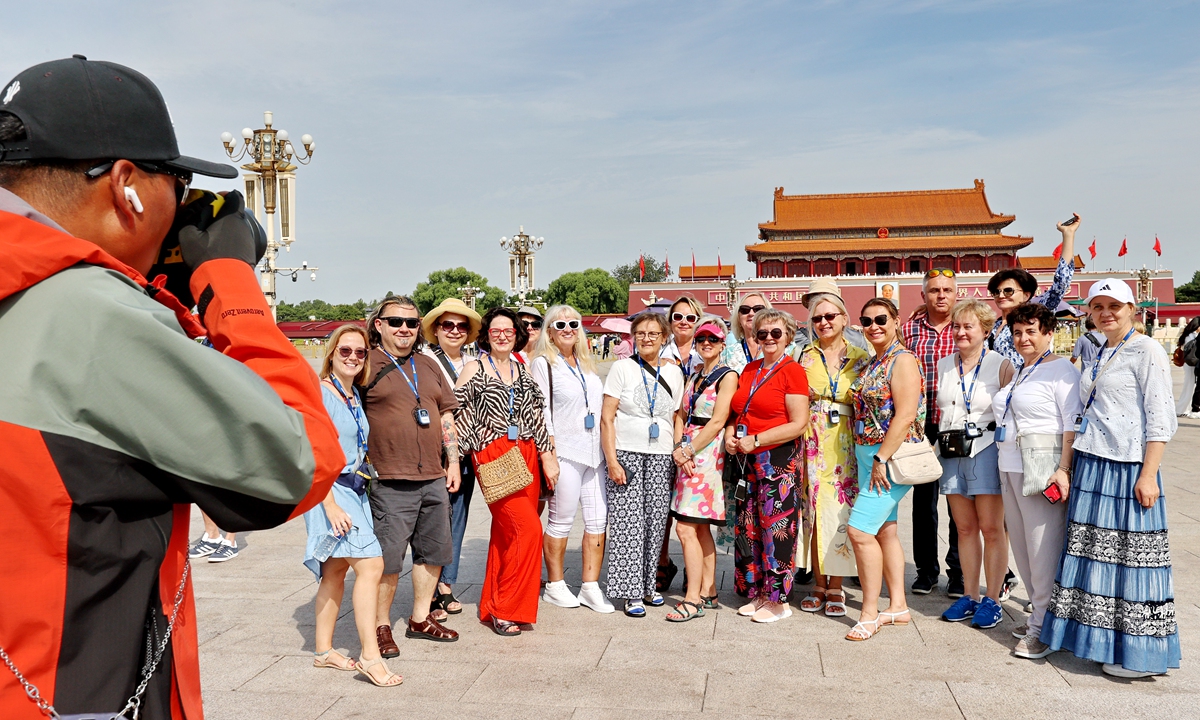
Foreign tourists visit Tiananmen Square in Beijing on September 26, 2025. Photo: VCG
In recent years, more and more global visitors have come to China and seen the country for themselves. Through firsthand experience, they saw a China that is starkly different from the image long distorted by some Western media. Such people-to-people exchanges grounded in firsthand experience have broken the narrative monopoly painstakingly built up by certain forces. As some Western media outlets continue to hype up a sense of "panic," one question deserves to be asked: who is really panicking, and what exactly are they afraid of?
The introduction of a management regulation that was originally "not particularly eye-catching" has unexpectedly drawn the attention of some Western media outlets in recent days. On July 31, the State Council, China's cabinet, released a decree issuing a regulation on exit and entry administration, refining and improving relevant rules in response to new challenges and issues emerging in exit and entry management in recent years.
Some Western media outlets have singled out phrases such as persuading people not to leave the country and restricting departure, claiming that China is tightening its exit and entry policies and causing "alarm," while hypocritically expressing concerns that China is moving toward "self-isolation."
China's previous legislation on exit and entry administration was introduced in 2012, 14 years ago. In 2013, the Exit and Entry Administration Law of the People's Republic of China officially came into effect. The number of exit-entry trips nationwide stood at 454 million that year. By 2025, the figure had risen to 697 million, and in the first half of 2026, it reached 369 million, continuing to operate at a high level. The pressure on China's ports, the demand for services, and the complexity of management are different from what they were in the past.
More importantly, the risks have also changed. In today's world, geopolitical conflicts are common, while issues such as transnational crime, telecom fraud and illegal immigration are becoming increasingly intertwined. Risks related to technological security and industrial security are also becoming more prominent. As the number of Chinese citizens traveling abroad and foreigners coming to China has both increased significantly, previous regulations have become no longer suitable, making it necessary to tailor the rules to the new circumstances. The release of the new regulation is a timely response to emerging challenges in exit and entry management amid China's continued pursuit of high-level opening-up. This is not only a common practice worldwide, but also an inherent requirement for advancing the modernization of China's system and capacity for governance.
Every provision of the new regulation has a clear legal basis and a well-defined purpose. Strengthening early warnings and guidance regarding outbound security risks is intended to provide Chinese citizens with greater protection and fewer risks when traveling overseas. Improving restrictions on false documents, illegal entry and exit activities, and other violations is aimed at maintaining orderly movement across borders, ensuring smooth passage for law-abiding individuals while making it difficult for violators to operate. Regulating the intermediary services market is designed to crack down on unscrupulous agencies, improve the industry environment, and effectively protect the legitimate rights and interests of people entering and leaving the country.
The essence of these measures is to build a stronger security network amid a complex and changing global environment, providing a more stable and predictable institutional framework for exchanges between Chinese and foreign nationals.
Some Western media outlets have focused in particular on provisions referring to conduct that endangers "national security" or "technological security," claiming they effectively "turn an individual's right into a privilege granted by the state." If they truly believe that, they should take a look at how the US handles similar issues.
In the US, provisions allowing passports to be revoked on the grounds of "endangering national security" leave authorities with broad discretionary powers in practice. In export control cases, travel restrictions are far from uncommon. Employees working in sensitive technology positions are often required to report international travel in advance, and their trips may be restricted if their employer or the government deems them inappropriate. Beyond national security, Americans can even have their passports revoked for owing more than $2,500 in child support. As for the management of foreign nationals, the US has rolled out biometric exit systems nationwide, while the Immigration and Nationality Act lists a wide range of grounds for denying entry. These measures have been in place for years, yet Western media rarely accuse the US of "closing itself off from the world."
The eagerness of certain Western media outlets to maliciously interpret regulation raises questions about their underlying motives. In recent years, more and more global visitors have come to China and seen the country for themselves. Through firsthand experience, they saw a China that is starkly different from the image long distorted by some Western media. Such people-to-people exchanges, grounded in seeing with one's own eyes, are steadily dismantling the false narratives that have underpinned the West's information campaign against China and eroding the narrative monopoly carefully cultivated by certain forces. They resent the growing vitality of exchanges between Chinese and foreign people and fear the wider dissemination of authentic stories about China. That is why they are so eager to stir up anxiety in the public discourse. As they continue to hype up a sense of "panic," one question deserves to be asked: who is really panicking, and what exactly are they afraid of?
China is committed to expanding high-standard opening-up, and its broader direction of facilitating cross-border travel has never wavered. Measures such as nationwide passport application services, routine processing of exit-entry documents outside one's place of household registration, the continued expansion of mutual visa exemptions, and faster digitalized customs clearance have all made travel more convenient for ordinary citizens, businesspeople, and international students. Would a country supposedly intent on "closing its doors" open itself to the world and warmly welcome visitors from every corner of the globe? Would a country supposedly trying to "keep foreigners out" inspire the trend of "traveling to China after work on Friday" among young people in neighboring countries? The answer is obvious.
Security is the foundation of openness, while openness is the ultimate purpose of security. The new regulations are not about putting the brakes on opening-up, but about fastening a seat belt for cross-border exchanges.
As the volume of travel grows and interactions become more frequent, it is crucial to make the rules clearer and risk prevention more precise, so that lawful cross-border movement can remain smoother and more sustainable. Improving governance through more scientific and standardized regulation is what will allow China's doors to open even wider.
RELATED ARTICLES