Report of China-made EVs capturing one-third of S. Korea’s H1 sales highlights competitive rise and win-win opportunities: expert
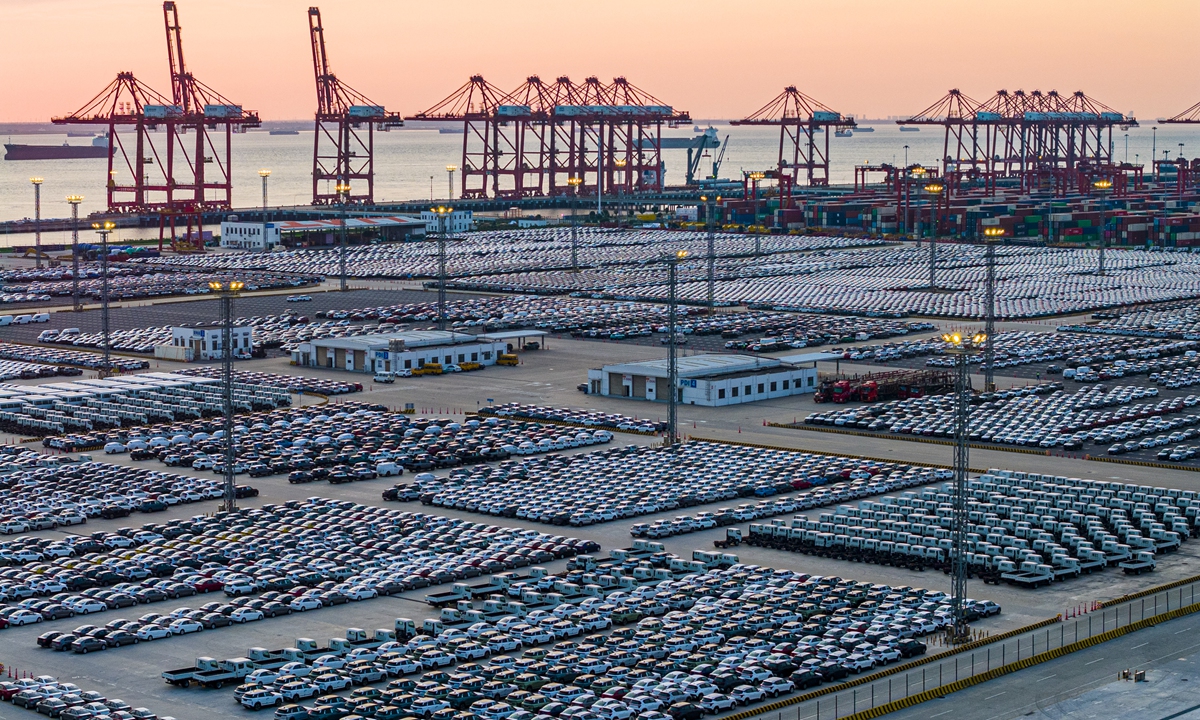
Domestically produced vehicles are ready for export overseas at the Taicang port zone of Suzhou Port, East China's Jiangsu Province on July 14, 2026. Photo: CNS Photo
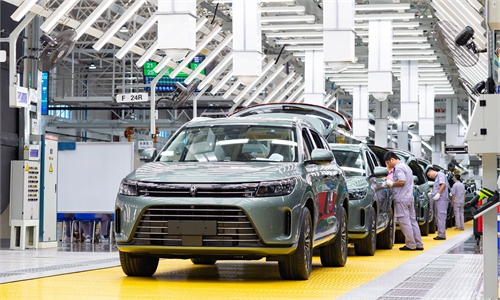
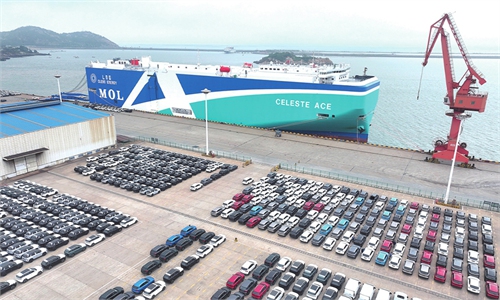
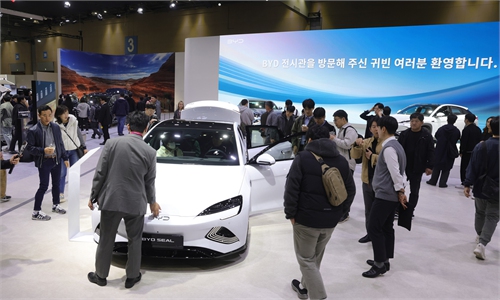
In the first half of this year, more than one-third of the electric vehicles (EVs) sold in South Korea were manufactured in China, Yonhap News Agency reported on Tuesday, citing a latest industrial report. A Chinese expert said that the result highlights Chinese EV's rising competitiveness in a demanding market, adding that the two neighboring countries can strengthen cooperation through combining their respective industrial strengths, which will turn competition into win-win outcomes.
According to data released by the Korea Automobile Manufacturers Association (KAMA) on Tuesday, a total of 69,513 China-made EVs were newly registered in South Korea from January to June this year, representing a year-on-year increase of 178.7 percent, with the share of overall new EV registrations rising from 26.8 percent in the same period to 35 percent, said the report.
The sharp growth in sales of China-made EVs is mainly attributed to higher import volumes of the Model Y and Model 3 produced at Tesla's Shanghai Gigafactory, combined with increased market efforts by brands such as BYD and Polestar, said the report.
"The industrial report showed that in the South Korean market, which has high tech requirements and relatively rational consumers, China-made EVs have shifted from being a marginal option to becoming an important component," Cui Dongshu, secretary-general of the China Passenger Car Association, told the Global Times on Tuesday.
As South Korea's transition to electrification has been relatively slow, the recognition of China's advanced EVs in the local market has been further enhanced, thanks to China's advancement in electrification technology, as well as continuous improvements in manufacturing capabilities, Cui noted.
China-made vehicles have also significantly strengthened their position in South Korea's imported car market, said Yonhap. In the first half of the year, imports of China-made automobiles reached 79,444 units, up 127.8 percent year-on-year. Their market share by country of production reached 41.3 percent, overtaking Germany to claim the top spot for the first time, according to the report.
"Germany long dominated South Korea's imported car market with its premium brands such as Mercedes-Benz, BMW, and Audi. Chinese-made vehicles, led by EVs, have now overtaken them, which can be seen as a structural shift between the new forces of electrification and the old forces of traditional fuel vehicles," Cui said, noting that it also embodies the future direction of the industry's development.
According to Yonhap, Chinese-made vehicles overtook Japanese brands in South Korea's import market for the first time in April, driven largely by BYD, whose April registrations alone exceeded the combined sales of major Japanese brands such as Toyota, Lexus and Honda.
The expert said that the performance of Chinese EVs in the South Korean market is not surprising. "Features such as intelligent driving assistance, digital cockpits and battery technology have helped Chinese brands attract consumers seeking alternatives to traditional internal combustion vehicles," Cui noted.
KAMA said that the large-scale inflow of Chinese EVs into the South Korean market helps promote EV adoption and expands consumer choices, but it may also increase operating pressure on local automakers and intensify competition across the industrial supply chain.
Cui said that competition is inevitable and represents a normal market choice, and both sides can strengthen cooperation to achieve mutual benefit.
"South Korea holds advantages in semiconductors, high-end materials, and certain core components, while China leads in batteries, electric drive systems, vehicle integration, and large-scale production. South Korean automakers can leverage China's supply chain to reduce the cost of electric vehicles and enhance their global competitiveness," the expert noted.
A latest example is the signing of a $75 million investment agreement between South Korean automaker KG Mobility (KGM) and China's Chery Automobile Co, the Yonhap News Agency reported on Monday.
As part of the expanded partnership, the companies will broaden their cooperation on the SE10, KGM's upcoming midsize sport utility vehicle scheduled for launch in January. The Chinese automaker's global vehicle platforms and extensive supply chain are expected to support KGM's efforts to accelerate new model development and expand its overseas business, said the report.
RELATED ARTICLES