ARTS / CULTURE & LEISURE
5,800-year-old Chinese site yields 7 fire pits resembling the Big Dipper
Hongshan relics reveal ancient stargazing wisdom
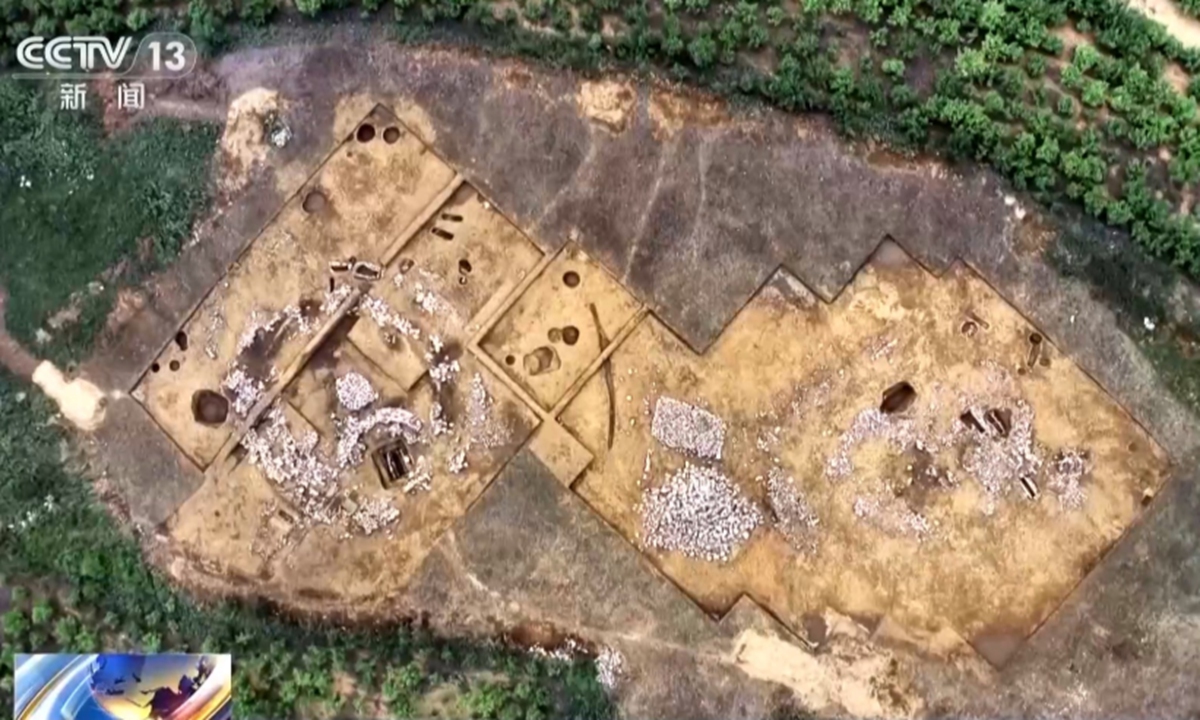
Photo: CCTV
Chinese archaeologists have discovered seven pits made of fired earth at the Niuheliang archaeological site in Northeast China's Liaoning Province, with their arrangement closely resembling the Big Dipper, providing new clues to the astronomical knowledge and social development of people living there 5,800 years ago years ago, state broadcaster CCTV reported on Tuesday.The discovery was made during the latest round of archaeological excavation and research at the Niuheliang site, located in the northwest of Chaoyang city, Liaoning Province. Archaeologists are focusing on the site's first area, where they have identified the remains of large architectural platforms and associated structures.
The Niuheliang site is a key site of the Neolithic Hongshan culture. Its discoveries have pushed back understanding of the origins of Chinese civilization and provided evidence that an early form of civilization had emerged there around 5,800 years ago.
The Hongshan culture is a significant prehistoric archaeological culture that dates back approximately 5,000 to 6,000 years.
The seven fire pits were discovered within the identified boundaries of a large platform known as Platform No.7. According to archaeologists, their arrangement closely resembles the seven stars of the Big Dipper.
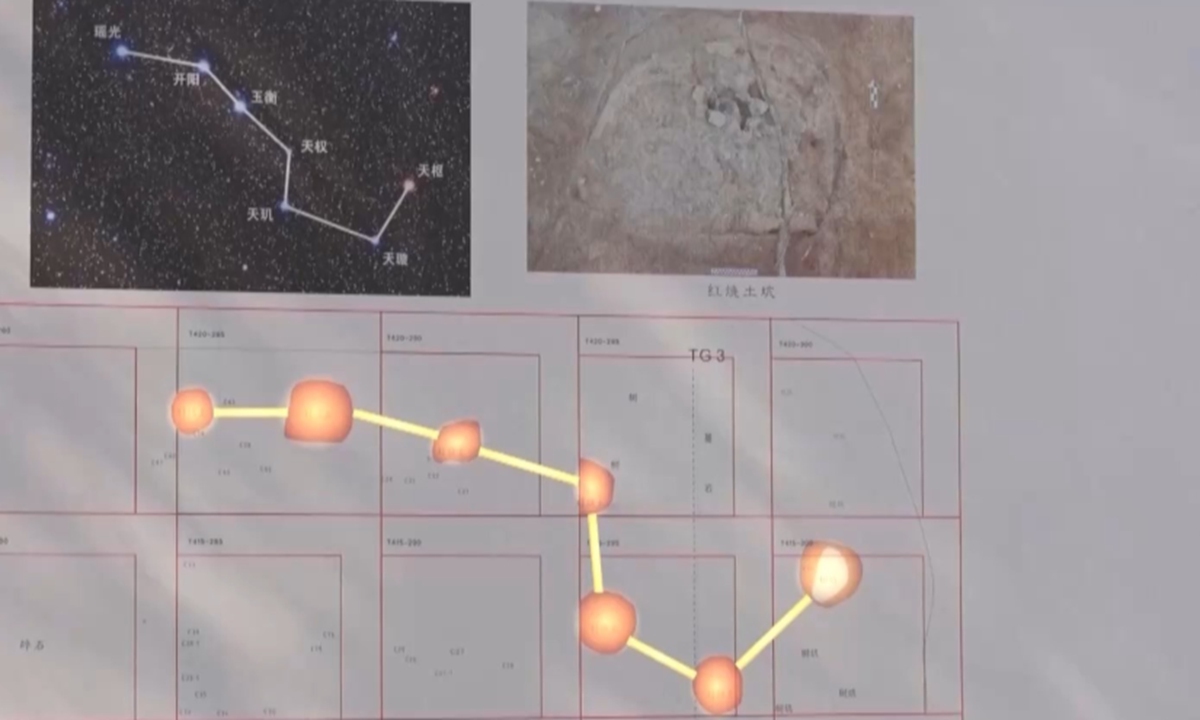
Photo: CCTV
"Within the identified area of Platform No.7, we found only seven fired-earth pits, so we suspect that the Hongshan people represented their understanding of the universe in the form of a model in the northern part of Platform No.7," Jia Xiaobing, a researcher at the Institute of Archaeology of the Chinese Academy of Social Sciences and the leader of the Niuheliang field archaeology project, told the Global Times.According to Jia, the direction indicated by the Big Dipper's handle changes with the seasons. As such, the fired-pit model suggests that by the time Hongshan society had reached an early stage of civilization, its understanding of astronomy and ability to keep track of time had reached a relatively advanced level.
The Niuheliang site was first discovered in 1981. After more than four decades of archaeological excavation and research, more than 60 archaeological sites have been identified within the protected area and the surrounding region.
The first area of the Niuheliang site is considered its largest and one of its most important sections. Archaeologists have identified nine large platforms and related facilities there, covering a total area of more than 100,000 square meters.
Archaeological research suggests that the large ceremonial architectural complex was constructed on a large scale within a relatively short period around 5,800 years ago. The complex, described by researchers as a large-scale construction project for its time, has provided important evidence for understanding the emergence of early forms of civilization in ancient China, CCTV News reported.
The site has also produced evidence of ritual practices and social hierarchy.
The Niuheliang "Goddess Temple," discovered at the site, is considered the earliest known holy temple in China and is best known for the discovery of a head sculpture believed to depict a Hongshan goddess. It is widely regarded by Chinese archaeologists as the earliest known remains associated with ancestor worship discovered in China.
Another important discovery was made in the site's second area, where archaeologists found three concentric circular platforms believed to have been used for rituals to worship heaven.
The largest of the circular platforms has a diameter of about 22 meters. Researchers have suggested that the three concentric circles respectively corresponded to the winter solstice, the spring and autumn equinoxes, and the summer solstice, reflecting the annual movement of the sun as observed from Earth.
Jia said the origins of these core concepts - "reverence for heaven, respect for the earth and honoring one's ancestors" - can all be found at Niuheliang.
He described the site as an important early example of the origins of Chinese civilization and said its discoveries provide evidence for the continuity of ritual traditions over more than 5,000 years.
The Niuheliang site has also yielded a large number of pottery and jade artifacts. Experts say jade objects, including jade dragons, jade phoenixes, cloud-shaped jade pendants and jade figures, are notable for their variety and sophisticated craftsmanship. Their different combinations in tombs of varying status provide evidence of the early development of a jade-based ritual system in ancient China.
As archaeological excavation and research at Niuheliang continue, further discoveries are expected to provide additional evidence for understanding the origins and development of Chinese civilization, according to CCTV News.
RELATED ARTICLES