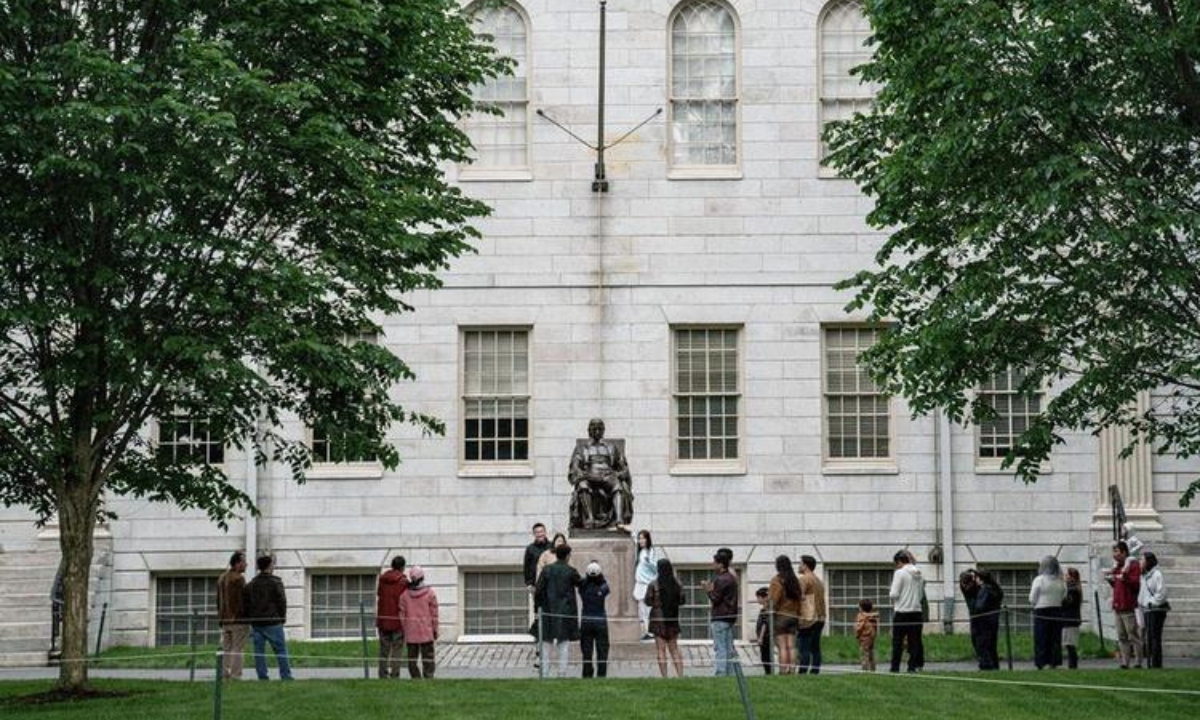
This photo taken on May 24, 2025 shows a view of the Harvard University campus in Cambridge, Massachusetts, the United States. (Photo by Ziyu Julian Zhu/Xinhua)
A US think tank's report claims that restricting visas for Chinese students will "greatly benefit American students and national security." In essence, normal educational exchanges are being politicized and weaponized, with "national security" used as a pretext for discriminatory restrictions. When a report frames the decline in the number of international students as a "victory," what it truly reveals is not a "threat" from others, but its own anxiety.A report released on August 3 by the US‑based Center for Immigration Studies shows that the US Department of State issued far fewer F‑1 student visas to Indian and Chinese nationals between May and August 2025 compared to previous years. The May‑August window is chosen precisely because the bulk of each year's F‑1 visas are issued during this period. Astonishingly, the report argues that if this downward trend continues, it will "greatly benefit American students and our national security," while recycling the tired old trope that Chinese students are linked to "espionage."
How exactly do international students "threaten US national security"? The report offers zero evidence. Student‑visa policy has become deeply divisive and highly politicized in the US. Since last year, US Immigration and Customs Enforcement (ICE) agents have arrested foreign students, triggering widespread panic across the US international‑student community. Some Americans advocate for openness to sustain academic competitiveness; others fear international students crowd out job opportunities. Some view international students as drivers of innovation, while others paint them as security threats. This is a reflection of the growing populist and polarized nature of US society.
It is true that visa approvals for Chinese students have dropped sharply. This is not because "espionage" has emerged among Chinese students; it is the direct outcome of a series of US political moves: suspended visa interviews, sweeping social‑media vetting, multilayered intensified background checks, plus public announcements of "enhanced scrutiny" targeting students from specific countries. Put plainly, normal educational exchanges are being politicized and weaponized, with discriminatory restrictions imposed on students of particular nationalities in the name of "national security." Repeatedly hyping up the so-called "threat" is nothing more than a tactic by some Americans to manufacture an imaginary enemy for domestic political purposes, forcing innocent international students to pay the price for US own partisan battles.
Fewer international students will not automatically expand educational access for American students. International students are heavily concentrated in graduate programs and STEM majors. A significant number work as research assistants and teaching assistants, helping to keep laboratories running on a day‑to‑day basis. Many international students pay full tuition fees, and the revenue generated from their tuition helps universities maintain courses, laboratories, scholarships, and faculty positions.
According to data from the US Department of Commerce, international students contribute about $55 billion to the US economy every year through tuition payments and living expenses, supporting more than 400,000 jobs. A report by the Association of International Educators found that the decline in new international student enrollment in the fall of 2025 alone resulted in nearly $1.1 billion in economic losses for the US and the loss of about 23,000 related jobs.
US President Donald Trump has also repeatedly said publicly that he welcomes Chinese students, and has warned that "US colleges would struggle without Chinese students." The real factors affecting employment opportunities for young Americans are deeper structural issues, including industrial structure, education-to-workforce alignment, and labor costs - not international students who study and work legally in accordance with US regulations.
Educational exchange is a two-way street. Chinese students studying in the US have not only gained advanced knowledge but also brought Chinese perspectives and creativity to American campuses. Likewise, American scholars who come to China have benefited greatly from these exchanges. To portray such mutually beneficial interactions as a "threat" posed by one side to the other is simply a resurgence of Cold War thinking. The US became a global center of technological innovation over the past several decades in large part because it attracted talent from around the world. If political confrontation and fear lead the US to cut off the flow of talent, it will undermine its own capacity for innovation - a point that many clear-headed voices within the country have repeatedly emphasized.
Some in the US are quick to invoke "national security," as though keeping Chinese students out would somehow make the country safer. That logic does not withstand scrutiny. Security has never been achieved through isolation or self-imposed closure. We firmly oppose any stigmatization or discriminatory treatment of Chinese students studying abroad.
For nearly five decades since the establishment of China-US diplomatic relations, educational exchange has remained one of the areas of bilateral ties with the broadest public support. China has consistently supported normal international educational cooperation, but it will not accept any Chinese citizen studying in the US being subjected to unfair treatment at any time or in any place. Whatever policy adjustments Washington chooses to make, it must not make Chinese students pay the price, smear them, or undermine the normal educational and cultural exchanges between the two countries.
Scientific and technological progress depends on international exchange and cooperation, while academic advancement thrives on the exchange and cross-fertilization of ideas. What truly makes a country strong has never been walls, but its ability to attract talent and foster innovation. When a report frames the decline in the number of international students as a "victory" and claims that it "benefits American students and national security," what it truly reveals is not a "threat" from others, but its own anxiety.
RELATED ARTICLES